
You’ve built a killer product. But your pitch deck is a mess. Be honest.
Most founders treat their deck as an afterthought. The result is a confusing story that loses investors in 30 seconds. This is why professional presentation design services are the secret weapon for founders who raise capital. They turn complex ideas into fundable stories.
Why your pitch deck is failing

Investors see hundreds of pitches a year. A messy deck is a red flag. It signals you aren’t prepared or can’t communicate clearly.
This isn’t about fancy animations. It’s about strategic communication. A great deck guides an investor through your vision with zero friction. It builds their confidence with every slide.
VCs spend an average of just 3 minutes and 44 seconds on a pitch deck. Your design must make every second count. When a deck is hard to follow, investors don’t try harder-they just move on.
The common founder mistakes
Founders fall into the same traps when building a deck. These mistakes create a wall between a great business and the capital it needs.
- Walls of text: Jamming slides with dense paragraphs forces investors to read instead of listen.
- No clear narrative: A deck is a story, not just a collection of facts. Without an arc, the pitch feels amateur.
- Confusing data: Raw spreadsheets or complex charts create confusion. Great design turns data into instant insight.
These are fixable problems. Stop thinking of your deck as a document. Start treating it like a product designed for one user: the investor. A proven startup pitch deck template can help you get the structure right from day one.
From confusing document to compelling story
This is where professional presentation design services make a difference. They don’t just make things pretty. They act as a strategic partner to sharpen your narrative.
You wouldn’t launch an app without a UX designer. A pitch deck is the user interface for your company’s value proposition. A professional ensures that interface is intuitive and effective.
Here’s a quick example of the difference:
| Attribute | DIY pitch deck | Professionally designed deck |
|---|---|---|
| First impression | Signals "amateur" or "not ready" | Signals "professional" and "serious" |
| Story clarity | Often confusing and text-heavy | Clear, logical narrative that flows |
| Data visualization | Messy charts that hide insights | Clean visuals that make data easy to grasp |
| Investor confidence | Raises doubts about execution | Builds trust and signals competence |
| Time to "get it" | Requires effort to understand | The value prop is understood instantly |
A DIY deck creates friction. A professional deck removes it. The goal is a deck that builds trust, projects professionalism, and makes it easy for an investor to say "yes."
What presentation design services actually do
Most founders think presentation design services just make slides look good. This is a huge misconception. The real work goes much deeper.
A true design partner blends storytelling, information architecture, and visual identity. This isn’t a last-minute polish. It’s a strategic partnership to shape your fundraising narrative.
Storytelling and narrative crafting
The best services dig into your story first. They work with you to distill your complex business into a sharp, compelling narrative for a VC audience.
They help you build a story with a hero (your customer), a villain (the problem), and a powerful resolution (your solution). This helps you answer the tough questions VCs are thinking.
- Example: A fintech founder has a 30-page whitepaper on their algorithm. A design partner translates that into a single, punchy slide titled "Our unfair advantage" using three clear bullets.
Information architecture and data visualization
Next, they organize the information. This is information architecture-the art of arranging complex data so it’s simple to understand. Every slide gets one clear job.
Good design makes your key metrics-like CAC or TAM-instantly digestible. It’s the difference between a confusing chart and a visual that makes an investor say, “I get it.”
- Example: Instead of a raw data table of user growth, they create a clean line chart with a callout highlighting the 40% month-over-month increase.
Custom visual identity and branding
Finally, visual design brings the story to life. This isn’t just slapping your logo on a template. It’s creating a custom visual identity for your pitch that signals professionalism.
This includes:
- Custom graphics that explain your business model.
- A consistent typography and color palette.
- A clean, uncluttered layout.
Good presentation design is not decoration. It reduces the effort required to understand your business model and helps investors focus on the evidence that matters.
A professionally designed deck shows you’re a serious founder who respects an investor’s time.
The 4-step process behind a winning pitch deck
Founders need to know what they’re paying for. A great design agency follows a structured process to turn your raw ideas into a fundable story.
This process ensures every decision is intentional and focused on your fundraising goals.
Phase 1: discovery and strategy
This is the foundation. The agency needs to understand your business on a fundamental level. Expect deep-dive calls where they ask tough questions about your market, model, and vision.
You’ll hand over your existing materials-a draft deck, a business plan, or financial models. The goal isn’t to polish what you have. It’s to distill everything down to its core.
- Key activities: Founder interviews, market research, competitive analysis.
- Primary outcome: A clear, concise strategic brief.
This stage is all about alignment. It ensures the team is building the right story. A solid brief is crucial. For more, check our guide on the design brief definition.
Phase 2: storyboarding and wireframing
With a clear strategy, the next step is building the skeleton of your presentation. The agency maps out the narrative flow, slide by slide, without any visual design.
You’ll see a simple document detailing the headline and key message for each slide. This forces everyone to agree on the story before investing hours in visual execution.
It’s the best way to catch narrative gaps early.
This infographic shows how story, structure, and visuals come together.
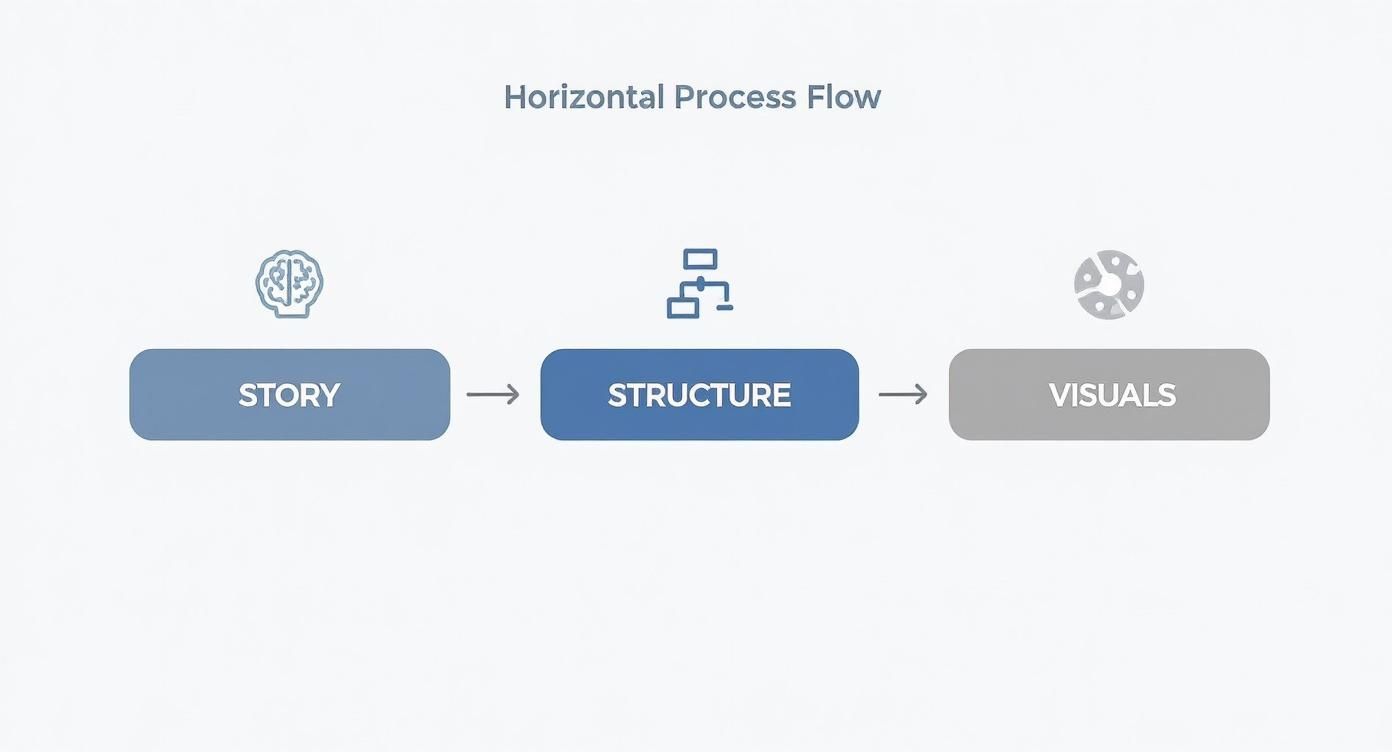
A solid story and logical structure must be nailed down before the final visual layer is applied.
Phase 3: visual design and execution
Once you sign off on the storyboard, the magic happens. The design team translates that blueprint into a polished, on-brand presentation.
This includes:
- Developing a visual concept that reflects your brand.
- Transforming data into clean, easy-to-understand charts.
- Designing custom icons and graphics that make your deck stand out.
This is where your investment becomes tangible. The raw story is brought to life with a design that signals credibility from the first slide.
Phase 4: revisions and final delivery
No design is perfect on the first try. The final phase is all about refinement. Professional agencies build in one or two rounds of revisions for your feedback.
This collaborative loop ensures the final product is something you’re confident to present. Once complete, you get all final files, including a fully editable version (PowerPoint or Google Slides) and a PDF.
- Example: A SaaS founder notices a user growth chart is confusing. During revisions, they flag it. The designer simplifies the visual, adding a callout that highlights 40% month-over-month growth. The final deck is crystal clear.
How to choose the right design partner
Finding the right partner isn’t like hiring a freelance designer. You’re investing in a strategic partner who will shape your narrative to convince investors.
Not all presentation design services are equal. Picking the wrong one is a fast way to burn cash. Here’s how to spot the difference.
Evaluate their portfolio with a founder’s eye
A portfolio is more than a gallery of pretty slides. It’s evidence of strategic thinking. Don’t get distracted by flashy animations for Fortune 500 companies.
- Industry experience: Have they worked with startups in your space, like SaaS or fintech?
- Fundraising context: Look for actual pitch decks, not just conference keynotes.
- Narrative clarity: Can you understand the core business just by scanning the slides?
You need a partner who understands the fundraising game. Learn more in our guide on how to choose the right pitch deck designers.
Look for authentic founder testimonials
Stock quotes on a website are nice. Real social proof is better. Hunt for detailed testimonials on platforms like LinkedIn, where you can verify the person.
Vague praise like "they did a great job" is a red flag. Look for specific outcomes, like "their process helped us clarify our go-to-market strategy."
The best testimonials speak to the process and the outcome, not just the visuals.
Insist on a transparent process
A professional agency should walk you through their exact process. If their explanation is fuzzy, be careful. A proven process is a sign of experience.
Ask them to explain their phases for:
- Discovery and strategy
- Storyboarding
- Design execution
- Revisions and delivery
A clear process minimizes risk.
Design partner selection checklist
Use this simple checklist to vet potential agencies and make a smart decision.
| Criteria | What to look for | Red flag |
|---|---|---|
| Portfolio relevance | Pitch decks for startups in similar industries. | Only corporate marketing or sales decks. |
| Founder testimonials | Specific, verifiable testimonials on LinkedIn or Clutch. | Generic quotes or no testimonials. |
| Process transparency | A clear, multi-step process. | A vague process or a jump to "making slides pretty." |
| Strategic input | Asks tough questions about your business. | Focuses solely on aesthetics. |
| Pricing | Clear, value-based pricing. | Suspiciously low prices. |
- Example: Agency A has a beautiful portfolio for brands like Coca-Cola. Agency B has a focused portfolio of Series A SaaS decks with glowing LinkedIn recommendations from founders. Agency B is the clear winner. Relevance beats glamor every time.
Unpacking the cost and ROI of a professional deck
Let’s get real about the numbers. For many founders, the price tag on presentation design services feels like a question mark.
The perspective shifts when you stop seeing it as a cost. Start treating it as an investment with a measurable return.
Play videoA founder's guide to presentation design services videoThis loads content from YouTube.
Your pitch deck is a tool to raise capital. Spending $5,000 to $15,000 on a world-class deck is small when it’s the key to a $1M+ seed round. This isn’t just about making slides look good. It’s about getting your company funded.
Breaking down the costs
There’s no one-size-fits-all price. It depends on the scope of work and strategic lift you need.
- Template refresh ($1,500 – $4,000): A purely visual upgrade. You bring a finished deck with a solid story. They give it a professional facelift.
- Narrative and design ($5,000 – $15,000): The sweet spot for most founders. You bring raw data. They help build the story, structure, and visuals.
- Full strategic partnership ($15,000+): A much deeper dive. The agency helps with market analysis, financial modeling, and fundraising strategy.
Presentation software is only the delivery layer. The return comes from a clearer investment case, faster iteration, and a deck your team can reuse across fundraising conversations.
Calculating the real ROI
The return on a pro-level deck isn’t just about the money you raise. It delivers value in other ways.
Time saved: How many hours will you sink into PowerPoint? Handing it off to a pro frees you up to build your product.
Increased confidence: You walk into a pitch meeting knowing your deck is world-class. Investors can feel that confidence.
A master storytelling asset: Your pitch deck becomes your master story. You can use slides for your sales deck, new hire onboarding, and marketing content.
Example: You spend 100 hours on a DIY deck that gets no traction. If your time is worth $200/hour, you’ve burned $20,000 for zero results. A $10,000 investment in a professional deck that helps close your round? The ROI is practically infinite.
The future of presentations: AI and interactive storytelling

The old-school, one-way slide deck is on its last legs. The future is dynamic, intelligent, and engaging.
Two major forces are driving this shift: artificial intelligence and interactive storytelling. They are rewriting the rules for how we build and deliver a pitch. You can see how these trends are defining corporate communication.
AI as a co-pilot, not a pilot
AI-powered design tools are everywhere. They’re great for getting past a blank page. They can spit out initial drafts and suggest visual concepts in minutes.
But AI is a tool, not a strategist. It’s brilliant at assembling information but has zero understanding of the narrative nuance needed to hook an investor. It can generate a chart, but it can’t tell you which data point matters.
Use AI as your co-pilot for the heavy lifting. This frees you and your design partner for the work that closes rounds: sharpening your message and refining the story.
The rise of interactive and non-linear decks
Investors are swamped. They don’t have time for a rigid, 15-slide story if they only care about slides 7, 9, and 12.
The future is interactive. It gives investors the driver’s seat to explore what they find most compelling.
This non-linear approach delivers key advantages:
Deeper engagement: It flips passive viewing to active exploration.
Personalized conversations: It lets you pivot your pitch on the fly.
Embedded, real-time data: You can embed live data that updates in real time.
Example: A SaaS founder shows a live chart of daily active users. An investor asks about a spike. The founder filters the data right there to show the marketing campaign that drove it. This builds rock-solid credibility.
Ready to turn your vision into a deck that gets funded? We combine VC insight with world-class design to build presentations that open doors and close rounds. Let’s build your winning pitch deck.
FAQ
How long does a typical project take?
It depends on the scope. A quick visual polish can be done in a few days. But a full project-strategy, storyboarding, and custom design-takes two to three weeks. This timeline allows for a proper discovery phase, thoughtful story development, and at least one round of revisions. A two-week timeline is a healthy benchmark.
What materials do I need to provide?
You don’t need a perfect deck to get started. Come prepared with the essentials:
– Your existing draft deck (even a messy brain dump).
– Your business plan or a detailed brief.
– Financial projections.
– Brand assets like your logo and color palette.
The more raw information you provide, the faster the agency can shape it into a powerful narrative.
How are revisions and feedback handled?
A professional process is collaborative. An agency should build specific feedback loops into the project timeline.
The process usually looks like this:
1. Strategic sign-off: You approve the core narrative and storyboard first.
2. First design draft: The agency delivers a complete version for your review.
3. Consolidated feedback: You provide one or two rounds of specific feedback.
4.Final polish: They implement changes and deliver the final files.
This structured approach ensures the final deck is something you are 100% confident in.
