
Choosing a designer is harder than it looks. This guide breaks down what actually matters and how to find someone who can turn your story into a “yes.”
Contributors: Olena Petrosyuk
Written by: Ruslana Yurchenko
Published: August 2025
Most pitch deck designers look great on Dribbble, but only a few can meet VC storytelling standards.
They may know how to make slides look sleek, but most miss the mark when it comes to what actually gets a “yes” from investors: sharp storytelling, clear logic, and a deck that builds conviction in under three minutes.
Quick data proof: According to recent data from DocSend and TechCrunch, VCs are spending less time per deck – around 2 min 20 seconds on average. And in such a short window, pretty slides without a point won’t cut it.
Design is easy to fake, but not the strategy.
Your deck is your first impression – your shot to get VCs onboard, raise a round, or keep momentum alive. And choosing the right partner to build it can be the difference between pre-seed and pre-dead.
This guide speaks on how to vet a deck designer and the red flags to spot before they cost you the raise.
The 7-step pitch-deck-designer-proof checklist 🚦
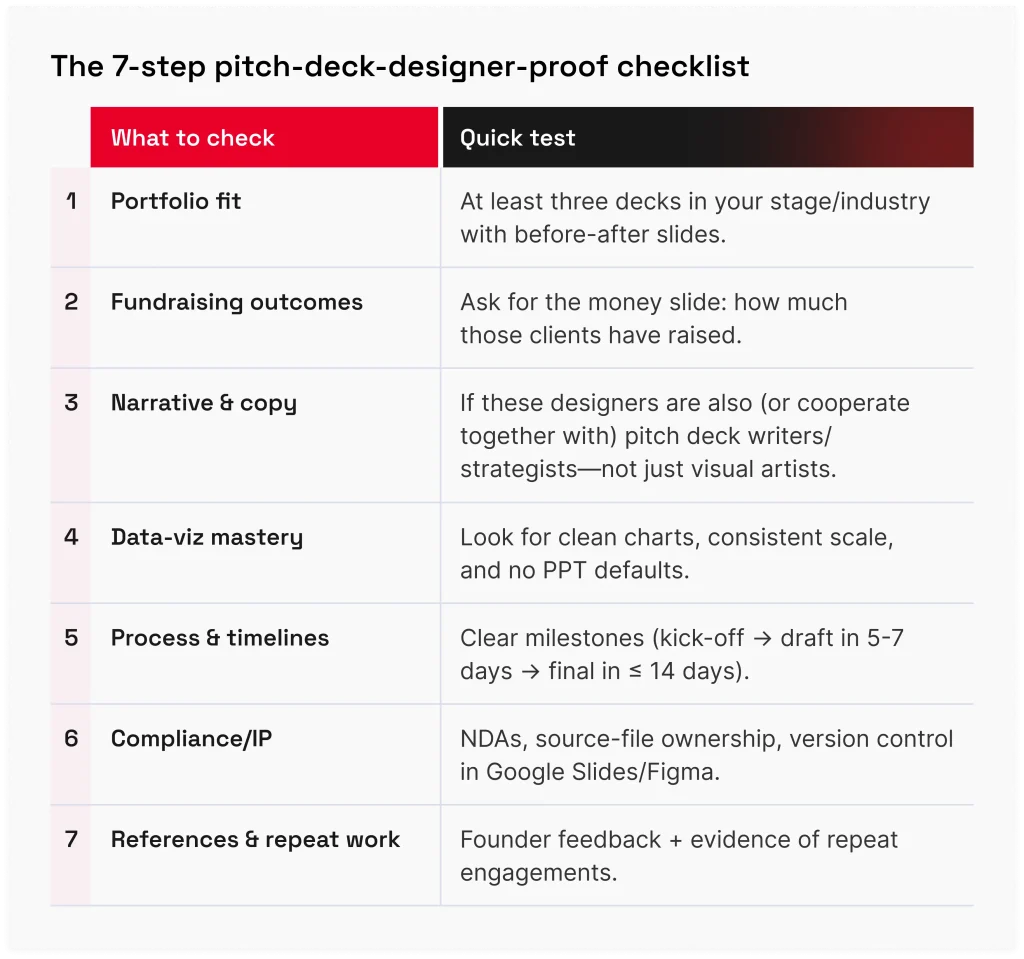
Pass all seven? Move forward. Miss three or more? Swipe left and move on to the next candidate.
Deep dive: what good pitch deck designers look like
Let’s get into more detail on each point from the checklist above to see what you need to look at to choose the best pitch deck designers.
1️⃣ What a good portfolio looks like
Great deck designers don’t just show the final slides. They show the transformation. That’s what helps you see – and feel – if this professional actually fits your business.
Here’s what to look for in a standout portfolio:
- Industry and stage match – If you’re a B2B SaaS seed-stage founder and their portfolio is packed with Series B consumer apps, it’s a mismatch. Look for designers who’ve worked with companies like yours—stage-and-sector twins.
- Clear before/after comparisons – You’re not just looking for prettier fonts. You want to see how they’ve sharpened the story, clarified the flow, or elevated positioning. The real value is in what changed, not just how it looks.
- Expertise across different sections of presentation – Pay attention to how they handle high-stakes sections: TAM, traction, GTM, financials, and the problem-solution narrative. A good pitch deck writer effectively mixes aesthetics, logic, and investor appeal in each section.
Want to see what that actually looks like in practice?
Here’s a peek at some before/after transformations from our team at Pitchili – real slides, real upgrades, real results.
2️⃣ Fundraising outcomes: pretty means nothing if it didn’t raise
A strong portfolio is a good start, but the real test is to check whether those decks actually helped startups raise capital. At the end of the day, that’s the point we all gathered here (founders, pitch deck designers, investors…).
That’s why, when vetting a design company, ask for outcomes, not just designs. Your partner will surely share this (while respecting client confidentiality, of course):
- How much was raised – even rough ballparks (e.g. $1.2M pre-seed) are helpful.
- What kind of round and when – timing gives context (seed in March 2024 means relevance compared to May 2015; yes, they might have been experts at that time, but since 2015, a lot has changed).
- Who invested – even anonymized mentions like “Tier 1 VC” or “strategic angels” go a long way.
If every deck is “confidential,” and they can’t speak to outcomes, that’s a red flag. You’re not buying design – you’re buying a tool to raise capital.
3️⃣ Industry expertise: not all storytelling is created equal
A deck that looks polished but misses what investors care about in your sector can do more harm than good.
The metrics, language, and logic investors expect vary widely:
- In B2B SaaS, it’s all about ARR, churn, and sales cycles.
- In marketplaces, GMV and take rate are important.
- Medtech needs simplified clinical data.
- Climatetech must address regulatory fit.
A strong partner understands these nuances. And they can tailor your business story accordingly, preempting investor questions before they’re asked. If pitch deck designers don’t speak your sector’s language, they won’t help you win the room.
4️⃣ Copywriting synergy: who actually writes the story?
A killer pitch deck is designed, but more importantly, it’s written.
Too many designers may ask you just to “send the copy,” as if the narrative magically exists already. But a strong pitch deck isn’t just about a visual upgrade; it’s about rethinking the whole story.
What you want is someone who helps build that narrative with you, not just lay it out slide by slide.
The right partner will:
- Pair design with strategy – or bring in a copy lead who knows investor logic.
- Challenge vague claims or slide bloat that dilutes the message.
- Help shape structure: the arc from problem to vision, not just fonts and spacing.
At Pitchili, we build decks with two hands.
On one side: finance strategists who speak investor language and can find a unique angle to shape your narrative in a way that makes sense and sells.
On the other: professional pitch deck designers who constantly track all the recent design trends to give your deck a powerful look&feel.
Here are a few recent decks we’ve built that helped founders close their rounds:
5️⃣ Data-viz skills: numbers must be crystal clear
Investors don’t read – they scan. If your charts confuse them, they’ll move on.
One messy CAC/LTV slide or a traction graph with no context can quietly kill the deal before you ever get in the room.
Look for a pitch deck designer who can turn raw numbers into quick, credible insights.
That means:
- Consistent chart scales (no y-axis games);
- Clear annotations that explain the “so what”;
- Smart layout hierarchy, with key metrics front and center—not buried in the fine print.
Your data tells the story. And your visuals should make this story obvious, not make investors guess.
Want to check your CAC or CAC/LTV ratio? Try these free calculators.
6️⃣ Process transparency: can designers ship fast, without chaos?
We know for sure that startup founders are usually tight on time. So, you need a great process that can save you days rather than a messy one that can kill your momentum.
Cool pitch deck experts should walk you through their workflow, showing you something like:
- Kickoff → First draft in 5–7 days → Final deck in ≤14 days;
- Tools like Figma, Google Slides, and Notion to track feedback;
- 2–3 rounds of revisions are already scoped in (no surprise fees).
For example, our team typically takes up to 14 days to finalize your investor presentation, but if you’re in a hurry, you can try our rush pitch deck design services – a deck in just 5 business days.
If an agency pitch deck can’t explain how they work – or worse, say, “we’ll figure it out as we go” – expect delays, scope creep, and endless email threads. You are here to refine the story, not to manage the process.
7️⃣ References and repeat clients: the best kind of proof
Strong pitch deck designers rarely work with a founder just once. The best ones get brought back for the next round – or get recommended to other founders over coffee, WhatsApp, or a warm intro. Word of mouth is still one of the most reliable signals of real expertise.
That’s why try checking customer feedback on their websites, forums, or LinkedIn. You may ask them who they cooperated with and if they have repeat customers, or maybe you’ll hear about these pitch deck design companies during business meetings. Check what people say before making the final decision.
🚩 Red-flag checklist
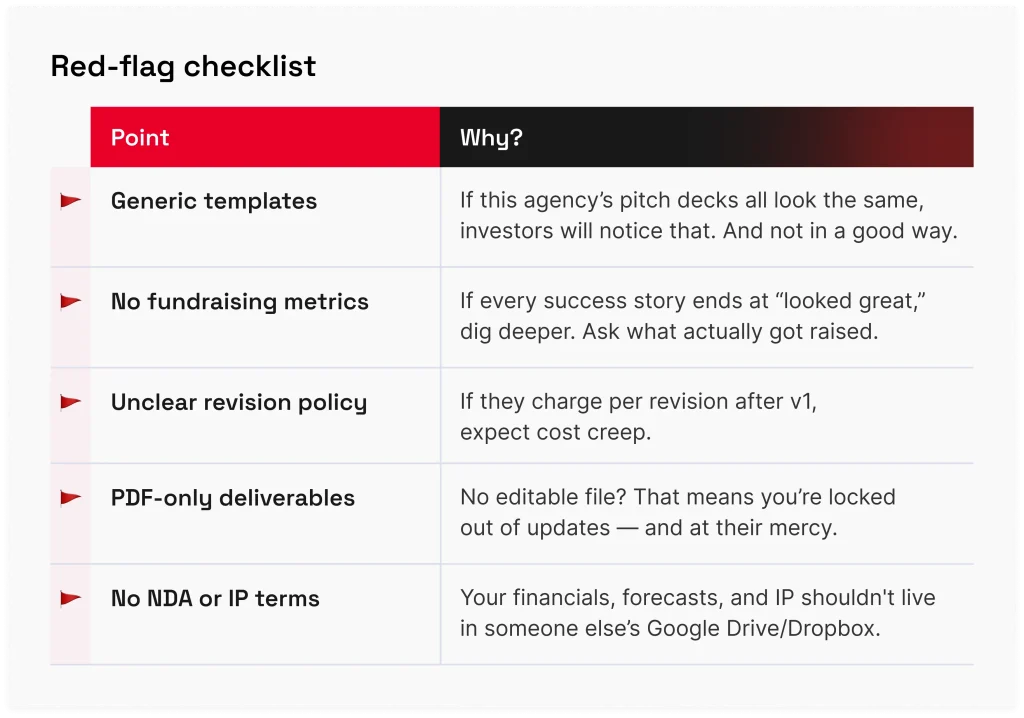
So, who’s actually going to build your pitch deck?
A professional agency, a freelancer, or maybe you’re thinking of doing it yourself?
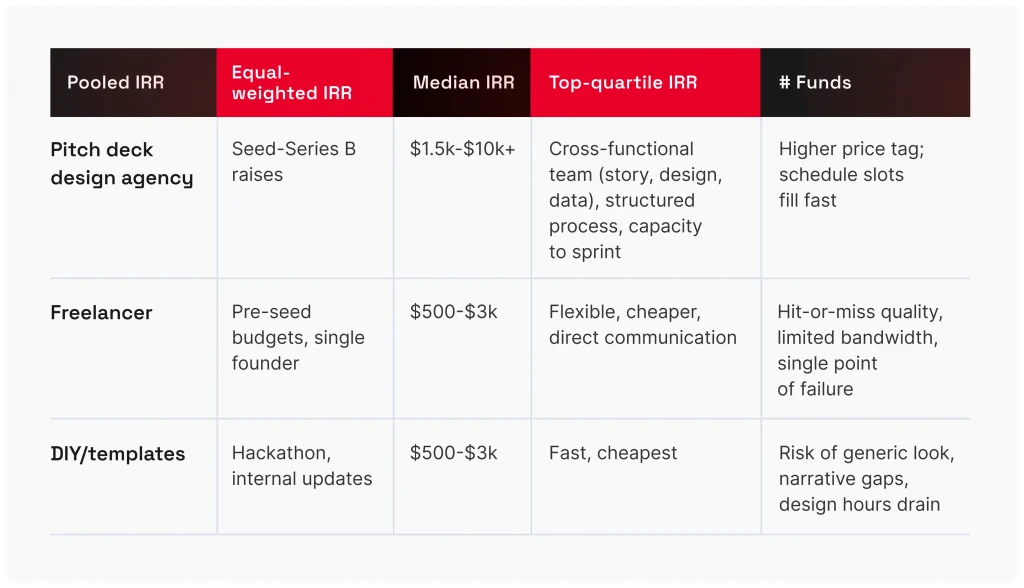
Now that you know what great pitch deck designers bring to the table, it’s worth zooming out for a second. Because the next decision is who should help you. And that depends on your budget, stage, timeline, and how much strategic firepower you actually need.
Here’s a quick breakdown to help you compare the main options—agency, freelancer, or DIY – and see what makes the most sense for where you are now.
If you’ve decided to go with the first option – pitch deck professionals – and want a team that already ticks every box in the 7-step checklist, talk to our experts at Pitchili. We’ve already delivered over 500 decks across 90+ verticals and helped our clients raise over $3 billion in funding. We know what works – and what can get you a “yes” from investors.
FAQ
What is a pitch deck designer?
A pitch deck designer is someone who helps craft your investor presentation, both in terms of visuals and (ideally) narrative. If chosen wisely, they can make slides look good and help tell your story in a way that builds investor conviction.
Can ChatGPT create a pitch deck?
ChatGPT can help, but it can’t replace real pitch deck designers. You can use it as a supportive tool to structure your narrative, brainstorm slide content, or refine your messaging. But for investor-ready design and strategic storytelling, you’ll still need a pro.
How much should I pay for a pitch deck?
It depends on what you’re getting. Freelancers charge anywhere from $500–$3,000. Pitch deck design companies typically start at $1.5K and go up to $10K+. If you’re raising a serious round, investing in a deck that actually converts is rarely money wasted.
