
Your project is stuck in endless revisions. The final design misses the mark. You’ve wasted time and money. This happens when you skip the most critical first step: the design brief.
A design brief is a short document that aligns everyone on a project’s goals before any work begins. It’s your single source of truth. This guide will show you how to write one that prevents costly mistakes and delivers results.
Why you can’t afford to skip a design brief
A design brief turns a vague idea into an actionable plan. Many founders skip it to move faster, but that’s a false economy.
A project without a brief usually spirals into:
- Endless revisions that burn cash.
- Miscommunication between teams.
- Final designs that fail to connect with users.
- Launch delays that give competitors an edge.
Aligning your team upfront is non-negotiable. This is especially true when you find the right pitch deck designers. They need a clear roadmap to turn your vision into an investor-ready story.
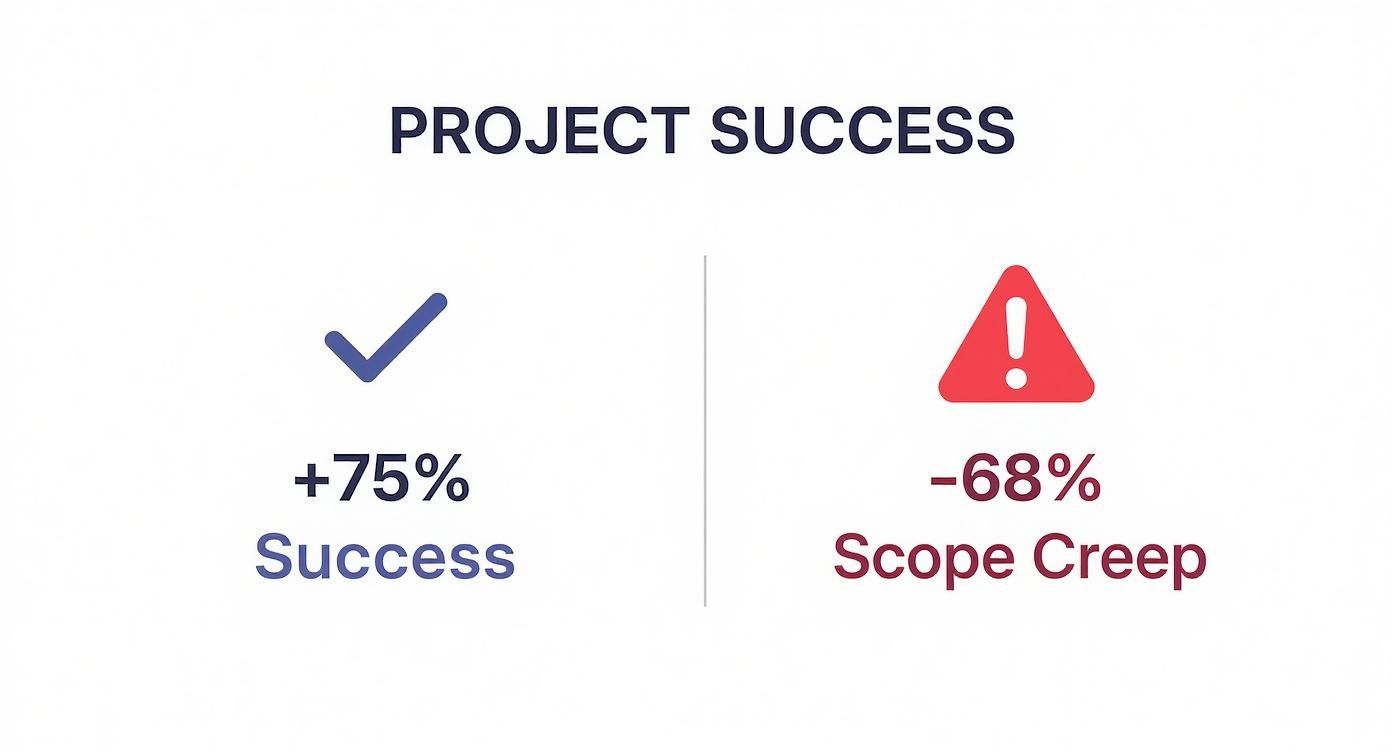
The data is clear. Projects with a solid design brief have a 75% higher success rate in meeting deadlines and budgets. A fuzzy brief causes scope creep in 68% of failed projects.
A brief forces you to answer the tough questions first. It creates a shared understanding of what success looks like for everyone.
Example: Instead of asking for a "better website," a brief defines the goal: "Redesign our homepage to increase demo sign-ups by 20% in Q3." This clarity focuses the entire project on a measurable business outcome.
The 7 essential components of a powerful design brief
A weak brief is a recipe for disaster. A powerful brief is a blueprint for clarity. It packs in seven non-negotiable elements that give your design team a clear roadmap.
1. Company overview
Start with a quick snapshot of your business. Who are you? What do you do? This context helps designers understand your brand’s personality and market position.
- Example: "We’re a B2B SaaS company that helps early-stage startups automate financial reporting. Our mission is to make bookkeeping effortless so founders can focus on building their business."
2. Project objective
What is the single most important thing this project needs to achieve? Tie it to a concrete business outcome. An objective like "improve the website" is useless because you can’t measure it. This is where you nail down the "why" behind the work. If you’re struggling, our guide on building a problem and solution slide can help you zero in on the core issue.
- Example: "Our main goal is to redesign the user onboarding flow to cut customer drop-off by 25% within three months."
3. Target audience
You must know exactly who you’re designing for. Go beyond broad demographics. Paint a sharp picture of your ideal user. What are their biggest headaches?
- Example: "Our target users are US-based SaaS founders, aged 28-40. They are non-technical and find managing user retention metrics a pain. They need a simple, visual dashboard that gives them answers at a glance."
4. Competitors
Who are you up against? List 2-3 direct and indirect competitors. Briefly explain what they do well visually and where they fail. This helps you spot gaps in the market and stand out.
- Example: "Competitor A has a clean UI, but their navigation is a mess. Competitor B has great features, but their branding feels dated."
5. Key deliverables
Get explicit about what you expect at the end. List every single asset you need, including file formats and dimensions. This prevents awkward "I thought that was included" conversations.
- Example: "Final deliverables: one high-fidelity Figma prototype of the new onboarding flow, a 10-page brand style guide (PDF), and five social media templates (1080×1080) as PNGs."
6. Budget and timeline
Every project runs on time and money. Be upfront about your budget range and any critical deadlines. This helps the design team scope the work realistically.
- Example: "The total budget for this project is $15,000. The final deliverables are due by October 31st."
7. Stakeholders and approval process
Who gives the final "yes"? Clearly list the key decision-makers. Name a single point of contact for the project. This prevents feedback-by-committee, a notorious project killer.
- Example: "Jane Doe (Head of Product) is the main point of contact. John Smith (CEO) has final sign-off authority."
Your simple design brief checklist
Reading about a design brief gets you started. A template gets you moving. Use this checklist to build a clear, effective brief in minutes.
A great brief tells a clear story, just like a great pitch deck. We use this same structure when building a high-impact startup pitch deck template.
Design brief checklist
| Section | Key Question to Answer |
|---|---|
| 1. Company Overview | Who are we and what market do we operate in? |
| 2. Project Objective | What single business problem does this solve? What does success look like? |
| 3. Target Audience | Who is our ideal customer? What are their specific pains and goals? |
| 4. Competitor Landscape | Who are our top 3 competitors, and what can we learn from their design? |
| 5. Key Deliverables | What specific assets do we need at the end (e.g., Figma files, PDFs)? |
| 6. Budget & Timeline | What is our realistic budget range and the final deadline? |
| 7. Stakeholders | Who is the main point of contact, and who has final sign-off authority? |
This checklist becomes your project’s North Star. It keeps designers, founders, and marketers all pulling in the same direction.
How to write a design brief that delivers results
Knowing what goes into a brief is one thing. Writing one that inspires incredible work is another. Your goal is to define the problem, not dictate the solution.
Focus on the why, not the what
Before you list deliverables, nail the "why" behind the project. A designer who understands the business goal can make smarter creative choices.
- Weak request: "We need a new homepage design."
- Strong request: "We need a new homepage that communicates our value to enterprise clients and increases demo requests by 20%."
This shift turns your designer into a strategic partner.
Involve your designer early
Don’t write the brief in a vacuum. Pull your lead designer into the process from the start. A collaborative session can uncover challenges and opportunities.
A kickoff call lets the designer ask questions and challenge assumptions. It turns the brief from a one-way order into a shared game plan.

Provide inspiration, not instructions
Instead of telling a designer exactly what to do, show them what you like. Use mood boards. Gather images, color palettes, and screenshots that capture the vibe you want.
Provide visual inspiration to guide the feeling of the design. It’s about setting a direction, not giving orders.
A quick history of the design brief
The design brief wasn’t born overnight. It came from necessity as projects got bigger and messier.
Decades ago, a handshake was often enough. But as businesses scaled, casual agreements led to expensive failures.
The modern design brief definition took shape in the mid-20th century with the rise of professional design. You can learn more about the history of the design brief.
This evolution proves the design brief is a serious business tool. It manages risk, aligns teams, and ties creative work to commercial outcomes.
A clear design brief is the foundation of any successful project. At Pitchili, we kick off every engagement with a deep-dive discovery to build a brief that aligns your vision with what investors need to see. Learn how we can help you build a pitch deck that gets results.
FAQ
How detailed should a brief be?
You need enough detail to kill ambiguity but enough freedom to spark creativity. Define the sandbox, don’t tell them how to build the sandcastle.
1. Too Vague: "We need a modern website." (Useless)
2. Too Restrictive: "Use Helvetica Neue, 16px, color #00A4EF for every CTA." (Kills creativity)
3. Just Right: "Our goal is a website that feels trustworthy to Series A founders. We like the minimalist vibe of Stripe but need to inject our brand’s unique personality."
This gives your designer clear direction without handcuffing them.
Who writes the design brief?
Writing the brief should be a team sport. You, the client, bring the core business goals. The designer helps sharpen them into an actionable plan. The best briefs come from a conversation between you and your design lead. A design brief is a shared understanding, not a top-down command.
Can we change the brief mid-project?
Yes, but be careful. A design brief is your project’s constitution. Minor tweaks are fine. If you need to change core goals, hit pause. Formally update the brief and discuss how it impacts the timeline and budget. The brief acts as your baseline to spot scope creep and agree on a new plan.
