
Raising capital is brutal. Most founders get ghosted after sending their deck because they treat it like a data dump, not a story. This guide gives you a VC-approved startup pitch deck template to build a narrative that gets the next meeting.
A pitch deck is a story, not a spreadsheet

Founders often cram decks with jargon and complex financial models. They treat it like a spreadsheet – a collection of every metric they’ve ever tracked.
This is a mistake. A great pitch isn’t about drowning investors in facts. It’s about telling a story that sells a vision.
Shift from presenting to persuading
Your pitch deck has one job: secure the next meeting. That’s it. It’s the trailer, not the movie.
Your goal is to spark enough curiosity to make an investor say, "I need to learn more."
This requires a shift from presenting data to crafting a narrative. Your story must frame the opportunity and position your team as the only one capable of capturing it.
Focus on clarity, not complexity
Investors see hundreds of decks. They spend an average of 3 minutes and 44 seconds on each one, according to research from DocSend. They don’t have time to decipher convoluted graphs.
A proven startup pitch deck template gives you an advantage. It provides a narrative backbone, forcing you to be concise.
In fact, one analysis found that founders using structured templates shortened their pitch process from eight weeks to just five. You can explore the data behind these pitch deck findings for more details.
- Example: Don’t say "Our synergistic platform leverages AI-driven paradigms." Say "Our tool saves teams 10 hours a week."
The 10 core slides every investor expects
A proven structure respects an investor’s time. It gets straight to the point with a story that makes sense.
Frameworks from VCs like Sequoia Capital work because they create a logical flow that builds conviction.
Here is the blueprint for the 10 core slides in almost every successful pitch.
1. Company purpose and vision
This is your one-liner. Nail what you do in a single, crisp sentence. No jargon.
It needs to be so clear that anyone can get the mission instantly.
- Example: "Stripe for cross-border B2B payments in Latin America."
2. The problem
Don’t just state a problem. Make it urgent and personal.
Use a relatable story or a shocking statistic that shows the real pain customers face. The goal is to get the investor nodding along.
- Example: "SMBs in Mexico lose $1,200 per month in hidden fees on international invoices. Maria, a small business owner, waits 15 days just to get paid."
3. The solution
Introduce your product. Explain exactly how you solve the problem you just laid out.
A simple screenshot is more powerful than a dense paragraph. Show, don’t tell.
- Example: "Our platform offers one-click international payments that settle in 24 hours for a flat 1% fee."
4. Market size (TAM, SAM, SOM)
Investors need to see a massive opportunity. Break down your market into Total Addressable Market (TAM), Serviceable Available Market (SAM), and Serviceable Obtainable Market (SOM).
Use credible, third-party data to back up your numbers. Our guide on the market size slide can help you nail this.
5. Business model
How do you make money? Be specific.
Clearly state your pricing and unit economics. This slide answers the investor’s critical question: "How will this business generate revenue?"
- Example: "We charge a 2% transaction fee on every payment. Our average customer processes $50,000 in payments per month."
6. Traction and milestones
This slide is your proof. Show revenue, user growth, or key partnerships.
If you’re pre-revenue, showcase engagement metrics, waitlist numbers, or a successful pilot program. This builds credibility and proves you can execute.
7. Team
Investors bet on people. Introduce your founding team and key advisors.
Highlight relevant experience that makes you the team to solve this specific problem. Why are you uniquely equipped to win this market?
8. Competition
Acknowledge your competition. It shows you’ve done your homework.
A simple 2×2 matrix or a feature comparison chart can show how you’re different and better. Pinpoint your unique advantage.
9. Financials
Keep this high-level. A simple chart showing historical and projected revenue for the next 3-5 years is all you need.
The goal is to demonstrate a thoughtful plan for growth, not drown them in a complex spreadsheet.
10. The ask
End with a clear, confident ask. State how much you’re raising and what you’ll use it for.
Break down the use of funds into key buckets like product development, hiring, and marketing. This shows investors you have a strategic plan.
- Example: "We are raising $1.5M to hire five engineers, acquire our first 1,000 customers, and hit $1M ARR in 18 months."
Pitch deck slide checklist
| Slide # | Slide Title | Purpose |
|---|---|---|
| 1 | Company Purpose & Vision | Hook the investor with a clear one-liner. |
| 2 | The Problem | Make the pain point real and urgent. |
| 3 | The Solution | Introduce your product as the clear answer. |
| 4 | Market Size | Show a massive, defensible market opportunity. |
| 5 | Business Model | Explain exactly how you make money. |
| 6 | Traction & Milestones | Provide concrete proof that you can execute. |
| 7 | Team | Show why your team is the only one that can win. |
| 8 | Competition | Pinpoint your unique, defensible advantage. |
| 9 | Financials | Present a believable plan for future growth. |
| 10 | The Ask | State what you need and what you’ll achieve. |
Build your narrative from problem to solution
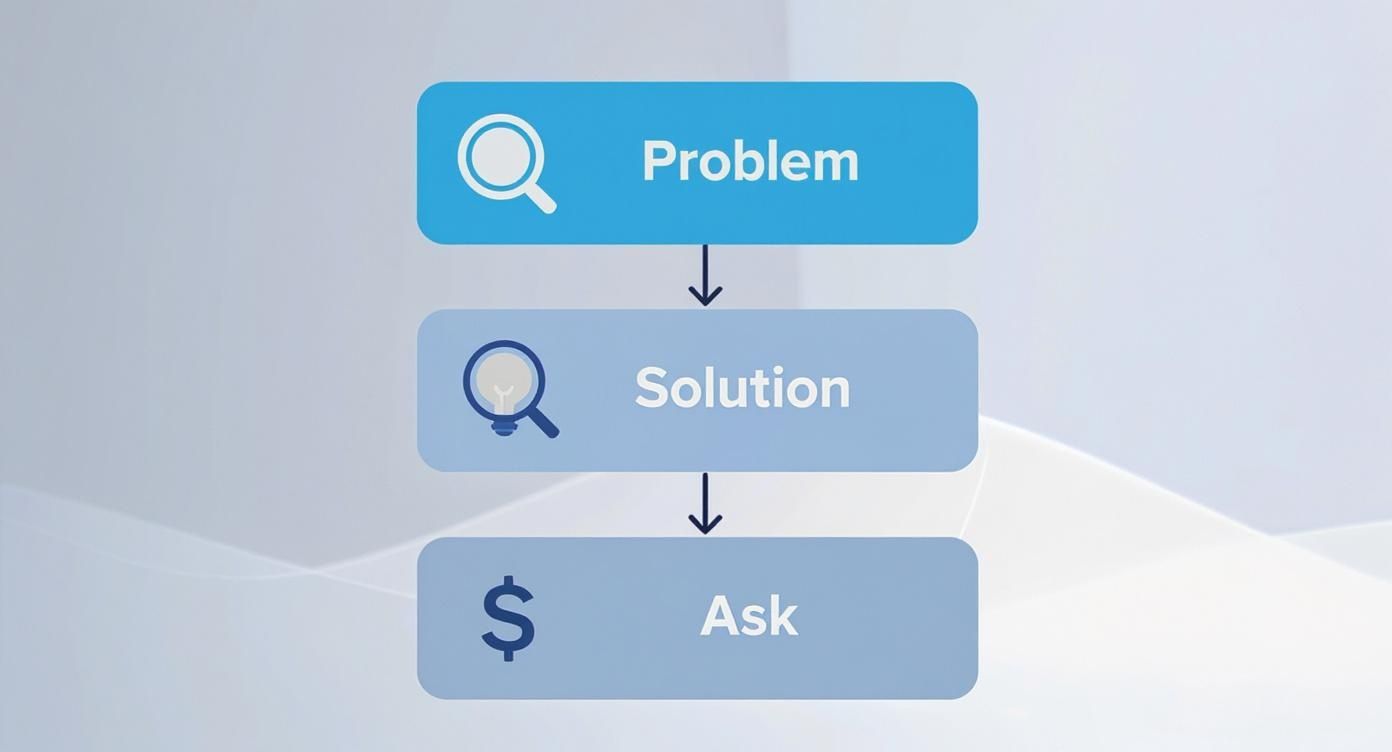
A great pitch deck tells one powerful story. Many founders present their problem and solution slides as two separate facts. This is a mistake.
The magic happens when you build a bridge between them. Create a narrative so compelling that investing feels like the only logical next step.
Your goal is to make the problem feel urgent and personal. Then, your solution becomes the inevitable hero of that story.
Frame the problem with relatable pain
Investors are human. They need to care about the problem before they care about your TAM.
Ditch generic statements like "the market is inefficient." Instead, tell a micro-story or use a shocking statistic.
The first Airbnb pitch deck didn’t open with a market analysis. It started with a simple problem: "Price is a major concern for travellers", and "There’s no easy way to book a room with a local."
This approach:
- Creates empathy. The investor gets the pain.
- Builds urgency. A specific problem demands an immediate solution.
Present your solution as the inevitable answer
Once you’ve established the problem, your solution needs to be the clear hero. The transition must be seamless.
Focus on the core value that directly resolves the pain you just described. Talk about benefits, not just features.
- Feature: "We have an AI-powered dashboard."
- Benefit: "Our AI saves teams 10 hours a week."
For a deeper dive, our guide on how to build a problem and solution slide offers more specific tactics.
Connect your story with a clear vision
A strong narrative is tied together by a clear vision. It answers "why now?" and "why you?"
A structured framework can sharpen your story. For instance, startups using certain frameworks raised 15% more than the industry average. This shows how much a structured narrative impacts your raise.
You can read more about these powerful pitch deck frameworks and how they drive results.
Prove your vision with market and traction data
Play videoYour winning startup pitch deck template videoThis loads content from YouTube.
You’ve hooked the investor with a problem and solution. Now, ground your vision in reality with data.
Your market size and traction slides build credibility. They prove your idea is a massive, tangible opportunity.
Forget vague claims like "this is a billion-dollar industry." Investors need to see a thoughtful, bottom-up analysis.
Quantify the opportunity with TAM, SAM, and SOM
Your market size slide must be ambitious but believable. The standard framework breaks your market into three segments.
- Total Addressable Market (TAM): The total market demand for a product like yours.
- Serviceable Available Market (SAM): The segment of the TAM you can realistically reach.
- Serviceable Obtainable Market (SOM): The portion of SAM you can capture in the first 3-5 years.
Decks that visually map TAM, SAM, and SOM with real numbers are rated as 42% more credible by investors. You can discover more insights about pitch deck examples that show how powerful this is.
Our guide on the market size slide gives you actionable steps for these calculations.
Showcase traction even if you’re pre-revenue
Traction is the best way to prove you’re a business in motion. But traction isn’t just about revenue.
If you are pre-revenue, focus on metrics that show user love and early signs of product-market fit.
Your traction slide should answer: "What have you achieved with the resources you’ve had so far?"
Highlight non-revenue metrics that tell a story:
User Growth (MoM): Shows your user base is expanding.
Engagement Rates: Metrics like daily active users (DAU) or retention prove people find value.
Waitlist Numbers: Demonstrates strong demand before launch.
Pilot Program Results: Positive feedback or letters of intent (LOIs) are incredibly powerful.
Example: "We launched our beta 3 months ago and have grown to 1,500 active users with 25% week-over-week growth, entirely through organic channels."
Design a deck that looks professional
Your deck’s design is the first signal of your company’s quality. A cluttered, amateurish design suggests a cluttered company. It’s an instant credibility killer.
You don’t need to be a Figma wizard. The real goal is clarity, not artistic flair. Good design makes your story easier to absorb.
Keep it clean and consistent
The foundation of great design is consistency. It creates a professional experience for the reader.
- Use one or two fonts, max. Pick a clean sans-serif like Inter or Helvetica.
- Stick to a limited color palette. Use 2-3 primary brand colors consistently.
- Leverage white space. Crowded slides are impossible to read. White space gives your content room to breathe.
Visualize data to tell a story
Numbers in a spreadsheet are boring. The same numbers in a clean chart can tell a powerful story.
A simple bar graph showing user growth is far more effective than a table. Make sure every chart has a clear title and the key takeaway is obvious.
If you need support, our guide on how to choose the right pitch deck designers can help.
Pitch deck design checklist
| Design Element | Check | Quick Tip |
|---|---|---|
| Font Readability | ☐ | Is text legible? Stick to 18pt+ for body copy. |
| Color Consistency | ☐ | Are you using the same 2-3 brand colors on every slide? |
| Slide Titles | ☐ | Does every slide have a clear, action-oriented title? |
| High-Quality Visuals | ☐ | Are all logos, icons, and images crisp? |
| One Idea Per Slide | ☐ | Does each slide communicate a single, focused message? |
Your deck is your first impression. A great startup pitch deck template is a start, but the story is what gets you funded. See how we can help you get funded.
FAQ
How long should my pitch deck be?
Keep it between 10 to 15 slides. Anything more is a red flag.
Successful Y Combinator companies average 10-12 slides. Your goal is to earn the next conversation, not close the deal.
If you can’t tell your story in under 15 slides, your narrative is too complicated. Be ruthless. Cut anything that doesn’t push the story forward.
What are the biggest mistakes to avoid?
Investors spot these mistakes instantly.
1. Too much text. VCs scan decks. Use visuals and short, punchy bullet points. If a slide looks like a wall of text, cut it in half.
2. Unrealistic financials. Hockey-stick projections kill credibility. Ground your numbers in reality and show your assumptions.
3. No clear “ask.” State exactly what you’re raising and what that capital will help you achieve. A vague ask signals you don’t have a plan.
Also, make sure your contact info is impossible to miss on the first or last slide.
Should I send my deck as a PDF?
Yes. Always send your deck as a PDF. A PDF locks in your formatting. It looks the same on an investor’s laptop as it does on their phone. It also prevents accidental edits. For tracking, use a platform like DocSend. It lets you see who opens your deck and which slides they spend time on. That data is gold.
