
Getting an investor isn’t about having a great idea. It’s about proving you can execute.
Before you write that first investor email, you need a solid foundation. You need a clear business plan, a solid financial model, and proof that your product solves a real problem. Investors don’t back ideas. They back evidence.
This guide gives you a step-by-step plan to get your business investor-ready and secure the funding you need.
1. Build an investor-ready business first
Investors see thousands of pitches. They fund businesses that have already started the journey.
Think of it this way: investors manage risk. Your job is to de-risk the opportunity for them before you ask for their money. Prove you understand your market, can manage the numbers, and have a product people want.
Create a concise business plan
Forget the 50-page document nobody reads. Your business plan should be a lean, direct guide. It’s the blueprint that proves you’ve thought through the critical parts.
Your plan needs to nail three core questions:
- What’s the problem? Define the specific pain point you solve and for whom. Quantify the market size to show the opportunity.
- What’s your solution? Explain what your product does and what gives you an edge. This is your "moat."
- How will you win? Outline your go-to-market strategy, revenue model, and key milestones for the next 18-24 months.
Example: Instead of "We’re building a SaaS for project management," get specific. "We’re building a tool for remote creative agencies struggling with async feedback, a $1.2 billion niche in the project management market."
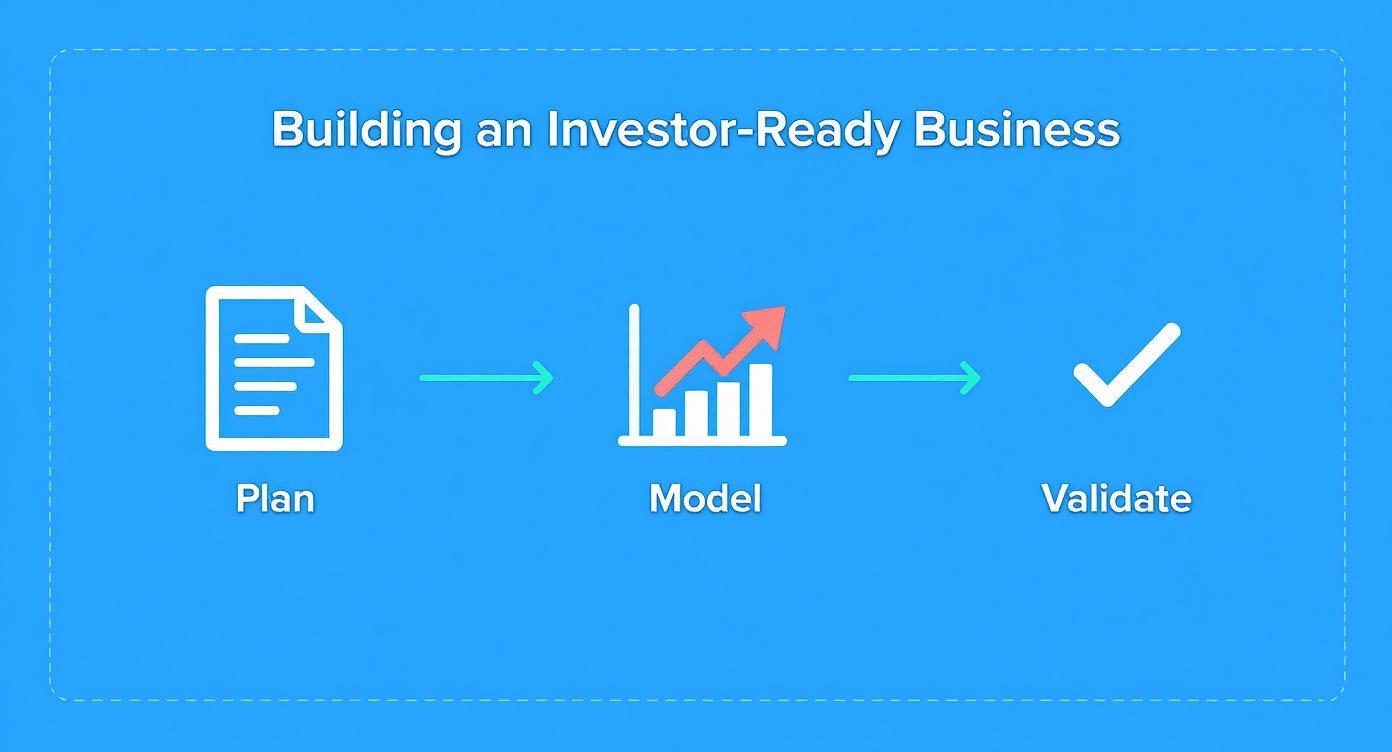
Develop a realistic financial model
Your financial model tells your business story in numbers. It needs to be a bottom-up projection grounded in logical assumptions.
A credible model includes:
- Key assumptions: List your inputs for customer acquisition cost (CAC), lifetime value (LTV), and churn rate. Be ready to defend them.
- Three statements: Include a profit and loss (P&L), balance sheet, and cash flow statement for the next 3-5 years.
- Unit economics: Show that you can acquire customers profitably. For SaaS, an LTV/CAC ratio of 3:1 or higher is the gold standard.
Your model shouldn’t just show revenue doubling. It needs to show how.
Example: "We’ll hire two sales reps in Q3. We project they will each close 4 deals per month at an average contract value of $1,500, adding $12,000 in new MRR per month."
Validate product-market fit
Product-market fit (PMF) is what investors look for. It’s when your solution clicks with a real, urgent market need. You prove it with evidence.
Collect these proof points:
- Qualitative feedback: Testimonials and case studies that show your product delivers real value.
- Quantitative metrics: Hard data on user engagement and retention rates. A high Net Promoter Score (NPS) is a powerful signal.
- Willingness to pay: The ultimate validation is revenue. Nothing speaks louder than customers who pay for your product.
Example: Imagine saying: "We launched our beta with 50 users. After three months, 80% are still active daily, and our waitlist has 500 people. Ten beta users have already converted to our paid plan."
2. Find the right investors, not just any investor

Fundraising is a matching game. Spamming a generic email to 500 VCs is the fastest way to get 500 rejections.
The goal isn’t just money-it’s smart money. You’re looking for a partner who understands your industry, adds strategic value, and believes in your vision. This takes research and a methodical process.
Understand the investor landscape
Not all investors are the same. Each type has a different focus, stage, and check size. Pitching the wrong category wastes time.
Here are the main players:
- Angel investors: High-net-worth individuals investing their own cash, usually at the pre-seed or seed stage.
- Venture capital (VC) funds: Institutional firms investing money from Limited Partners (LPs) into a portfolio of startups.
- Corporate venture capital (CVC): Investment arms of large corporations. They invest for strategic and financial reasons.
- Family offices: Private wealth management firms for ultra-rich families. They often have a longer-term outlook.
To get a sense of the latest trends, check out the global venture capital outlook.
Asset: Which investor type fits your business?
This table breaks down common investor types to help you find the best fit.
| Investor Type | Typical Stage | Investment Size | Key Advantage |
|---|---|---|---|
| Angel Investors | Pre-seed, Seed | $10k – $250k | Hands-on mentorship, industry connections. |
| Venture Capital | Seed, Series A+ | $500k – $50M+ | Deep pockets for scaling, formal governance. |
| Corporate VC | All Stages | Varies Widely | Strategic partnerships, distribution channels. |
| Family Offices | Seed, Series A+ | $250k – $5M+ | Patient capital, long-term focus. |
Build a targeted investor list
Forget quantity. A well-researched list of 50-75 investors is better than a generic list of 500. The goal is to find alignment.
You’re searching for investors whose thesis matches your business. An investment thesis is the set of beliefs that guides a VC’s decisions.
For every investor on your list, answer these questions:
- Do they invest at my stage? A Series A fund won’t look at your pre-seed idea.
- Is my industry in their strike zone? A FinTech investor probably won’t fund a MedTech company.
- Is their check size right? If they write $5M checks and you’re raising $500k, it’s a mismatch.
- Have they funded a direct competitor? If so, they are almost certainly conflicted out.
- Who is the right partner at the firm? Research individual partners to find the best fit.
This research is non-negotiable. To go deeper, read our guide on how to find venture capitalists.
Get a warm introduction
Cold emails have a low success rate. Investors use their networks as a filter. The best way to get a meeting is a warm introduction.
A warm intro comes from a trusted contact. It gives you immediate credibility.
The best sources for intros are:
- Founders of their portfolio companies: This is the gold standard.
- Other VCs: A VC who passes might know someone who’s a better fit.
- Lawyers and service providers: Startup-focused lawyers and accountants have huge networks.
- University alumni networks: Leverage your school’s network to find connections.
Example: You identify a target partner at "Future Ventures." You discover on LinkedIn that a CEO of one of their portfolio companies went to your university. You reach out, mention your shared alma mater, and ask for a quick email introduction.
3. Craft a pitch deck that gets the meeting
Your pitch deck has one job: get the meeting. That’s it.
Investors are busy. They might give your deck less than three minutes. Your story has to be clear, compelling, and concise. Think short sentences, hard-hitting data, and a narrative that sticks.
The essential slides for your narrative
A solid deck is about 10-12 slides. Each one builds a logical flow.
These are the building blocks:
- The problem: Start with the pain. Nail down a significant, urgent problem.
- The solution: Introduce your product as the clear, elegant fix.
- Market opportunity: Put a number on the market size (TAM, SAM, SOM).
- Business model: How do you make money? Be specific.
- Go-to-market plan: How will you find and win customers?
- The team: Why is your crew the one to solve this problem? Highlight relevant experience.
- Financials: Show key metrics and 3-5 year projections.
- The ask: State how much you’re raising and what you’ll use it for.
For a deeper dive, our guide on the perfect pitch deck template for startups breaks down each slide.
Tell a story backed by data
A good story grabs attention. Hard data holds it. Your deck must weave these two together.
Every claim needs a proof point. Don’t just say you have an amazing product. Show a slide with user retention graphs or quotes from paying customers.
Example: Instead of a slide that says "Our Traction," try this: "Our user base is growing 30% month-over-month. Our 6-month retention is 65%. This proves our solution is becoming an essential tool."
Avoid common deck mistakes
VCs have a finely tuned radar for red flags. Avoid these deck-killers:
- Walls of text: Use short bullet points. If a slide takes more than 30 seconds to grasp, it’s too complicated.
- Unrealistic projections: A chart showing $100 million in revenue in year three with no clear basis screams amateur.
- Weak team slide: Investors back people first. Show relevant achievements, not just titles.
- Poor design: A sloppy deck signals a lack of attention to detail.
Example:
- Weak: "Jane Doe – CEO"
- Strong: "Jane Doe – CEO. Previously led product at Stripe, growing a vertical from $0 to $50M ARR in two years."
4. Master outreach and the first meeting

Getting a "yes" to a meeting is just the starting line. Your goal is to show an investor that you’re the founder they want to work with for the next 5-10 years.
Nail the outreach email
A great outreach email respects an investor’s time. It’s short, direct, and shows a perfect match.
Your email must do three things fast:
- Hook them with relevance. The subject line and first sentence must prove you’ve done your homework.
- Hit them with the opportunity. Use a few crisp sentences to explain the problem, your solution, and one killer traction metric.
- Make the ask easy. The goal is a short call. Suggest a 15-20 minute meeting and attach your deck.
Example: A subject line like "Following up on your post about vertical SaaS" is a world away from "Introductory email – Investment Opportunity."
Prepare for the first meeting
Investors aren’t just vetting your business. They’re stress-testing you.
Before the meeting, you must:
- Research the person and firm: Read their blog posts, listen to their podcast interviews, and understand their investment thesis.
- Anticipate the hard questions: What are the weakest links in your business? Prepare concise, honest answers.
- Prepare your own questions: This shows you’re vetting them, too. Ask about their decision-making process or how they support founders.
Example: A killer question could be, "I saw you invested in Company X, which also targets SMBs. What were the key lessons from their go-to-market strategy that might apply to us?"
Structure the conversation
That first meeting is about building a connection. It should feel like a guided conversation, not a rigid presentation.
Start with a clear agenda. Something like, "Thanks for the time. I’d like to share my background, walk through the business, and save plenty of time for your questions. Does that work?"
Pause after key slides. Ask, "Does that make sense?" This invites dialogue and makes them a participant in the story.
Think about the exit from day one
Showing you’ve thought about the end game gives investors confidence. It proves you understand how they make money.
M&A activity gives VCs viable paths to liquidity. In Q3 2025, M&A transactions jumped by 8% to 2,324 deals, according to some reports. You can dive into current venture capital trends to get a feel for the landscape.
Example: Mention this in the first meeting: "Long-term, we see a path to being an attractive acquisition target for companies like Adobe or Salesforce, who are actively buying tools in our space."
5. Navigate due diligence and close the round
Getting a verbal ‘yes’ is a massive win. But the deal isn’t done until the money is in the bank.
The period between the handshake and the wire transfer is called due diligence. This is where investors scrutinize your reality. A smooth process builds confidence and gets you across the finish line fast.
Prepare your data room
Due diligence is about verification. Set up a secure virtual data room using Dropbox or Google Drive with all critical documents organized.
Your data room must include:
- Corporate docs: Certificate of incorporation, bylaws.
- Cap table: A 100% accurate list of every shareholder and their ownership.
- Financials: Historical statements, your financial model, and recent bank statements.
- Key contracts: Major customer agreements and supplier contracts.
- Intellectual property (IP): Patent filings and IP assignment agreements from every employee.
- Team info: Employment agreements for key personnel.
A messy cap table is a huge red flag. Use a tool like Carta or Pulley to manage it from day one.
Understand the term sheet
The term sheet is a non-binding agreement that outlines the investment terms. Don’t let the valuation number distract you from other critical clauses.
Key terms you must know:
- Valuation: The value of your company before (pre-money) and after (post-money) the investment.
- Liquidation preference: Who gets paid first if the company is sold. A 1x non-participating preference is standard.
- Anti-dilution provisions: These protect investors if you raise a future round at a lower valuation.
- Board seats: Outlines how many board members the new investors can appoint.
These terms are dense but crucial. Read our breakdown of what a term sheet is and how it works and have a good startup lawyer review it.
Manage the closing process
Once the term sheet is signed, you move to the final legal paperwork.
Set a target closing date. Schedule weekly check-in calls to keep things on track. Be hyper-responsive to information requests.
The final step is the "closing," where all documents are signed and the investor wires the funds. Don’t celebrate until that wire has cleared.
Founder fundraising FAQ
Fundraising is tough. Here are quick answers to common questions.
How much traction do I need to get an investor?
It depends on the round.
- Pre-seed: A strong team, a compelling MVP, and a big vision might be enough.
- Seed: Investors want to see early product-market fit. This usually means early revenue ($5k-$25k MRR) or a fast-growing user base.
- Series A: Investors expect a proven growth engine, often around $1M in annual recurring revenue (ARR).
What is the biggest mistake founders make when fundraising?
Failing to do your homework. Spraying a generic pitch to hundreds of investors who don’t invest in your space is a waste of time.
Another pitfall is a weak narrative. Investors bet on founders who can paint a vivid picture of a huge problem, a brilliant solution, and a compelling vision. Data is your proof, but the story gets you in the door.
How long does the fundraising process usually take?
Plan for three to six months. It almost always takes longer than you think.
Here’s a rough timeline:
- Prep work (1-2 months): Building your deck, financial model, and data room.
- Outreach & meetings (1-2 months): Pitching, follow-ups, and building relationships.
- Due diligence (1 month): The investor’s deep dive into your business.
- Legal & closing (2-4 weeks): Finalizing docs and waiting for the wire.
Should I use a fundraising platform to find investors?
Platforms like AngelList or Republic can be useful tools, especially for early-stage rounds. They can supplement your main strategy.
However, the best venture rounds still happen through direct networking and warm introductions. Use platforms to expand your reach, not replace the hard work of building genuine relationships.
Your pitch deck is your first impression. Pitchili combines top-tier design with deep VC insight to create decks that secure meetings and close rounds. Turn your story into a term sheet.
