
A good pitch deck isn’t a collection of slides. It’s your blueprint for telling a story that gets funded. It forces you to answer the tough questions VCs will ask, making your story tight and data-backed.
This guide gives you a no-fluff template and practical examples.
The essential slides every pitch deck needs
Before touching fonts, you need a framework. A pitch deck is a structured argument designed to walk an investor from a massive problem to your solution.
Your goal is to build a narrative that feels inevitable. Each slide flows from the last, building conviction step by step.
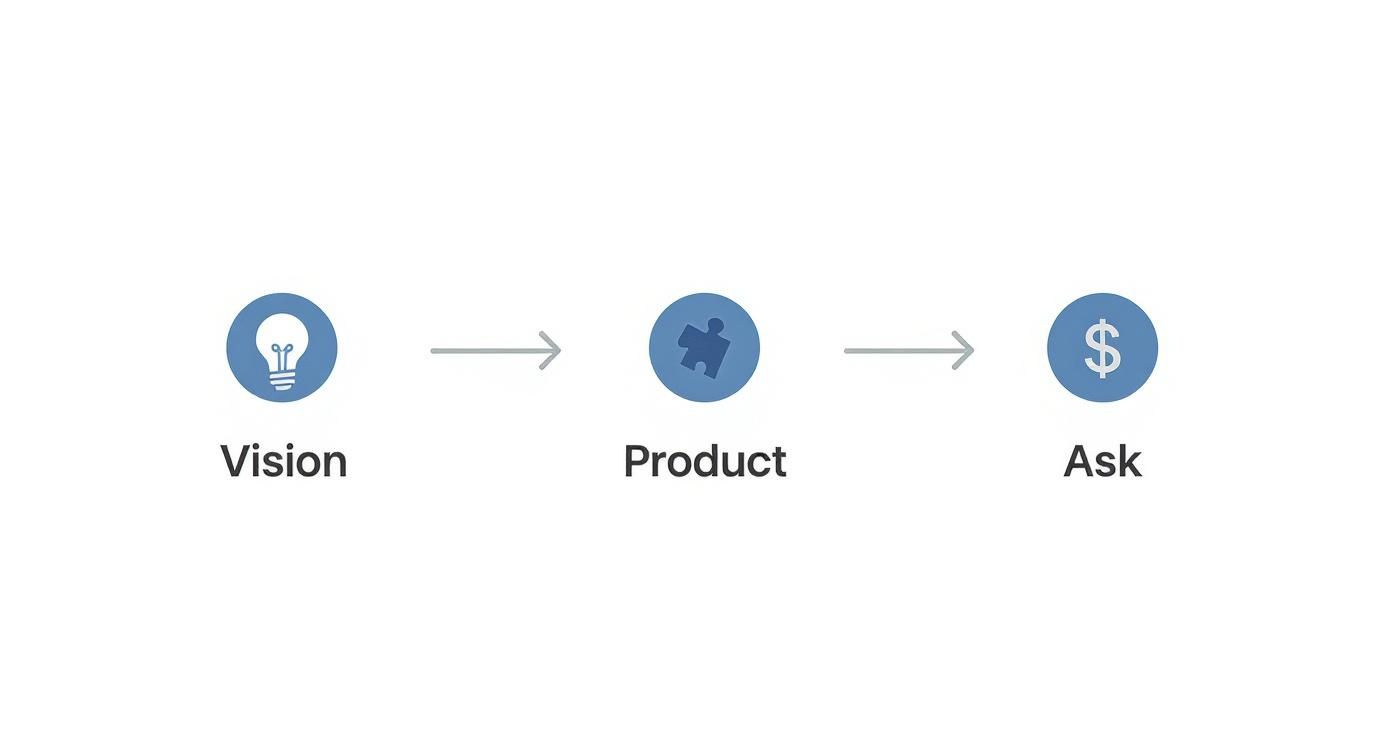
This flow ensures your story holds together. Hook them with the opportunity, then drill down into your product, team, and financials.
The 12 must-have slides for your pitch deck
Investors have a mental checklist. If you miss a key part, it signals you haven’t done your homework. A solid deck has 10 to 15 core slides.
This structure is proven to work. It starts broad to grab interest, then zooms in on the hard details of your business.
Pitch deck slide checklist
| Slide | Purpose | Key question to answer |
|---|---|---|
| 1. Company purpose | A one-sentence summary of your business. | What does your company do? |
| 2. Problem | Describe the pain point your customers face. | Why does this market need you? |
| 3. Solution | Explain how you solve that pain point. | How do you uniquely fix the problem? |
| 4. Why now | Show the market forces making your solution timely. | Why is this the perfect time for your company? |
| 5. Market size | Define your TAM, SAM, and SOM with data. | How big is the opportunity? |
| 6. Product | Show how your product works with visuals. | What have you built? |
| 7. Business model | Explain exactly how you will make money. | How do you generate revenue? |
| 8. Team | Introduce your core team and their expertise. | Why are you the right people to win? |
| 9. Competition | Map out the competitive landscape. | Who are your competitors and what is your advantage? |
| 10. Financials | Provide high-level 3-5 year projections. | What does your path to profitability look like? |
| 11. Traction | Showcase key metrics, growth, and milestones. | What have you accomplished so far? |
| 12. The ask | State how much you’re raising and for what. | How much capital do you need and how will you use it? |
The first two slides – Problem and Solution – are where you win or lose attention.
To nail this opening, see our guide on how to build a problem and solution slide that grabs attention.
Example: The famous Sequoia Capital pitch deck template uses a similar 15-20 slide structure. It covers every critical angle and is a masterclass in hitting the right notes.
Crafting a narrative investors remember
Data gets you in the door. A story gets you the check.
Investors see hundreds of decks. They all have TAM slides and financial projections. What makes them remember your startup? A powerful narrative.
A great story frames your company as the inevitable solution to a real, painful problem.
It’s the difference between "we built an app for renters" and "we’re ending the nightmare of finding a place to live." The first is a feature. The second is a mission.
Start with a powerful hook
You have about 30 seconds to grab an investor’s attention. Don’t waste it with a bland summary.
Start with a relatable problem or a shocking statistic. This creates immediate emotional buy-in. It gets them nodding before they even see your product.
Example: Airbnb’s early deck didn’t open with a platform description. It started with a problem: hotels are expensive and disconnect you from the local culture. A simple, universal pain point.
Create urgency with "why now"
A great idea isn’t enough. Investors need to know why your solution is critical right now.
This slide shows the market shift or tech leap that makes your success probable. It creates urgency and FOMO (fear of missing out).
Consider what’s driving this moment:
- Technological shifts: Has new tech (like generative AI) made your product feasible?
- Market changes: Has a new market segment with unmet needs emerged?
- Regulatory changes: Have new laws opened a previously locked-down industry?
- Behavioral shifts: Are consumers adopting new habits (like remote work)?
Example: The rise of the gig economy and smartphone adoption created the "why now" for Uber. It was the perfect moment for an on-demand ride service.
Make your solution the inevitable climax
After laying out the problem and urgency, your solution should feel like the logical conclusion.
Show exactly how your product solves the pain points you outlined. Use simple language and clear visuals. The investor should think, "Of course, that’s what this market needs."
Example: The classic Uber pitch deck did this well. After highlighting the pains of traditional taxis, their app was the simple and inevitable answer.
Using data to build an undeniable case
Your story creates a spark. Data keeps it from burning out.
VCs hear compelling stories all day. Hard evidence proves your vision isn’t a fantasy. They need to see a clear path from where you are to a massive return on their investment.
Projecting the future realistically
Financial projections are a classic founder trap. Investors know your five-year forecast will be wrong. They are testing your assumptions about growth, costs, and market dynamics.
Your projections need to feel ambitious but grounded. Build your model from the bottom up.
- Customer growth: How many new customers will you acquire each month? What is your conversion rate?
- Revenue per customer: Show your pricing model and average revenue per user (ARPU).
- Key expenses: Be upfront about headcount, marketing spend (CAC), and operating costs.
For a deeper look, our guide on a startup financial projections template gives you steps to build a model investors trust.
Example: Instead of a generic "hockey stick" chart, show the math. To hit $1 million in ARR in year two, you need X customers paying Y price. This shows you’re a rigorous thinker.
Focusing on the metrics that matter
Not all data is equal. The key metrics depend on your business model – SaaS is different from a marketplace.
Presenting the right KPIs shows you get what drives value. According to Visible VC, investors are keenly focused on capital efficiency and sustainable growth. You can read more about what investors looked for in recent seed rounds.
Here are the essentials investors expect:
- Customer acquisition cost (CAC): What does it cost to get a new paying customer?
- Lifetime value (LTV): How much will you make from that customer? A healthy LTV/CAC ratio is 3:1 or higher.
- Monthly recurring revenue (MRR): For subscription businesses, this shows predictable revenue.
- Burn rate: How much cash are you burning each month?
- Gross margin: How profitable is your core product?
Example: A SaaS startup could show a clean bar chart illustrating MRR climbing from $5k to $50k over six months. Next to it, list CAC at $350 and LTV at $1,200, highlighting a healthy 3.4x LTV/CAC ratio.
Designing your deck for clarity not clutter
Great design is about communication. A cluttered deck signals a cluttered mind – a massive red flag.
The goal is a professional, crisp presentation. Your design should make your story and data easy to absorb. Stick to one rule: one core idea per slide.
This approach forces you to be disciplined. It also respects the investor’s time, making the deck scannable in minutes.
Simplify your visual language
You don’t need to be a graphic designer. Focus on the fundamentals of readability and consistency.
- Stick to two fonts at most. Use one for headers and another for body text.
- Use a simple color palette. Two or three brand colors are all you need.
- Embrace whitespace. Negative space guides the eye and stops slides from feeling cramped.
Good design is invisible. If they notice your font choice before your market size, you’ve done it wrong.
Example: Use a clear sans-serif font like Helvetica for your slide titles and a readable serif font like Georgia for short body text. Keep it consistent on every slide.
Use visuals with purpose
Images and charts should support your narrative, not just decorate the slide. Every visual must earn its place.
A well-designed chart showing 20% month-over-month user growth is more powerful than a bullet point stating the same fact.
For founders who aren’t design experts, a professional can help. You can learn how to choose the right pitch deck designers to get the professional polish your deck needs.
Example: Don’t just list your traction numbers. Use a clean bar chart to show MRR growth. The visual impact makes the growth feel more real and impressive.
Adapting your deck for different funding stages
A pitch deck is not one-size-fits-all. The deck that gets a pre-seed check is different from one that closes a Series B.
As your startup grows, investor expectations shift from vision to hard data. Your pitch deck template has to evolve with you. Match your narrative to the questions investors ask at each stage.
Pre-seed and seed stage decks
At the earliest stages, investors bet on you and your idea. Your deck should be lean, visionary, and focused.
Stick to 10-12 slides that are heavy on:
- The problem: Make the pain point feel undeniable.
- The vision: Paint a huge picture of the future you’re building.
- The team: Show why you are the only team who can win this market.
- The market: Prove the opportunity is massive.
Your seed deck is a conversation starter. It gets an investor excited enough to take the next meeting.
Example: A pre-seed deck for a new SaaS tool might have one slide with a product mockup, but three slides on the founding team’s unique industry experience.
Series A and beyond
At Series A, the game changes. The bet is on a business with proven traction. Investors need a data-driven path to scale.
Your deck must add more depth and hard data:
- Traction: Show month-over-month growth in users, revenue (MRR/ARR), and engagement.
- Unit economics: Prove your business model is sustainable. What is your LTV to CAC ratio?
- Go-to-market strategy: Detail your repeatable customer acquisition channels.
- Financials: Present detailed models with clear assumptions backed by historical data.
Successful companies have adapted their decks over time. Your narrative must mature with your company.
Example: A Series A deck should have a dedicated slide for unit economics. Show a clear chart illustrating how your CAC has decreased over time while LTV has remained stable or increased.
Common pitch deck mistakes that guarantee a no
Play videoA winning pitch deck template for startups videoThis loads content from YouTube.
Knowing what to put in your deck is half the battle. Knowing what to leave out is just as important.
Many founders trip over simple, avoidable mistakes. These are red flags that get your deck sent to the trash.
Unrealistic or sloppy financials
This is the fastest way to lose credibility. If your slide shows $100 million in revenue by year three with zero marketing spend, you won’t get a callback.
Investors know your forecast is a guess. But your assumptions must be grounded in reality. Show your work – customer acquisition costs, conversion rates, and churn.
Example: Instead of just showing a revenue goal, list the key assumptions: "We project reaching $5M ARR by Year 3 based on a $250 CAC, a 2% monthly churn rate, and an ACV of $5,000."
A vague or inflated market size
Claiming a "$1 trillion market" is an instant eye-roll for any VC. It shows a lack of focus.
Investors want a smart, bottom-up analysis. Start with your specific customer and build from there.
- How many target customers exist?
- How much would they realistically pay?
- What’s an achievable slice of that market?
This proves you have a real go-to-market plan.
Example: Don’t say "the global software market is $600B." Instead, say: "Our target is US-based SMBs with 10-50 employees. There are 500,000 such companies. At our price point, this represents a $2.5B SAM."
Ignoring or downplaying competition
"We have no competitors" is the single biggest red flag. It means you haven’t done your homework.
A strong competitive analysis shows you get the landscape and have a defensible edge. Show how you are different on the things customers care about.
Acknowledging competition signals confidence.
Example: Use a 2×2 matrix. Plot your company and competitors based on two key value propositions, like "Ease of Use" vs. "Enterprise-Ready." This visually shows where you win.
Ready to build a deck that gets you funded? Pitchili combines VC insight with world-class design to craft a narrative that converts investor attention into term sheets. Get your pitch funded.
FAQ
How long should a pitch deck be?
Keep it to 10-15 core slides. Your first deck is a teaser. Its job is to get a meeting, not close the round. An investor needs to get the gist of your business in under five minutes.
What’s the most important slide in a pitch deck?
The Team slide and the Problem slide. The Problem slide proves you’re tackling a real, painful issue. The Team slide shows you’ve got the right people to pull it off. Early-stage investors bet on you as much as the idea. An A+ team with a B+ idea is more fundable than the reverse.
Should I put financials in my first deck?
Yes, but keep them high-level. A 3-5 year forecast is standard. Investors know the numbers will change. They want to see that you’ve thought critically about how your business makes money. Show your key assumptions – what drives revenue and what are the major costs.
Is it okay to use a generic online pitch deck template?
Yes. A proven template from sources like Sequoia Capital or Airbnb is a great place to start. But never just copy and paste. Use the template as a skeleton. Customize every slide to fit your unique story, brand, and data. Your narrative makes a deck memorable, not the template.
