
Finding the right VC is a process, not a lottery. It comes down to three moves: define your ideal investor, build a focused list, and get a warm intro. This guide gives you a practical framework to find partners who are a genuine fit for your startup.
1. Create an investor thesis before you build a list
Stop the spray-and-pray. The fastest way to waste a year is pitching VCs who would never invest in a company like yours.
Before building a list, create an investor thesis. This is a clear profile of the exact type of investor who is a perfect match for your startup.
An investor thesis isn’t just about finding a checkbook. It’s about finding the right partner – someone who gets your vision, your market, and your stage. Without this focus, you’re just another email in an overflowing inbox.
Define your ideal partner criteria
Start by narrowing the field. Your goal is to create a filter that instantly qualifies or disqualifies firms. This stops you from chasing misaligned investors.
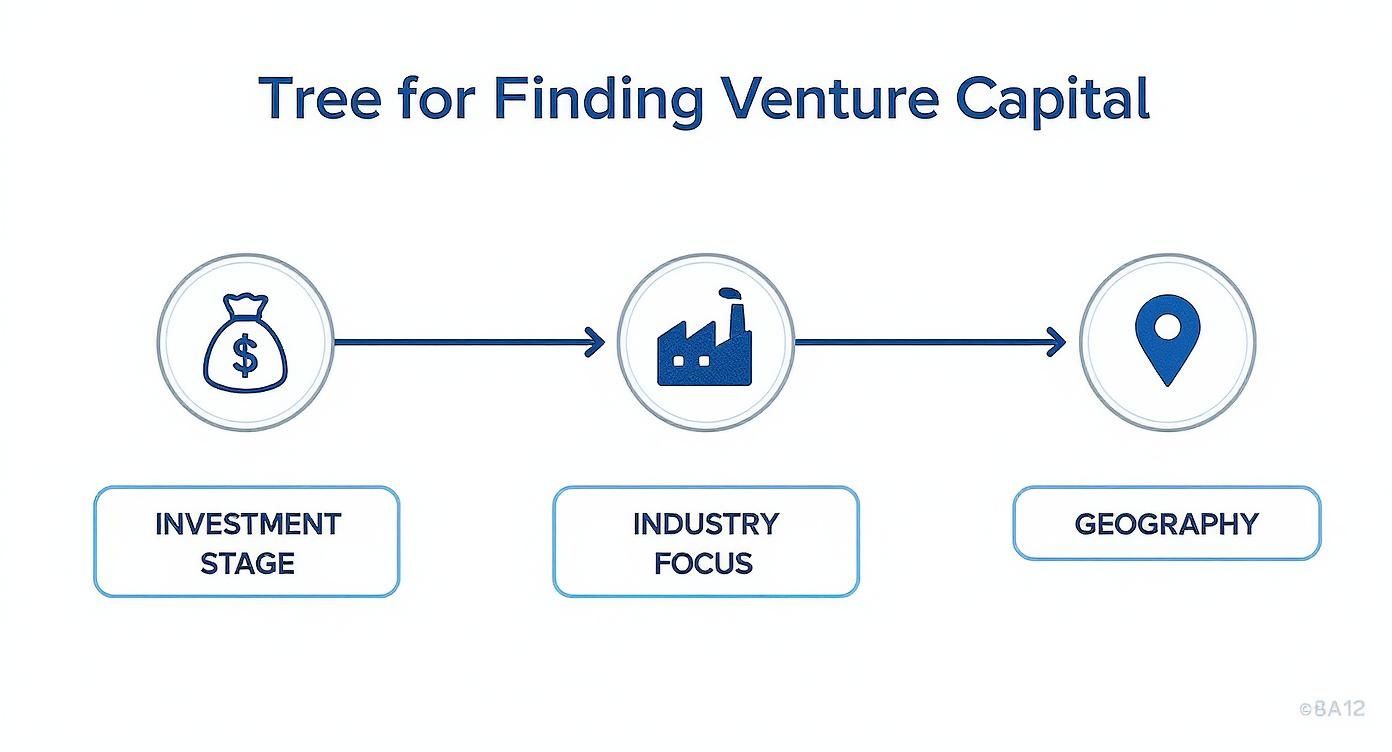
Focus on these key pillars:
- Investment stage: Are you raising a pre-seed, seed, or Series A round? A firm that writes $10M checks for Series B companies won’t look at your $500k pre-seed deck.
- Industry focus: Does the VC specialize in your world? A SaaS-focused fund rarely touches deep tech. Look for partners whose portfolio proves they understand your industry.
- Geographic focus: Many VCs prefer to invest locally for easier board access. Check if they have a mandate for the US, EU, or a specific state.
Write these criteria down. This simple framework becomes your guide for the entire process. It ensures every outreach has a real shot. With this clarity, you can build startup financial projections that speak to their strategy.
Example:
- Stage: Seed
- Check size: $500k – $1.5M
- Industry: B2B SaaS (fintech vertical)
- Geography: US-based, remote-friendly
2. Map the VC landscape with data-driven research
Once you have your thesis, you can build a smart, targeted list of investors. The goal is to find VCs with a track record of backing companies like yours.
Data platforms are your best friend here. Tools like Crunchbase, PitchBook, and Signal NFX turn a chaotic search into a structured process. Start by looking for VCs who invested in your competitors or similar companies. That’s the strongest signal of interest.
Use data to find active investors
Don’t waste time on firms that aren’t actively deploying capital. You need to focus on investors writing checks now.
Venture capital is always in motion. For example, recent global VC funding trends show a massive concentration in AI, with some quarters hitting over $60 billion. Staying on top of these trends is non-negotiable.
Platforms like Crunchbase are perfect for tracking these movements in real time.
This screenshot from Crunchbase News shows how you can monitor funding announcements. It gives you a direct line of sight into which sectors are attracting capital today.
VC research tool comparison
| Tool | Best For | Key Feature | Price Point |
|---|---|---|---|
| Crunchbase | Early-stage startups & tracking funding news | Real-time funding alerts & company profiles | Freemium, Pro starts at $49/mo |
| PitchBook | Deep-dive financial data & PE/VC analysis | Detailed financials & proprietary research | Enterprise (request quote) |
| Signal NFX | Mapping warm intro paths & founder networks | Visualizing connections to investors | Free (by application) |
| Dealroom | European market intelligence & ecosystem data | Strong focus on international tech hubs | Freemium, custom pricing |
Example: A founder uses Crunchbase to find three VCs who recently led seed rounds for AI-powered SaaS companies in the US. This is a direct match for their thesis.
3. Engineer warm intros that VCs can’t ignore
A warm introduction is your most powerful tool. It’s not just about skipping the line. It’s about borrowing credibility from someone the investor already trusts.
Cold emails are a numbers game with terrible odds. An intro from a respected source signals you’re worth their time before they even see your deck.
Map your path to an introduction
You are more connected than you think. Map your connections strategically instead of blasting your network with blind requests.
Use LinkedIn. Once you identify target investors, look for shared connections. A second-degree connection is the sweet spot.
Prioritize your outreach like this:
- Advisors and mentors: They have a vested interest in your success.
- Fellow founders: Founders who have raised capital get it. They are often happy to pay it forward.
- Early employees or colleagues: You never know who from a past job has a crucial connection.
Reach out to portfolio founders
Here is an effective but underused strategy: connect with the founders of a VC’s portfolio companies.
An endorsement from them is pure gold. They have already been vetted and funded by your target investor.
But don’t just ask for an intro. Show genuine interest in their work first.
- "Hi [Founder Name], I’m the founder of [Your Company] and I’ve been following [Their Company]’s progress. I admire how you solved [Specific Problem]. Would you have 15 minutes to share any insights?"
This approach builds a relationship. Once you establish rapport, then you can ask for an introduction. You’ve just turned a cold ask into a warm referral. Make sure you have an exceptional pitch deck design ready.
Example: You find a mutual connection on LinkedIn to a partner at a target VC firm. You ask for a "double opt-in" intro, making it easy for both parties to accept or decline gracefully.
4. Tap into VC ecosystems, online and off

Venture capital is clustered in specific cities and online communities. To get funded, you need to be in the flow of that capital and conversation.
Location still matters. The US recently captured over 50% of global VC funding, according to some global venture capital outlook trends.
But you can plug into these ecosystems from anywhere. Follow local VCs on X (formerly Twitter). Tune into virtual demo days. Build bridges with founders in key regions. The goal is to be present and build your network.
Find VCs where they actually hang out online
Today, some of the best deal flow happens in niche online corners. VCs are lurking where the sharpest founders and experts are.
Get on their radar by becoming a value-adding member of these communities.
- Niche Slack and Discord channels: Are you in SaaS or fintech? There’s a community for that. Jump into discussions and answer questions. VCs are often silent observers.
- Industry forums and subreddits: Places like Hacker News are hotspots for real tech talk. Sharing your progress can catch an investor’s eye.
- X (formerly Twitter): Many VCs are active on X. They share investment theses and source deals. Follow them, interact, and share your own journey.
Don’t just show up to ask for money. Become a known entity by contributing valuable insights first.
Example: You consistently answer questions about API security in a developer-focused Slack channel. An associate from a cyber-focused VC firm who is in that channel notices your expertise and reaches out.
5. Evaluate corporate venture capital arms
Play videoHow to find venture capitalists: A founder’s guide videoThis loads content from YouTube.
Don’t just chase the usual suspects. Corporate Venture Capital (CVC) arms – think Google Ventures or Salesforce Ventures – offer more than a check. They bring strategic value, industry connections, and powerful distribution channels.
But CVCs are a different breed. Their goals are twofold: generate financial returns and support the parent corporation’s strategy. This can be a massive advantage, but it can also come with strings attached.
Weigh the strategic benefits and risks
Understand this unique dynamic before approaching a CVC. The upsides are clear, but the downsides need a hard look.
- Benefit – market access: A CVC can open doors to partnerships and customers inside its parent company.
- Risk – slower decisions: Corporate investors often have more bureaucracy, leading to longer due diligence.
- Benefit – deep expertise: You get a partner with insider knowledge of your industry.
- Risk – acquisition conflicts: Your CVC partner could one day be a potential acquirer. This might complicate future fundraising. Be sure you know what is a term sheet.
CVCs can be a powerful source of strategic capital. SVB’s State of CVC report offers broader context on corporate venture activity.
Align your pitch with their corporate strategy. Show them how your tech helps their parent company win.
Example: A logistics startup pitches the CVC of a major shipping company. The pitch focuses not just on ROI, but on how their tech can reduce the parent company’s fuel costs by 15%.
Common questions about finding VCs
Fundraising can feel like a black box. Here are straight answers to the questions we hear most from founders.
How many vcs should i realistically target?
Chasing hundreds of investors leads to burnout and sloppy outreach. Quality beats quantity.
A tiered list of 50–75 VCs is the sweet spot. It’s big enough for a real shot but small enough to personalize every interaction.
Break your list down to stay focused:
- Tier 1 (10-15 VCs): Your dream partners. Perfect portfolio, sharp expertise. Every outreach needs deep personalization and a warm intro.
- Tier 2 (20-30 VCs): Strong strategic fit. They check most boxes. Warm intros are the goal, but a meticulous cold email can work.
- Tier 3 (20-30 VCs): Solid-fit VCs. They align on stage and sector. This tier is great for building momentum and getting feedback.
How should I handle a 'no' from an investor?
Get comfortable with "no." You will hear it more than "yes." Handle it with grace and turn it into something productive.
When an investor passes, stay professional. Don’t argue. Thank them for their time and ask one simple question:
"Thanks for the candid feedback. Is there anyone else in your network who you think might be a better fit for what we’re building?"
This signals you are coachable and resilient. It can also flip a rejection into a high-quality referral.
When is the right time to start fundraising?
The best time to start is 6-9 months before you need the cash. A full fundraising cycle takes time – from outreach to due diligence to wiring funds.
Don’t wait until you have two months of runway. Desperation is a terrible look.
A smarter approach is building relationships with Tier 1 investors before you ask for a check. Send quarterly updates and share big wins. This "pre-fundraising" warms them up, so you’re not starting from zero.
Finding the right VC is the first step. Telling a story they can’t ignore is the next. At Pitchili, we build pitch decks that get you from outreach to term sheet. See how we can help you get funded at /.
