
You got a term sheet. Now what?
Getting an offer from a VC is a huge milestone. But the excitement fades fast when you face a document full of dense legal jargon. This is normal.
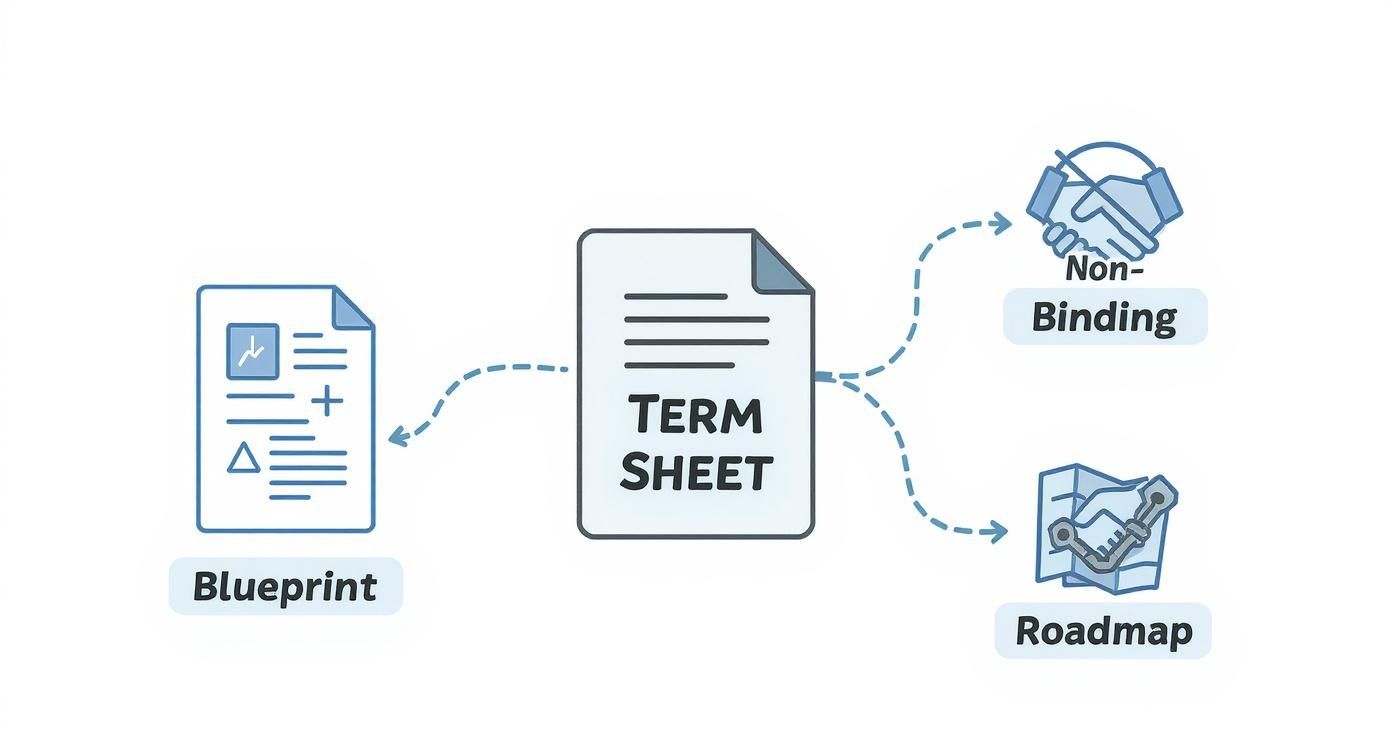
A term sheet is a non-binding agreement. It outlines the core terms of an investment deal. Think of it as an engagement before the marriage – a way to agree on the big picture before paying lawyers to draft final contracts.
This guide breaks down what a term sheet is, what terms matter most, and how to negotiate a deal that sets you up to win.
What’s in a term sheet?
A term sheet aligns founders and investors on the deal’s framework. It covers the economics, governance, and other key rules of the partnership.
Term sheet: what it is vs. what it isn’t
Here’s a simple breakdown of the document’s purpose.
| What it is | What it isn’t |
|---|---|
| A high-level outline of the deal’s core terms. | A legally binding contract (with a few exceptions). |
| A tool to align founders and VCs early. | The final, exhaustive set of investment documents. |
| The foundation for formal legal paperwork. | A guaranteed promise of funding. |
| A way to save time and legal fees. | Something to sign without careful review. |
Why it’s mostly non-binding
A term sheet’s main job is to create a shared understanding, not to be legally enforceable. But two clauses are always binding and require your full attention.
- Confidentiality: You cannot share the deal’s details with other potential investors or the public.
- No-shop / exclusivity: This gives the investor an exclusive negotiation period, usually 30-60 days. During this time, you cannot seek or accept offers from other VCs.
The median time from signing a term sheet to closing a deal is about 30–45 days in the US and Europe.
A term sheet is different from earlier fundraising tools. Our guide on convertible notes explains how they work for unpriced seed rounds. A term sheet kicks off a priced equity round.
Decoding the economic terms
Economic terms define the financial mechanics of the deal. They determine your company’s valuation and how the proceeds are split at a future exit. Getting these right protects your equity.
Valuation
Valuation is the price investors place on your startup. It directly sets how much equity you give away for their investment. You will see two key numbers:
- Pre-money valuation: Your company’s worth before the investment.
- Post-money valuation: The pre-money valuation plus the new investment amount.
The median pre-money valuation for US Series A deals was around $45 million in Q1 2024, with founders typically selling 15–25% of their company. Our startup financial projections template can help you build a data-backed case for your valuation.
Example: An investor offers $2 million at an $8 million pre-money valuation. Your post-money valuation becomes $10 million. The investor now owns 20% of your company ($2M is 20% of $10M).
Liquidation preference
Liquidation preference is an investor’s downside protection. It dictates who gets paid first – and how much – when the company is sold or liquidated.
The most common type is 1x non-participating preferred stock.
"1x" means investors get their original investment back before common stockholders (founders, employees) receive anything. After they are paid, the remaining funds are distributed among common stockholders.
Example: An investor puts in $2 million. You later sell the company for $5 million. With a 1x preference, the investor gets their $2 million back first. The remaining $3 million is divided among you and your team.
Employee option pool
Investors will require you to create or expand an employee stock option pool (ESOP). This is a block of equity used to attract and retain key talent.
Investors will insist this pool be created based on the pre-money valuation.
This means the dilution from the option pool comes from existing shareholders – you and your co-founders. A typical option pool is 10–20% of the company’s post-financing equity.
Example: Your company has an $8 million pre-money valuation. The investor wants a 15% option pool. That 15% is calculated from the $8M valuation before their money comes in. This effectively lowers your valuation and increases your dilution.
Understanding the control terms
Control terms define who makes key decisions. These clauses shape your relationship with investors long after the deal closes. Understanding them is critical to protecting your vision.
Board composition
The board of directors holds the ultimate authority. They can hire and fire the CEO, approve budgets, and set strategy. The term sheet specifies who gets a board seat.
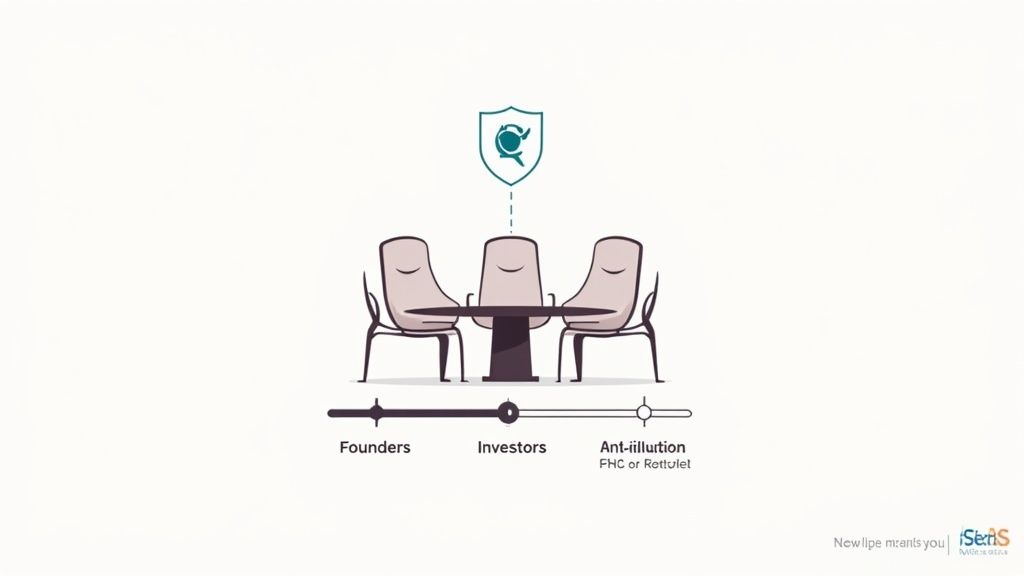
A typical early-stage board has three or five members:
- Founder seats: One or two seats for the founding team.
- Investor seat: The lead investor will take one seat.
- Independent seat: An outside expert, mutually agreed upon by founders and investors.
Recent surveys show 85% of deals include board seats for lead investors. This structure balances founder vision with investor oversight.
Example: A term sheet proposes a three-person board: one founder, one investor, and one independent member. This structure forces collaboration, as neither side has majority control.
Protective provisions
Protective provisions give investors veto power over specific corporate actions, even without a board majority. This is their safety net against decisions that could harm their investment.
Standard provisions cover major events like:
- Selling or merging the company.
- Issuing new shares that rank higher than theirs.
- Changing the board size.
- Taking on significant debt.
Review this list carefully. Overly restrictive provisions can slow your company down by requiring investor approval for routine operational decisions.
Example: You receive an acquisition offer. The founders love it, but the price is below the investor’s expectations. Protective provisions allow the investor to veto the sale.
Anti-dilution protection
Anti-dilution clauses protect investors if your next funding round is at a lower valuation (a "down round"). There are two main types.
- Broad-based weighted average: This is the common, founder-friendly method. It adjusts the conversion price of preferred shares based on the size and price of the new round, resulting in moderate founder dilution.
- Full ratchet: This is a harsh, rare clause. It reprices all of the investor’s shares to the new, lower price. This causes massive dilution for founders.
Always push for a broad-based weighted average formula.
Example: An investor buys shares at $1.00 each. In a down round, new shares sell for $0.50. With a full ratchet, the investor’s original shares are all repriced to $0.50, effectively doubling their share count at your expense.
The fine print founders often miss
Some of the most impactful clauses are hidden in the details. These terms dictate founder obligations and investor rights. Ignoring them is a common mistake that can limit your flexibility later.
Founder vesting
Investors are betting on you. Founder vesting ensures you are committed for the long term. Your existing shares will be put on a new vesting schedule.
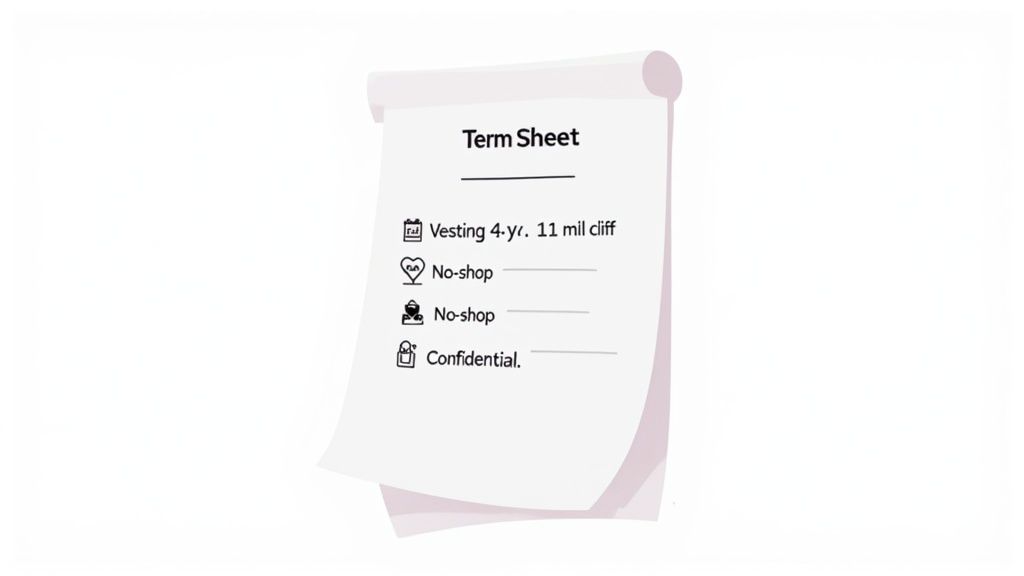
The standard structure is:
- A four-year vesting period.
- A one-year cliff: You get 0% of your shares until you complete one year of service post-funding. On your first anniversary, 25% of your stock vests. The rest vests monthly after that.
This protects the company if a co-founder leaves early.
Example: A co-founder leaves six months after closing your round. With a one-year cliff, they leave with no vested shares. The company reclaims their unvested equity.
Information and pro rata rights
These two rights give investors a view into your progress and the option to increase their investment.
Information rights
This clause defines your reporting obligations. You must provide investors with regular updates, including:
- Annual audited financial statements.
- Quarterly unaudited financials.
- An annual budget.
Good investors use this information to offer help and make introductions.
Pro rata rights
This gives investors the option to maintain their ownership percentage by investing in future funding rounds. It is their right to avoid being diluted by new investors.
Example: An investor owns 15% after your Series A. Their pro rata right allows them to invest enough in the Series B to maintain that 15% stake.
A simple term sheet negotiation checklist
Negotiation is a test of your future partnership. The goal is a fair deal that helps everyone win. Treat it as a collaborative puzzle, not a battle. This checklist provides a simple framework to track the key terms.
Term sheet negotiation checklist
| Term | Founder-friendly | Investor-friendly |
|---|---|---|
| Valuation | Higher pre-money valuation to reduce founder dilution. | Lower pre-money valuation to increase ownership stake. |
| Liquidation preference | 1x non-participating. Aligns founder and investor interests. | Participating preferred or a multiple >1x to de-risk the investment. |
| Board composition | A founder-majority board, or at least equal representation. | A board seat for the lead investor to have oversight. |
| Option pool | A smaller pool (e.g., 10%) to reduce pre-money dilution. | A larger pool (e.g., 20%) to cover future hires. |
| Protective provisions | Vetoes limited to major events (e.g., selling the company). | Broad veto rights over operational and financing decisions. |
| Anti-dilution | Broad-based weighted average. The market standard. | Full ratchet. Harsh on founders and rarely used. |
How to negotiate the deal
- Prioritize your asks. Decide on your must-haves, nice-to-haves, and giveaways. You can’t win on every point, so focus on what matters most.
- Create leverage. The best leverage is having another offer. If you don’t, use data. Know the market standards for your stage and sector.
- Negotiate the package, not the points. Don’t get stuck on one term. Treat the deal as a whole. You can trade a concession on one point for a gain on another.
- Hire a great lawyer. An experienced startup lawyer has seen hundreds of deals. They know what’s standard and can protect you from long-term risks.
After securing your first priced round, you’ll need a solid strategy for finding future investors. Our guide on how to find investors can help you build a repeatable fundraising process.
A great pitch deck is what gets you to the term sheet. At Pitchili, we use VC insight and data-driven design to build decks that get deals done. Let’s build your story together.
