
Running a startup means your time is gold. You don’t have time for vague theories-you need answers that work. So, how many slides should you have for a 15-minute presentation?
For a 15-minute window, the magic number is 10 to 15 slides.

This range isn’t a guess. A 2023 Visme study found the average 15-minute talk has 13 slides. Presentations in that 10-15 slide sweet spot also have a 23% higher audience retention rate than decks with over 20 slides.
Less is more. This proves you can keep your audience locked in without overwhelming them.
Why this number works
Sticking to 10-15 slides creates a perfect balance between information and pacing. It gives you enough canvas to tell a compelling story but forces you to be disciplined.
Each slide becomes a visual anchor for one key idea, not a teleprompter you read from.
This structure is the bedrock of a great pitch deck. It forces you to distill your message down to what is essential. That clarity is what investors and stakeholders want.
Example: the 90-second rule
Aim for one core idea per slide. If you’re talking for more than 90 seconds on a single slide, that’s a red flag. It means you’ve crammed too much in. Break that topic into two slides to keep your story moving.
Recommended slide counts for different goals
Not all 15-minute presentations are the same. A pitch to VCs has a different goal than a talk at an industry conference.
Use this quick reference to tailor your slide count to the room you’re in.
Presentation slide count table
| Presentation type | Recommended slide count | Average time per slide | Primary goal |
|---|---|---|---|
| Investor pitch | 10–12 slides | 75–90 seconds | Secure a follow-up meeting by creating interest and demonstrating value. |
| Conference talk | 8–10 slides | 90–120 seconds | Educate and inspire the audience with high-impact visuals and minimal text. |
| Sales demo | 12–15 slides | 60–75 seconds | Guide a potential customer through a product’s features and benefits. |
| Internal update | 10–15 slides | 60–90 seconds | Inform the team about project progress, metrics, and next steps clearly. |
Think of these as starting points. The key is to match your slide count to your goal. Ensure every minute you have is spent building conviction.
The 10-20-30 rule: your pitch’s secret weapon
Let’s talk about a framework that’s saved countless founders: Guy Kawasaki’s 10-20-30 rule. This isn’t a theory-it’s a battle-tested model from a VC who has seen thousands of pitches.
The rule is simple: 10 slides, 20 minutes, and a 30-point font. For your 15-minute slot, that first part-the 10 slides-is pure gold.
This isn’t about being lazy; it’s about being disciplined. The 10-slide limit is a powerful constraint. It forces you to cut the fluff and get straight to the point.
Founders are catching on. One survey of 200 startups found that 78% used 10 or fewer slides for their 15-minute investor pitches. If you want to dive deeper, check out this in-depth article on presentation structure.
Why 10 slides force you to be clear
The 10-slide limit is a psychological hack. It forces you to confront the core of your business. You don’t have the runway to meander through non-essential details.
Think of each slide as a chapter in a short story. Ask yourself:
- What is the one, most important message for this chapter?
- Does this slide directly answer a question an investor will have?
- Can I explain everything on this slide in under two minutes?
If the answer to any of those is "no," that content doesn’t belong. This discipline separates a rambling presentation from a compelling story.
The hidden genius of a 30-point font
Now for the second part of the rule: a minimum 30-point font. This sounds like a minor design choice. But it’s a functional constraint that prevents the most common presentation mistake: cramming slides with too much text.
Using a big font physically limits how many words you can fit. It forces you to be brief and punchy. Your audience should be listening to you, not squinting at dense paragraphs.
The 30-point font rule does three things:
- Makes it readable: Ensures your message is clear, even in the back of the room.
- Forces conciseness: You use keywords and short phrases instead of long sentences.
- Keeps the focus on you: The slides support your story, they don’t become the story.
Structuring your 10-slide investor pitch
An investor pitch isn’t just a presentation. It’s a story you tell to get your company funded. The 10-slide model is the gold standard because it forces you to be disciplined and compelling.
This structure works because it answers the questions in every investor’s head. From "Is this a real problem?" to "Can this team pull it off?" A recent study found that 72% of professionals do exactly that for their 15-minute presentations.

The blueprint for a winning deck
Every slide has one job. Guide the investor from one point to the next, building conviction with every click. Resist the temptation to cram in extra details.
For a deeper look, check our guide on how to make a pitch deck that converts.
Here’s the slide-by-slide breakdown:
- Slide 1: The problem. Start with the pain. Who are you solving this for? Make it feel urgent.
- Slide 2: Your solution. Introduce your product as the obvious answer to that pain. In simple terms, what is it and how does it work?
- Slide 3: The product. Show, don’t just tell. Use mockups or screenshots to bring your product to life.
- Slide 4: Market size. Show investors the size of the prize. Define your TAM, SAM, and SOM to prove the opportunity is massive.
- Slide 5: Business model. How will you make money? Get specific about pricing and revenue streams.
- Slide 6: Go-to-market strategy. What’s your plan to find and win customers? Lay out your marketing and sales channels.
- Slide 7: Your team. Why are you the only people who can build this? Highlight relevant experience.
- Slide 8: Financials. Share your key projections for the next 3-5 years. Stick to the high points: revenue, key metrics, and assumptions.
- Slide 9: The competition. Acknowledge competitors, then pivot to your unique advantage. What’s your "moat"?
- Slide 10: The ask. Be direct. State how much you’re raising and what you’ll spend it on.
Example: the narrative arc
An investor pitch is a story – backed by data. Your job is to make them believe in the protagonist (your company), feel the urgency of the conflict (the problem), and see the successful ending (the ROI).
Adapting your slide count for different scenarios
Not all 15-minute presentations are built for VCs. The number of slides you need changes based on who is in the room.
The biggest mistake founders make is forcing one generic deck to do every job. A conference crowd wants big-picture insights. Your internal team needs granular data.
Knowing how many slides to use for a 15-minute presentation in each context is key.
Technical demos: more slides, more detail
When you’re running a technical demo, your job is to show, not just tell. This is one of the few times where using more slides is better.
Use 15 to 20 slides for a 15-minute demo. Think of each slide as a single, clear step in the user’s journey.
- Slides 1-3: The setup. Restate the problem and introduce the feature.
- Slides 4-15: The walkthrough. Use clean screenshots or short GIFs showing a single action.
- Slides 16-20: The payoff. Summarize benefits, show pricing, and give a clear call to action.
Conference talks: fewer slides, bigger impact
For a conference talk, the rules flip. Your goal is to educate and inspire, not get lost in the weeds.
Your slide count should be lean-think 8 to 10 slides at most. This forces you to focus on big, memorable ideas supported by powerful visuals.
Your slides are the backdrop to your story, not the story itself. If you are looking for a foundational structure, our guide to the ultimate pitch deck template for startups offers a solid starting point.
Common mistakes that undermine a presentation
Nailing the right slide count is just the start. Even a perfectly structured 10-slide deck can tank if your delivery is off.
The most common mistakes are subtle errors that quietly kill your credibility. The good news is they are all avoidable.
Cramming too much text on one slide
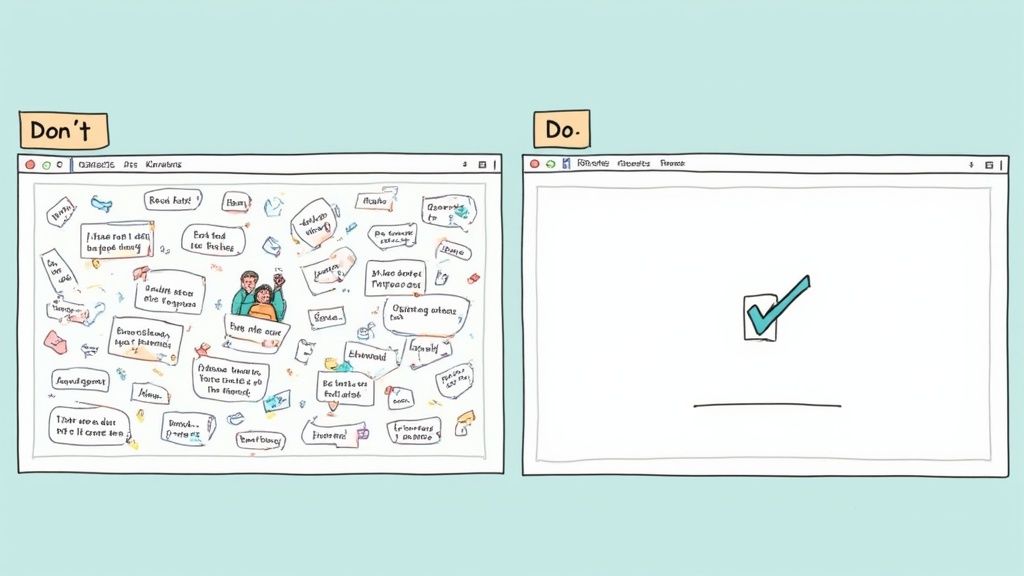
This is the cardinal sin of presentations. Your slides are billboards, not book pages. The moment your audience has to read, they’ve stopped listening to you.
- What not to do: Packing a slide with five long bullet points, each a full sentence.
- What to do instead: Use a single image and a one-line heading. Or, limit yourself to three to five words per bullet.
Reading directly from your slides
Your slides are a visual aid, not a teleprompter. Reading them word-for-word screams a lack of confidence. Investors fund founders, not slides.
- What not to do: Turning your back to the room to read a sentence off the screen.
- What to do instead: Treat your slides as cues. Make eye contact and talk to the people in the room.
Ignoring the narrative flow
A great pitch is a story. It has a beginning, a middle, and an end. Treating each slide as an isolated piece of information leaves the audience to connect the dots.
- What not to do: Jumping from your team slide to financials and then back to market size.
- What to do instead: Follow a proven structure, like the 10-slide model. Use transition phrases to bridge the gap between slides.
Neglecting visual design and branding
A sloppy, inconsistent deck makes your venture look amateurish. Mismatched fonts, clashing colors, or low-res images distract from your message.
- What not to do: Using default PowerPoint templates with pixelated logos.
- What to do instead: Create a simple, clean template with your brand’s colors and fonts. A well-designed deck communicates professionalism.
How to rehearse for perfect timing
A great presentation looks effortless. That smooth delivery isn’t luck; it’s the result of practice. Nailing your timing means internalizing your story so the slides become your guide, not a crutch.
Effective practice isn’t about memorization. It’s about building muscle memory for your narrative.
Adopt the module rehearsal method
Don’t just practice your entire deck from start to finish. Instead, break it down. Treat each slide as a standalone module.
For each slide, set a timer for your target duration-usually 60 to 90 seconds. Practice delivering the content for that one slide until you can hit your key points clearly.
Conduct a full dress rehearsal
A full dress rehearsal is non-negotiable. This is your final exam. Run through the entire presentation exactly as you will on the day of the pitch.
Here’s what a proper dress rehearsal involves:
- Use a timer: Start a stopwatch and let it run, no matter what.
- Find a test audience: Present to one or two people who can give you honest feedback.
- Record yourself: Set up your phone and record the session. Watching yourself back is painful but valuable.
Example: a simple rehearsal schedule
Don’t leave practice to the last minute. Knowing how many slides you need for a 15-minute presentation is step one; mastering the delivery is step two.
- Day 1-2: Module practice. Focus on mastering slides 1-5, then 6-10. Time each one.
- Day 3: Section run-throughs. Practice the first half and the second half as complete sections.
- Day 4: First full run-through. Do a complete, timed run-through by yourself. Record it.
- Day 5: Dress rehearsal. Present to your test audience. Get direct feedback.
- Day 6: Final polish. Do one last timed run-through to solidify your flow.
- Day 7: Rest. Don’t over-rehearse. Trust your preparation
Ready to build a presentation that wins funding? The team at Pitchili combines VC-side experience with world-class design to create pitch decks that get results.
Learn more about our pitch deck design services
FAQ
How much time should I leave for Q&A in a 15-minute slot?
Aim for a 12-minute presentation. This leaves you a solid 3-minute buffer for Q&A. It signals confidence and shows you’re ready for a real conversation. If you run right up to the 15-minute mark, just say, "I know we’re at time, but I’m happy to stay for a few questions."
What’s the best way to handle an unexpected interruption?
Interruptions are inevitable. Stay cool and guide the conversation back to your narrative. Acknowledge: "Great question. Let me give you the short answer now, and we can dive deeper after." Answer: Address their point concisely. For example, "Our CAC is currently $150, which I cover on our go-to-market slide." Redirect: Smoothly get back on track. "On that note, let’s look at how we acquire those customers..."
Should I send my deck beforehand?
No, unless they specifically ask for it. When you send your deck in advance, you give up control of the narrative. You lose the chance to tell your story with passion and context. If they insist, send a "teaser" version-a shorter, high-level deck that builds curiosity.
What if my presentation has a lot of data?
Your job isn’t to be a human spreadsheet. It’s to deliver insights. Use your slides to showcase the single most important takeaway. Stick everything else in an appendix. On-screen: Show a graph of your user growth. The headline should be the takeaway: "25% MoM user growth for 6 straight months." In your appendix: Keep detailed slides ready with raw numbers and cohort analysis for deep-dive questions. This approach keeps your presentation punchy while showing you know your numbers cold.
