
A pitch deck is a short presentation, usually 10-15 slides, that gives investors a high-level overview of your business. It answers one question: Why should I invest in your company?
Its sole purpose is to get you the next meeting. Investors see hundreds of decks. Yours has to cut through the noise with a powerful story backed by solid data.
This isn’t a story for your customers. It’s for investors. They need to quickly grasp the problem you’re solving, why your solution is unique, and how you’ll turn their capital into a big return. It’s the most important tool in your fundraising toolkit.
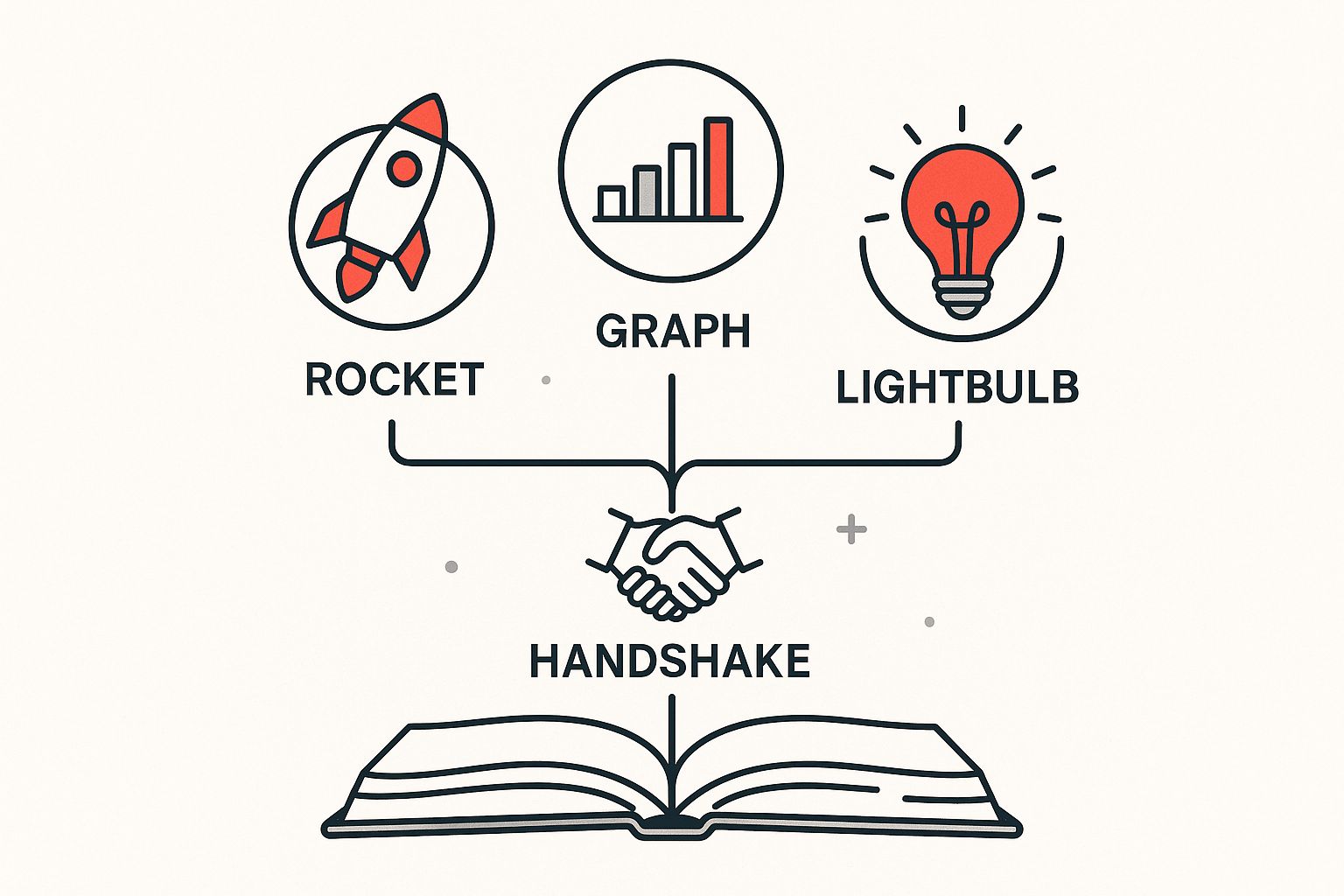
A great pitch deck weaves together your idea, a clear growth path, a smart launch strategy, and the partnership you’re offering. It turns these elements into a persuasive argument for why your startup is the one to bet on.
The goal is a narrative so clear that investors have to learn more. Let’s break down the essential slides.
Pitch Deck Checklist
Use this checklist to ensure your deck covers the core elements investors expect to see.
| Section | Slide Included? | Key Question Answered? |
|---|---|---|
| 1. Vision | ☐ | What does your company do in one sentence? |
| 2. Problem | ☐ | What painful problem are you solving? |
| 3. Solution | ☐ | How does your product solve it? |
| 4. Market Size | ☐ | Is this a massive opportunity? |
| 5. Business Model | ☐ | How do you make money? |
| 6. Team | ☐ | Why are you the right people to win? |
| 7. The Ask | ☐ | How much are you raising and what for? |
Get these right, and you’re not just asking for money—you’re inviting investors on a journey.
The 10 Essential Slides Every Pitch Deck Needs

Investors don’t read pitch decks; they scan them. They expect a logical flow that takes them from a problem they recognize to an opportunity they can’t ignore.
Think of these 10 slides as the non-negotiable chapters. While the details are yours, the structure is standard. It turns a scattered idea into a compelling investment case.
Anatomy of a Winning Pitch Deck
| Slide Number | Slide Title | Core Purpose |
|---|---|---|
| 1 | Vision / Hook | Grab attention instantly with a single, powerful sentence. |
| 2 | The Problem | Make the investor feel the customer’s pain. |
| 3 | The Solution | Present your product as the clear, elegant answer. |
| 4 | Why Now? | Create urgency. Why is this the moment? |
| 5 | Market Size | Prove the opportunity is massive. |
| 6 | Competition | Show you understand the landscape and have a unique edge. |
| 7 | Product / Demo | Give a tangible glimpse of your product in action. |
| 8 | Business Model | Explain exactly how you make money. |
| 9 | The Team | Build confidence in your ability to execute. |
| 10 | The Ask | State what you need and what you’ll achieve. |
Let’s break down each section.
The Core Narrative
These first slides hook the investor or lose them. Get the core idea across immediately.
- Vision: Start with one jargon-free sentence. Example: “We help remote teams build better software, faster.”
- Problem: Get straight to the pain point. Use a sharp statistic or a relatable story to make an investor feel the customer’s frustration.
- Solution: Introduce your product as the antidote. Show, don’t just tell. This isn’t a feature list; it’s a simple visual that shows how you solve the problem.
- Why Now?: What market shift or tech breakthrough makes your solution inevitable today? This shows you’re riding a massive wave.
Example: A fintech startup might frame its "Why Now?" slide around the recent rise of open banking APIs, making their new product possible for the first time.
For a deeper dive, read our guide on how to build a problem and solution slide.
The Business Case
You have their attention. Now prove it’s a massive business opportunity.
- Market Size (TAM, SAM, SOM): Show investors the Total Addressable Market (TAM) to prove the pond is huge. A massive, growing market is a key signal for 10x return potential.
- Competition: Never say you have no competitors. Acknowledge them, then show how you’re different. A 2×2 matrix plotting your unique value is a classic for a reason.
- Product/Demo: Make it real. Show key screenshots, a link to a demo video, or a simple workflow. Highlight the core experience that makes your product special.
Example: An e-commerce brand might show a Market Size slide with data from Statista on the growth of their specific retail category, then narrow it down to their serviceable segment.
The Execution Plan
You’ve outlined the vision and the opportunity. Now, build confidence that your team can pull it off.
- Business Model: How do you make money? Get specific. SaaS subscription? Marketplace take rate? Detail your pricing.
- Team: Investors bet on people first. Introduce the core team and highlight relevant experience that proves you can solve this problem.
- The Ask: Be direct. State how much you’re raising and what you’ll use it for. Outline key milestones you’ll hit in the next 18-24 months.
Example: A SaaS company’s "Ask" slide might state: "We are raising £750k to hire 3 engineers, acquire our first 1,000 customers, and reach £25k MRR in 18 months."
Crafting a Pitch for Today’s Investor
The funding game has changed. Hype is out. A clear path to profitability is in. Today’s investors want proof, not just promises.
Your pitch deck must be a sharp, data-driven argument. It must show your company is a smart investment, not just another bet.
Show Them the Numbers That Matter
Forget flashy "up and to the right" charts. VCs want to see the engine that drives your startup.
Here’s what they’re looking for:
- Unit Economics: Can you make money from each customer? Show that your Customer Lifetime Value (LTV) is multiples higher than your Customer Acquisition Cost (CAC).
- Retention Metrics: High churn is a startup killer. Show clear data on user retention to prove your product has staying power.
- Capital Efficiency: How far does every pound go? Show that you use money to hit specific, measurable goals.
The bar for a pitch deck is higher than ever. According to The Innovative Times, investors are digging deeper and questioning every claim. Your deck is no longer just a sales tool; it’s a due diligence document. It must prove you are building a resilient company.
Common Pitch Deck Mistakes That Kill Deals
Even great startups stumble in fundraising. Often, the culprit is the pitch deck. Simple mistakes can send your deck to the trash folder.
These errors signal a lack of preparation or a shaky understanding of the market. Know the red flags to make sure your deck gets a proper look.
Overlooking the Details
Small mistakes erode credibility instantly. If you can’t get your presentation right, how will you manage millions in funding?
- Typos and Grammatical Errors: A spelling mistake on your financials slide screams carelessness.
- Poor Design: A cluttered, ugly deck is distracting. It makes your company look unprofessional.
- Being Too Long: A deck with 30+ slides shows you don’t respect an investor’s time. Brevity signals confidence.
The goal of a pitch deck is not to answer every question. Its purpose is to spark enough interest to get the next meeting.
A Weak Narrative and Ask
Beyond cosmetic errors, deeper strategic flaws sink a pitch.
- Unrealistic Financials: Projecting you’ll capture 80% of the market in two years is a massive red flag. Investors value grounded, assumption-led models.
- Ignoring Weaknesses: Every startup has risks. Pretending you don’t makes you look naive or dishonest. Address potential concerns head-on.
- A Vague ‘Ask’: Failing to clearly state how much you are raising and what you’ll achieve is a critical error. Your ask must be specific and tied to clear milestones. See our guide on how to nail the ask slide for more.
Adapting Your Pitch for a Longer Fundraising Journey
Fundraising is a marathon, not a sprint. Today’s reality is a longer, more deliberate process. Your pitch deck needs to endure it.
This means your narrative has to sustain investor interest for months, not weeks. A deck focused only on the next six months feels short-sighted.
You need to prove you’re a disciplined operator with a clear, long-term vision.
Building a Narrative for the Long Haul
Your pitch deck must tell a story of sustainable growth, not a mad dash for expansion.
Your deck should clearly articulate:
- Phased Milestones: Break down your growth plan into logical stages. What will you achieve with this round, and what does the next round enable?
- Capital Efficiency: Show how you’ll make every pound count. This is about being smart and strategic with your spending.
- A Defensible Position: How will you build a lasting advantage? Hint at a long-term strategy beyond initial traction.
The average time from Seed to Series A funding is now 29 months, a big jump from 18 months in 2019, according to data on UK startup funding timelines from Equidam. Your pitch has to outline your operational discipline for a more measured climate.
A focused pitch is your superpower. Show you are making deliberate choices to build a resilient business. This reassures investors that their capital will build a durable company, not fuel a short-lived sprint.
Pitch Deck Design and Formatting Best Practices
Before an investor reads a word, they see your design. A cluttered presentation suggests a disorganized founder.
Great design isn’t about being flashy; it’s about clarity. It builds trust and makes your story easy to follow. Bad design creates friction.
Simplicity and Clarity Are Key
The golden rule of pitch deck design is one idea per slide. Don’t cram details onto a single page. Use plenty of white space to guide the investor’s eye.
A few practical tips:
- Font Choice: Pick one or two clean fonts (e.g., Inter, Helvetica). Use at least 18pt so it’s easily readable.
- Colour Palette: Stick to two or three brand colours for consistency. A single accent colour is great for highlighting key data.
- Visuals: Use high-quality images, simple charts, and clean icons. Avoid cheesy stock photos and complex graphs.
If design isn’t your strength, expert services can help you choose the right pitch deck designers. A well-designed deck shows you respect the investor’s time and have a clear, organized vision.y yours.
At Pitchili, we help founders turn stories into investor-ready narratives. We combine VC insight with data-driven design to create decks that secure meetings. Let’s build your winning pitch deck.
FAQ
How Long Should a Pitch Deck Be?
10-15 slides, maximum. That’s it. Investors are busy. They value founders who get to the point. Your deck’s job is to hook them and secure the next meeting. It should be digestible in under five minutes. Put extra data in an appendix.
Should I Include Financial Projections in an Early-Stage Deck?
Yes. For a pre-revenue startup, a simple 3-5 year forecast is non-negotiable. It proves you’ve thought about your market, pricing, and costs. No one expects a perfect prediction. The goal is to show your thinking—the clear, logical assumptions behind your model. This builds credibility.
What Is the Difference Between a Pitch Deck and a Business Plan?
A pitch deck is a movie trailer. A business plan is the full film. A pitch deck is a short, visual presentation (10-15 slides) to grab attention A business plan is a dense, written document (often 20-50+ pages) analyzing every aspect of the business Lead with the pitch deck. You’ll rarely be asked for a full business plan in early-stage fundraising today.
Can I Use a Template for My Pitch Deck?
Yes, and you probably should. A template gives you a proven structure. It ensures you cover all the essential slides in an order investors expect. But you must make it your own. Use your branding, data, and unique story. A generic deck screams low effort. Use a template as a foundation, then build something that is unmistakably yours.
