
Written by: Ruslana Yurchenko
Published: September 2025
The slide that actually asks for money is usually the weakest one in the deck.
That’s because the ask slide gets treated like a footnote: “We’re raising $2M.” Cool. But why? For what? And what do investors get?
In this article, we’ll show you how to design a killer pitch deck ask & use of funds slide that states your funding goal and shows investors exactly where their money is going.
How to ask investors for money?
One of the slides in your pitch deck screams, “We know what we’re doing”, but most founders blow it.
It’s the ask and use of funds slide, and yes, this is where you lay out your funding ask and show how you’ll use it.
Think of it as your deck’s final act, the slide that says, “Here’s the capital we need, here’s exactly where it’s going, and here’s what it unlocks.”
Your ask slide is not just about asking for money. It’s about showing you’ll spend VC dollars like a founder building a company, not like someone blindly wiring their last paycheck to a crypto meme coin.
So, what’s on the slide?
- The ask: How much you’re raising, what it funds, and how far it takes you.
- The use of funds: A clean breakdown of where those dollars will go, and what outcomes they drive.
Why are they typically combined into one slide? Simple: because investors are skimming. They want to see, at a glance, the size of the check, what it buys, and whether it aligns with the business you say you’re building.
Done right, this slide gives investors the confidence to lean in. Done wrong, and they’ll smile politely before ghosting you by next Monday.
How to create a great ask & use of funds slide
Your main goal here is not just to show the numbers, but to show that you think like a business operator.
Start with the ask.
Be direct. Say how much you’re raising, how long that capital will last, and what it will fund. Bonus points if you name the key milestone it helps you reach, like “finding product-market fit” or “hitting $2M ARR.”
Then move to the use of funds.
Break the raise into 3–5 budget categories. Usually, these are:
- Product development
- Marketing & go-to-market (GTM)
- Hiring
- Operations
- Sales or customer success
It’s best to pair each category with a percentage of the total raise, and optionally, a dollar figure. And if you add visuals (like pie or bar charts), it can help VCs get the picture faster.
Example layout:
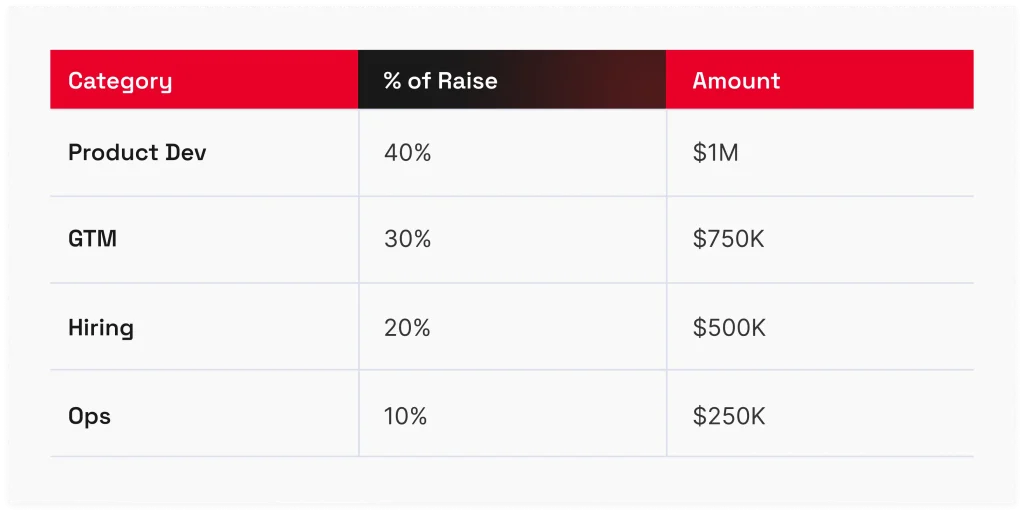
You also need to tie each spend category to an outcome. Don’t just say “Marketing – 30%.” Say what that marketing drives: 100K MQLs? International expansion?
A smart ask and use of funds slide shows investors that you know what you’re doing and where you’re going. That’s what gets the second meeting.
The ask & use of funds examples
The fastest way to improve your own ask slide? Study the ones that work. Below are examples from real-world pitch decks that nailed this final slide, along with a breakdown of why each one landed well with investors.
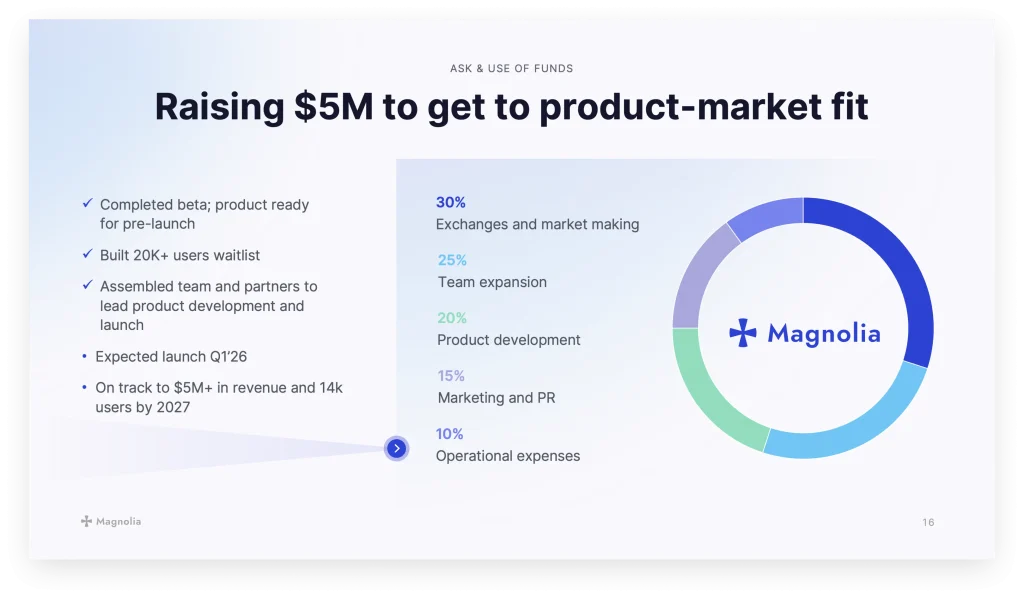
Why it works:
- Starts with traction, setting the stage before the ask.
- Ties the raise directly to product-market fit, a milestone every investor gets excited about.
- Visualizes the spend across five key categories with a sleek, no-frills pie chart.
- Highlights key drivers of growth, like product dev and go-to-market.
- Builds confidence in execution, not just vision.
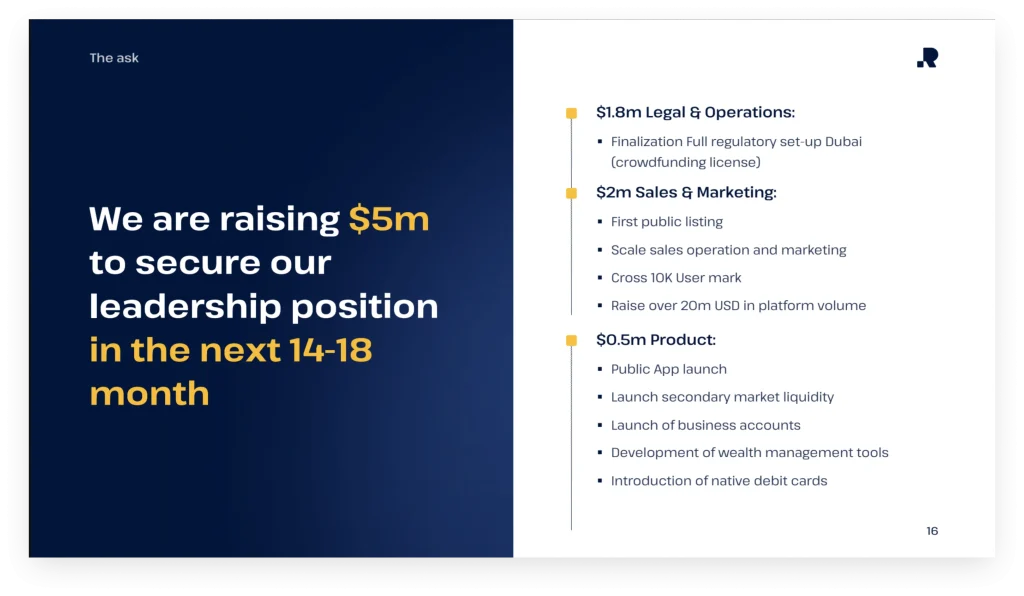
Why it works:
- Breaks down the ask by function, with numbers attached to each.
- Ties each category to specific business outcomes (like “Cross 10K users” or “Launch business accounts”).
- Frames the raise around a 12–18 month runway, giving investors a clear horizon.
- Covers regulatory, GTM, and product initiatives, showing a full-stack growth plan.
- Signals that this isn’t guesswork; it’s a playbook.
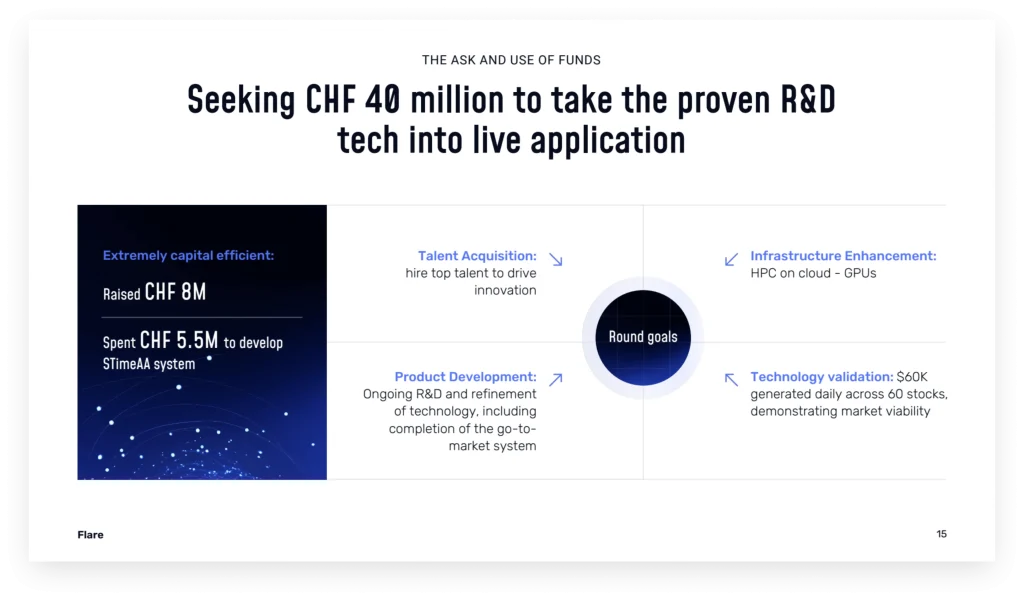
Why it works:
- Opens with capital efficiency: “Raised CHF 6M, spent CHF 4.5M”. This immediately builds trust.
- Shows ROI on past capital (a strong signal in a cautious market).
- Outlines clear categories tied to productization: talent, R&D, infrastructure, revenue goals.
- Communicates maturity; they’re not just testing tech, they’re operationalizing it.
- Appeals to investor logic: If this is what we achieved with $4.5M, here’s what we’ll unlock with $30M.
Mistakes to avoid in your ask slide
Even great founders can misfire here. Why? Because the ask slide looks deceptively simple, but even small missteps can raise big red flags.
Let’s have a look at the biggest culprits that can bury your ask & use of funds slide:
- You’re asking for way too much.
You’re pre-revenue and asking for $10M? That doesn’t say “big vision”; it says you haven’t done your homework on burn or what it actually takes to get to your next milestone.
- You’re asking for too little.
Under-asking is just as risky. If your raise doesn’t cover 12–18 months of execution runway, investors will assume you’ll be back raising before any traction hits.
- No story behind the number.
“We’re raising $3M” only works if you can explain what that number funds and why it’s the right size. Without context, it feels arbitrary and lazy.
- Your breakdown is vague.
If you list “Marketing – 30%” without saying what kind of marketing or what it’s supposed to drive, it looks like you’re making it up on the fly.
- There’s no roadmap.
If investors can’t see what success looks like after the raise (no milestones, no timeline), you’re just asking for a check without a plan.
How to fix them? Show the math. Tell the story. Make every dollar earn its place on your investment ask slide.
Final words
This ask and use of funds carries more weight than founders realize. It’s your final act, your capital blueprint, and your implicit promise to investors: If you fund us, here’s what we’ll deliver.
When you treat it like a filler slide, investors treat your pitch the same way. But when you treat it like a strategic asset – clear ask, precise allocation, tied to real milestones – you flip the conversation from speculative to serious.
So skip the fluff. Ground your ask. Show where the money flows. And connect every line item to the outcomes it unlocks.
Need help getting your ask slide investor-ready? At Pitchili, we craft pitch decks that get to a VC “yes” faster. Contact our expert team for assistance.
Related read:
- How to build a problem and solution slide
- How to write a value proposition slide that gets you funded
FAQ
What is an ask slide?
In a pitch deck, an ask slide outlines the amount of funding a startup is seeking, how the capital will be utilised, and the milestones the funding will help achieve. It typically appears near the end of the pitch and combines the funding ask with a high-level use of funds breakdown.
What is a great example of an investment ask?
A strong investment ask example might look like: “We’re raising $2.5M to launch in three new markets, hire key GTM talent, and reach $1.5M in ARR by Q1 2026.”
This format tells investors how much is needed, what it will fund, and what success looks like post-raise.
What is the use of funds slide?
The use of funds slide shows investors where their money’s going. It breaks down how you’ll spend the capital you’re raising (usually by category like product, marketing, hiring, or ops) and includes percentages or dollar amounts. Most founders use a simple chart or table to keep it easy to digest.
