
Written by: Ruslana Yurchenko
Published: August 2025
Investors don’t fund features. They fund value, and not just any kind. They want to see transformative outcomes that signal scale, defensibility, and a customer pain that’s not just real, but urgent.
That’s where 90% of decks drop the ball: they confuse what they built with what customers actually buy.
In this article, we’ll unpack what a value proposition really is (and isn’t), why most value proposition slides fail to connect with investors, and how to build one that’s clear, credible, and pitch-ready.
What is a value proposition?
A value proposition is the clear, specific benefit your customer gets from using your product that they can’t easily get elsewhere. It answers the question: “Why should they choose you over every other option?”
It’s equally important to call out what a value proposition is not, since this is where a lot of pitch decks derail:
- A tagline (“The smarter way to work”)
- A product feature list (“Real-time dashboards, integrations, AI automation”)
- A competitive moat (“We’re sticky because we’re hard to replace”)
Those may support your value proposition, but they aren’t the core of it. Your value prop should highlight a measurable outcome that matters to a specific user segment.
Let’s take Apple as an example. Their real value prop isn’t “smartphones and laptops.” It’s:
“Beautiful, intuitive tech built around privacy, innovation, and seamless user experience.”
Apple’s value proposition leans heavily on design, brand trust, and user-centric innovation. That’s the benefit, not the hardware. It’s customer-first, outcome-driven, and crystal clear: users get simplicity, reliability, and trust – all in one ecosystem. This is what sets Apple apart and keeps customers loyal, even with premium pricing.
So, great value propositions:
- Solve a painful, specific problem;
- Deliver a quantifiable or emotional benefit;
- Are catchy and sticky.
Nail this, and your pitch deck has a strong foundation. Miss it, and no amount of slide design will save the story.
How to prove you deliver real value?
Forget guesswork. There are only two investor-trusted ways to validate your value proposition:
1. Quantitative proof
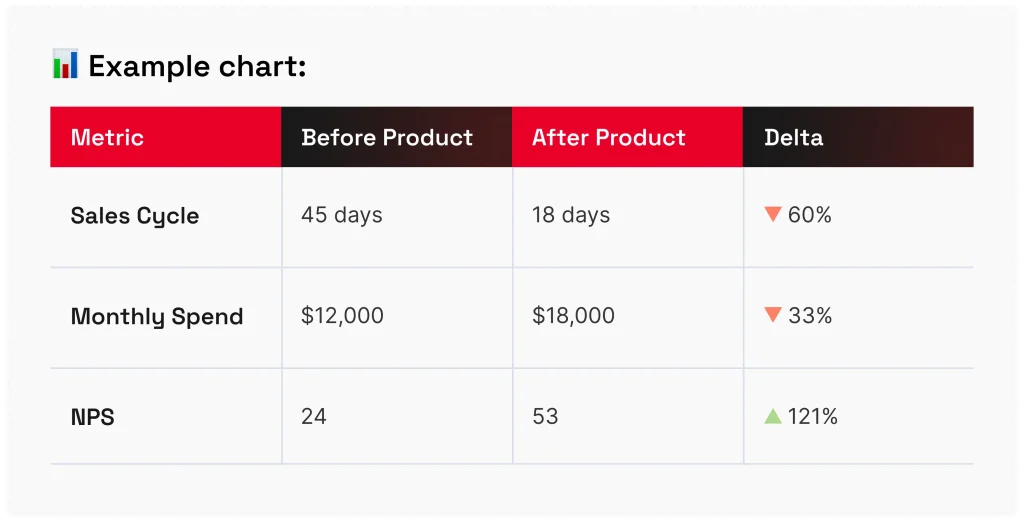
Investors are math-driven. That’s why try to show them:
- X% boost in team productivity
- Y% reduction in churn
- $Z saved per user/month
2. Qualitative proof
Use feedback, testimonials, or market validation:
- 4.8 ⭐ average app rating
- NPS score above 50? That’s gold.
- G2 quotes: “Cut our onboarding from weeks to hours.”
Bonus tactic: Use the language your users gave you. It makes the pitch feel human, not manufactured.
Why most value proposition slides don’t work
Founders often assume investors care about features. They don’t. What matters is the outcome for a specific customer. And most slides fail on three counts:
- Feature overload
Bullet lists of features (“real-time analytics, drag‑and‑drop editor, custom APIs”) look like product updates, not business cases. Investors ask: “So, what’s the real result for the customer?” - Generic claims without context
Phrases like “enhanced efficiency,” “AI-powered,” or “disruptive” are meaningless without quantification. Efficiency of what, exactly? Efficiency for whom? - No clear customer focus
Saying “we help teams collaborate” is too vague. Which teams? What problem are they desperate to solve?
The antidote is simple: your product value proposition slide must answer three investor questions in under 10 seconds:
- Who is the target customer?
- What urgent problem are they facing?
- How does your product create a significant outcome – faster, cheaper, or better?
Let’s flip the script: Instead of “Our platform features X, Y, Z,” say, “Marketing teams cut campaign launch time by 70% using our platform.” That single message packs customer, result, and context – all in one fast-read line.
Remember, this slide isn’t about you, it’s about customer payoff.
So, how to make a value proposition slide in your pitch deck work?
Slide anatomy of a winning value proposition
A high-conviction value proposition slide should have:
1. Hook headline
Start with a bold, benefit-driven claim that instantly communicates your core value. This is the first thing investors read, so make it count.
Example: “10× faster compliance audits for Fintech teams.”
A great hook headline should be specific (what gets better?), quantifiable (how much better?), and targeted (for whom?).
2. Value highlights
This is your quick-hit moment to distill your core customer benefits into sharp, high-impact statements. Each bullet should clearly answer: “Why do users care?”
For example:
- Cuts manual effort by 90%
- 3x cheaper than legacy software
- Live in under 5 days
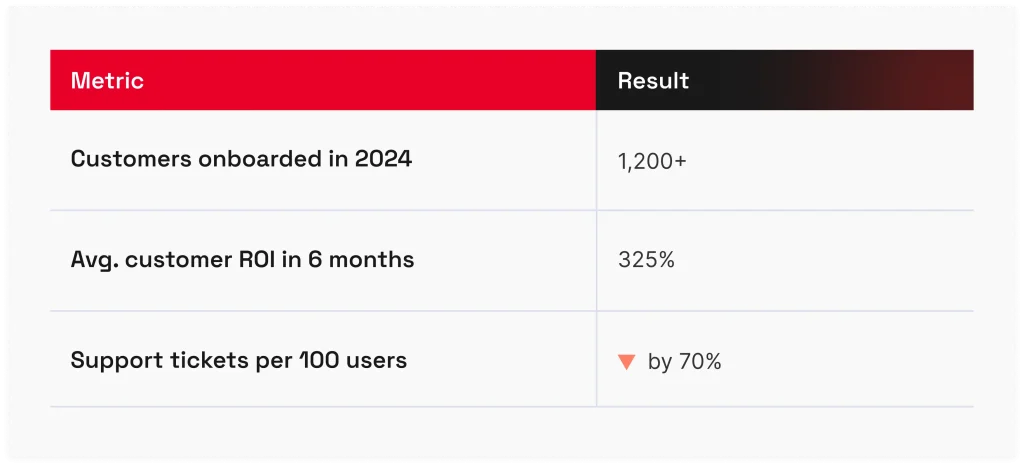
3. Proof metrics
Back your benefits with data. This is where you show, not just tell. Choose metrics that demonstrate traction, impact, or efficiency gains.
4. Trust elements
Don’t forget to reinforce credibility. Your claims land harder when they’re backed by external validation. This is your chance to show that others trust you, and that you’re already gaining traction with serious players.
This can be:
- Partnered with [industry leader logo]
- Mention awards, certifications, and endorsements
- Optional: testimonial from marquee client
And just a few things about the value proposition slide design, because even the strongest VP can fall flat if it’s visually overwhelming. Use plenty of whitespace to keep the slide clean and focused. Integrate icons or visuals to break up content and highlight key benefits. And wherever possible, anchor your claims with something visual (a chart, a logo, a customer quote) so the impact is felt instantly, not just read.
Examples of winning value proposition slides
Final thoughts
The best value proposition slides don’t just say you’re better. They prove you’re essential. So, if you want to magnet investors:
- Show what you solve, for whom, and why now
- Use real-world proof points that connect the dots
- Speak in outcomes, not features
Just remember that investors don’t need more ideas. They need reasons to believe yours will win.
Need a second pair of eyes or want help building a slide that actually converts? Contact our team, and we’ll help you build an investor-ready deck that raises.
Related read: How to build a problem and solution slide
FAQ
What is a value proposition slide?
A value proposition slide shows the core benefit your product offers and why customers choose you over others. It highlights the problem you solve, who you solve it for, and what makes your solution better.
What is a value proposition example?
A great value proposition tells a simple story about how your product makes life better. For example, a fitness app might say: “Get in shape in just 20 minutes a day—no gym required.”
It’s clear, outcome-focused, and shows exactly what the customer gets.
How do I create a value proposition?
Start by identifying your customer’s biggest pain point. Then explain how your product solves it better, faster, or cheaper (ideally in one clear sentence).
Use feedback from real users, data from your product, and clear language to refine the message. And always test it; if people can’t repeat it back, it’s too complicated.
