
Knowing how to make a pitch deck isn’t about features on a slide. It’s about telling a tight, data-backed story that proves your business is a smart investment. Your deck is a clear, concise argument for why your startup will win.
The 10-Slide Pitch Deck Framework
The fundraising rulebook has changed. Forget growth-at-all-costs narratives. Today, investors demand proof, not just potential. Substance over style. They are digging into fundamentals like unit economics, customer acquisition costs, and retention.
Your deck needs to show a viable, efficient business model now. It’s the first, and often only, chance to make your case. Its job is to give an investor everything they need to write their internal investment memo.
"A good pitch deck makes it easy for the reader to write an investment memo."
Let this guide every slide you create. Investors need clear, digestible information to justify their decision to their partners.
The New Pitch Deck Priorities
Founders must focus on what VCs want in this tougher climate.
- Profitability Over Projections: Show a clear and believable path to profitability.
- Efficiency Over Expansion: Highlight capital efficiency. Show how you’ll hit milestones with the capital you’re raising.
- Traction Over Talk: Concrete metrics are worth more than unproven plans. Early revenue, user engagement, and strong retention build credibility.
Your goal is to build a logical, compelling case, slide by slide.
Your Pitch Deck Checklist
Use this 10-slide framework as your blueprint. It’s a narrative arc designed to build conviction and get you to the next meeting.
| Slide Number | Slide Title | Core Question to Answer |
|---|---|---|
| 1 | Company Purpose | What is your one-sentence mission? |
| 2 | Problem | What urgent, costly problem are you solving? |
| 3 | Solution | How does your product uniquely fix this problem? |
| 4 | Market Size | How big is the opportunity? |
| 5 | Business Model | How do you make money? |
| 6 | Go-to-Market | How will you acquire customers efficiently? |
| 7 | Competition | Why are you better than the alternatives? |
| 8 | Team | Why is this the right team to win? |
| 9 | Financials | What are your key metrics and projections? |
| 10 | The Ask | How much are you raising and what will it achieve? |
This structure ensures every slide answers a critical question, leaving no room for doubt.
Crafting Your Narrative First
Your pitch deck is a story, not a collection of slides. Before opening PowerPoint, lock down the narrative. A strong story makes your deck memorable and easy for an investor to retell to their partners.
Investors fund stories: a painful problem, an elegant solution, and a massive vision. Your job is to make that story feel inevitable. If you can’t explain your business as a simple story, you haven’t refined it enough.
Start with a Three-Act Structure
Think of your pitch as a short play. This simple structure organizes your thoughts and ensures every slide serves the plot.
- Act I: The Problem. Who is your customer? What specific, urgent pain are they dealing with? Make the investor feel this pain.
- Act II: The Solution. How do you solve this problem uniquely? Focus on the core benefit, not a list of features.
- Act III: The Vision. Where is this all going? Paint a picture of the future you are building and the impact your company will have.
This flow is the bedrock of a pitch deck that works.
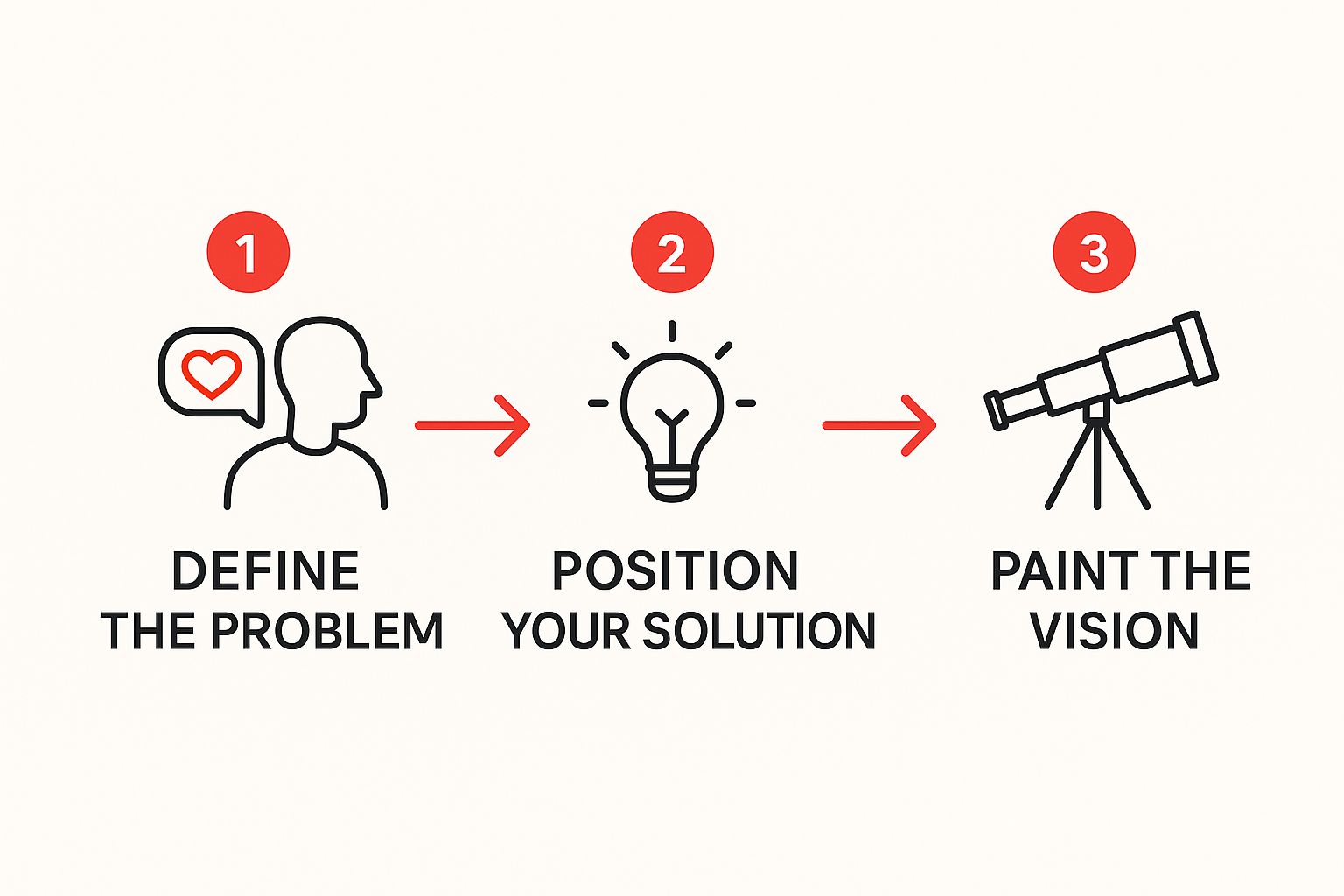
A powerful pitch moves logically from a relatable problem to an undeniable solution and an inspiring future.
Distil It into One Sentence
Combine your three acts into one powerful sentence. This becomes your company’s purpose and the anchor for your entire deck.
Example: "For freelance designers (Problem), who waste 10 hours a week on admin, our software (Solution) automates invoicing, giving them back a full day of creative work (Vision)."
This statement defines the customer, quantifies the pain, presents the solution, and shows the benefit. Nail this sentence before building a single slide.
Building Your Key Slides
You have the narrative. Now, translate it into clear, hard-hitting slides. Each one must build on the last, leading an investor to one conclusion: your company is a smart bet.
Slide 1: The Cover
First impressions matter. Your cover slide needs to be clean and to the point.
- Your company name and logo.
- A one-sentence company purpose.
- Your contact information (Founder’s name and email).
Example: ProjectFlow: The AI project management tool that automates reporting for creative agencies.
Slide 2: The Problem
Make the investor feel the pain your customers experience. Use concrete language and put a number on it. Specific, costly problems get funded.
This slide must define:
- Who the customer is. Be specific. Not "businesses," but "mid-sized e-commerce brands."
- The pain point. What’s the urgent, expensive, or frustrating issue?
- The cost of the problem. Frame it in time, money, or lost opportunities.
A CB Insights study found the top reason startups fail (35% of cases) is "no market need." Your problem slide proves this won’t be you. We have a detailed guide on how to build a problem and solution slide.
Example: Creative agencies spend 15 hours per week manually compiling client reports. This costs them over £30,000 a year in non-billable hours.
Slide 3: The Solution
Introduce your product as the obvious, elegant answer. Focus on the top 1–3 benefits that directly solve the problem. Show, don’t just tell. A clean product screenshot or a simple diagram works wonders. An investor should grasp your solution in under 10 seconds.
Example: ProjectFlow connects to existing tools (Slack, Asana) and automatically generates client reports in seconds. Agencies get their time back.
Slide 4: The Market Size
Investors hunt for opportunities big enough for venture-scale returns. Use the TAM, SAM, SOM framework.
- Total Addressable Market (TAM): The entire global market for your solution.
- Serviceable Addressable Market (SAM): The slice you can realistically reach.
- Serviceable Obtainable Market (SOM): The share you’re targeting in the short term.
Use credible, third-party sources for TAM/SAM and explain your SOM logic. It shows you’ve done your homework.
Example: The global market for agency software (TAM) is £15 billion. Our focus on UK and US creative agencies (SAM) is a £3 billion opportunity. We aim to capture £25 million of that (SOM) in 5 years.
Designing a Deck That Builds Credibility
Your deck’s design is a silent persuader. Good visuals build trust. Poor layouts create doubt. You’re not just showing slides; you’re signalling competence.
Use Readable Fonts and Simple Layouts
Clarity is key. Investors skim on small screens. Stick with clean, sans serif fonts at 24pt or larger.
- Clean Fonts: Use reliable choices like Open Sans or Roboto, available on Google Fonts.
- Whitespace: Use margins and spacing to create focus. Adding just 30% more margin space can double a slide’s legibility.
- One Idea Per Slide: Don’t cram information. Each slide should make a single, clear point.
Visualize Data and Financials
Raw numbers are overwhelming. Charts turn spreadsheets into stories.
| Chart Type | Best For |
|---|---|
| Line Chart | Showing revenue or user growth over time |
| Bar Chart | Comparing metrics month-on-month |
| Pie Chart | Illustrating market share or budget |
For financial slides, use clear labels and callouts to explain key assumptions (e.g., "Based on hiring 2 new sales reps in Q3"). This reduces investor questions and shows you’ve thought through the numbers.
Keep Your Brand Consistent
Consistent branding reinforces professionalism. Stick to your brand palette and logo placement.
- Place your logo in the same spot on every slide (e.g., bottom corner).
- Limit your palette to 3 core colours.
- Use a master slide template for alignment.
- Check colour contrast with a tool like the WebAIM Contrast Checker.
Need a second pair of eyes? Learn about our design services on Pitchili, or read our blog about design principles.
Common Pitch Deck Mistakes to Avoid
Play videoHow to make a pitch deck that wins funding videoThis loads content from YouTube.
Even a brilliant story can get derailed by unforced errors. After reviewing thousands of decks, we see the same deal-killing mistakes again and again. An investor might give your deck just 3 minutes and 44 seconds of their time. Avoid these red flags.
Unclear Financials and a Weak Ask
A vague or unrealistic financial slide kills credibility.
- Vague Projections: A "hockey stick" graph with no logic behind it is an instant pass. Your assumptions must be clearly stated.
- The Muddled 'Ask': Connect capital to specific milestones. Show how funding gets you from Point A to a more valuable Point B.
Before: "We are raising £1M for growth."
After: "We are raising £1M to hire 3 engineers and 1 sales lead. This will let us land 20 corporate clients and hit £30k MRR in 18 months."
Ignoring the Competition
The "we have no competition" slide is an instant red flag. It tells an investor you haven’t done your research or there’s no market for your idea.
Tackle your competitors head-on. Acknowledge their strengths but be sharp about your unique differentiator. A simple 2×2 matrix comparing your solution against others on key value axes can be incredibly powerful. It proves you understand the landscape and have a clear strategy to win.
Your pitch deck is your most important fundraising tool. At Pitchili, we combine VC insight with data-driven design to build decks that convert investor attention into term sheets. Get the expert support you need to win your round.
