
Raising capital feels broken. You spend months building a deck, only to get ghosted by investors. But what if the problem isn’t your idea, but your process?
This guide gives you a no-fluff, actionable framework. You will learn how to prepare, who to target, and how to close the deal-the same process top founders use to get funded.
1. Lay the groundwork to attract investors
Before you find an investor, you must get your house in order. This isn’t about looking busy. It’s about proving you’re a safe bet.
Investors see thousands of pitches. They use pattern recognition to filter out noise. Your job is to send all the right signals from day one.
Validate the problem and solution
Investors fund solutions to urgent, expensive problems. Not "nice-to-have" products. You need proof.
- Customer interviews: Talk to 20-30 ideal customers. Don’t sell. Just listen to their pain points.
- Market sizing: Build a bottom-up TAM, SAM, SOM analysis. Show a realistic, venture-scale market.
- Early traction: This could be a waitlist, a successful pilot, or high MVP engagement. Show real demand.
Example: The founders of Airbnb didn’t just have an idea. They rented out their own apartment to prove strangers would pay to sleep on an air mattress. That was their first, undeniable piece of traction.
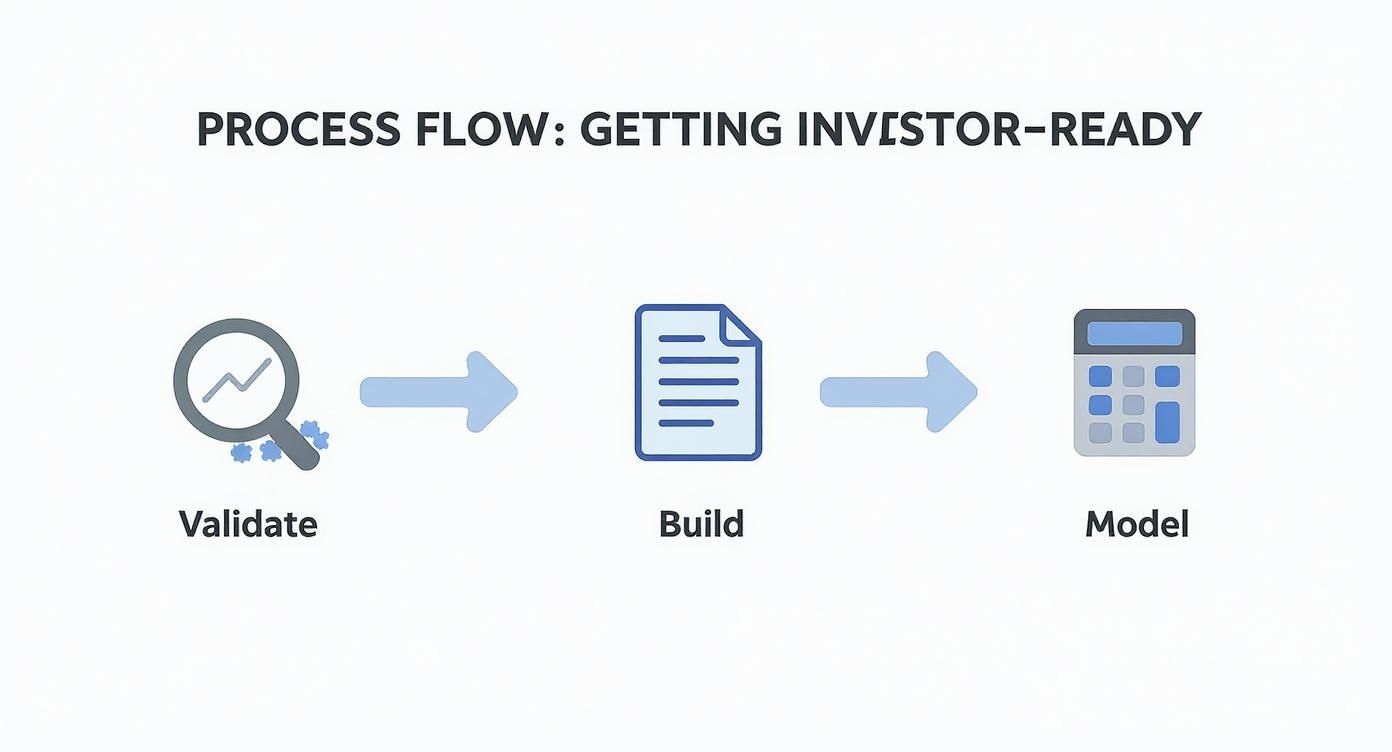
Build your essential documents
Once you have validation, package it cleanly. This is your "data room." It should be lean but thorough.
Your essential documents must include:
- A compelling pitch deck: 10-15 slides telling your story. Problem, solution, business model, team.
- A financial model: A 3-5 year forecast showing assumptions, revenue, and cash burn. Use a startup financial projections template to start.
- Team biographies: Short bios highlighting why your team is the only one that can win.
Example: Dropbox’s first "pitch" was a simple explainer video. It drove hundreds of thousands of sign-ups overnight. This validated demand and became a core part of their fundraising story.
2. Understand the current investor landscape

Not all money is the same. Pitching your pre-seed idea to a late-stage growth fund is a rookie mistake. Know the field you’re playing on.
The funding world changes with economic cycles and tech trends. Knowing who is writing checks for what is your secret weapon.
The current state of venture capital
Capital is flowing. In H1 2025, global venture funding hit $189.93 billion. That’s a 25% jump from H1 2024, according to global venture funding trends from S&P Global.
The tech, media, and telecom (TMT) sector got the largest share. This signals a clear investor bias for scalable software.
Example: If you’re building a SaaS startup, this data is your tailwind. If you’re in a different sector, it means you need to be surgical in finding VCs with a thesis that matches your industry.
Different investors, different playbooks
Each investor type has a different mandate, check size, and expectation. Targeting correctly saves months of wasted time.
- Angel investors: Individuals investing their own money ($25k–$100k). They bet early and often provide mentorship.
- Venture capital (VC) firms: Professionals investing a fund’s money ($500k+). They need to see a path to a 10x+ return.
- Accelerators: Programs like Y Combinator or Antler. They invest a small amount ($100k–$500k) for equity in exchange for intense mentorship and network access.
- Family offices: Private firms managing a family’s wealth. Their strategy varies from aggressive VC-style to patient, long-term capital.
Example: A founder with a deep tech idea but no revenue might target an angel with a PhD in that field. A founder with $10k MRR would target a seed-stage VC firm focused on their industry.
Investor types cheat sheet
Use this table to target your outreach. Every conversation should be tailored to the person on the other side of the table.
| Investor Type | Typical Stage | Check Size | What They Want |
|---|---|---|---|
| Angel investor | Pre-seed / Seed | $25k – $250k | A killer team and a compelling vision for a huge market. |
| Accelerator | Pre-seed | $100k – $500k | A coachable team and a promising MVP that can iterate fast. |
| Venture capital | Seed – Series C+ | $500k – $50M+ | Hard data on product-market fit, scalable growth, and a huge TAM. |
| Family office | Varies widely | $100k – $10M+ | Strong alignment with their values and a sustainable business model. |
3. Build your target investor list
Forget "spray and pray." To find an investor, think like a sniper. Your goal is a focused list of 50-100 high-potential people.
A great raise is won before the first email is sent. It’s won in the research and targeting.
Define your ideal investor profile
A great investor is more than a check. They bring expertise, connections, and strategic guidance.
Create a profile for your perfect partner. Ask yourself:
- Stage focus: Do they write pre-seed checks or only look at Series A deals?
- Industry thesis: Are they all-in on vertical SaaS, consumer health, or dev tools?
- Check size: Does it align with your fundraising target?
- Portfolio: Do they have companies in an adjacent space? (A direct competitor is a conflict).
- Value-add: Can they help with hiring, enterprise intros, or go-to-market?
Example: A fintech founder might look for an investor who was an early employee at Stripe and now focuses on seed-stage B2B financial infrastructure.
Use platforms to find aligned investors
With your profile defined, it’s time to build your list. Use platforms like Crunchbase, PitchBook, and Signal NFX.
Start by researching similar companies that recently raised a round. See who invested in them. That’s your entry point. These investors already understand your market. You can learn more about how to find venture capitalists in our detailed guide.
Example: A B2B SaaS founder finds a company in a similar space raised a $3M seed round six months ago. She adds the lead investor from that round to her target list, noting they understand her market.
Map your path to a warm introduction
Cold emails have a low success rate. A warm introduction cuts through the noise. It’s a transfer of trust.
For every investor on your list, find a path to a warm intro. Use LinkedIn to map first- and second-degree connections.
Best sources for intros are:
- Other founders (especially those backed by your target VCs)
- Your current advisors or angel investors
- Lawyers and service providers who work with startups
Example: You see your target investor is connected to a founder you know. You ask that founder for an intro, providing a short, forwardable email to make it easy for them.
4. Craft your outreach and nail the first meeting
You have your list. Now you need to turn names into conversations. This is where a sharp outreach strategy wins.
Your goal is to be the signal, not the noise. The best tool is a warm intro using a "forwardable email."
The forwardable email framework
This is a short message you send to a mutual contact. It’s written so they can forward it directly to the investor.
It must be three short paragraphs:
- A powerful one-liner: State what you do and for whom. No jargon.
- Key traction metrics: Highlight 2-3 impressive data points.
- The specific ask: Clearly state your fundraising goal and ask for a brief intro.
Example: "Hey Jane, Hope you’re well. We’re building a CRM for freelance designers and just hit $10k MRR with 20% MoM growth. We’re raising a $750k pre-seed round and noticed you’re connected to John Smith at XYZ Ventures. Would you be open to making an introduction? Thanks, Founder"
Investor outreach checklist
Use this checklist before you hit send. It ensures every email has the best chance of a response.
| ✓ | Element | Why It Matters |
|---|---|---|
| ☐ | Warm intro path | Cold emails have a <1% success rate. A shared connection is a credibility shortcut. |
| ☐ | Personalized hook | Mention their portfolio or a recent article. Show you did your homework. |
| ☐ | Clear one-liner | If they can’t understand what you do in 5 seconds, they’re moving on. |
| ☐ | 2-3 killer metrics | Data cuts through noise. Proof is better than promises. |
| ☐ | Specific ask | "Looking for an intro" is actionable. "Let me know your thoughts" is not. |
| ☐ | Forwardable format | Is it short enough to forward without editing? Brevity is king. |
Structure the first meeting
When you land the call, your job is to build rapport, not just pitch. Fundraising is a two-way street. You are interviewing them, too. You can learn how to create a pitch deck that tells a story.
Manage your 30 minutes like a pro:
- First 5 mins: Small talk. Find a human connection.
- Next 15 mins: Tell your story. Walk them through the deck-problem, solution, market, team.
- Final 10 mins: Open for Q&A. Ask your own questions about their process and how they support founders.
Example: A founder starts the meeting by asking about the investor’s recent trip mentioned on Twitter. This builds rapport before diving into the pitch, making the conversation feel more natural.
5. Navigate due diligence and close your round

A verbal 'yes' is not the finish line. It’s the start of due diligence. This is where investors verify every claim you’ve made.
A clean, organized data room signals you run a tight ship. Messiness here can kill a deal fast.
Survive the due diligence gauntlet
Investors are paid to find red flags. Your job is to have everything ready before they ask.
They will almost certainly ask for:
- Corporate and legal: Certificate of incorporation, cap table, board minutes.
- Financials and metrics: Historical financials, detailed financial model, bank statements, cohort analysis.
- Team and operations: Employment agreements, background checks.
- Product and IP: Product roadmap, tech stack details, proof of IP ownership.
Example: When a VC asks for the cap table, the founder sends a link to a cleanly organized folder within minutes. This speed and professionalism builds trust and keeps momentum high.
Understand the term sheet
While diligence happens, you’ll negotiate the term sheet. This non-binding document outlines the investment terms.
The valuation is important, but other clauses matter more. Pay close attention to:
- Valuation (pre-money vs. post-money): Determines how much ownership is sold.
- Liquidation preference: Dictates who gets paid first in an exit. 1x non-participating is standard.
- Pro-rata rights: Gives investors the right to invest in future rounds to maintain their ownership.
Example: A founder receives two term sheets with the same valuation. One has a 2x participating liquidation preference. They choose the other offer with standard 1x non-participating terms, protecting their future upside.
Finding an investor is a process of preparation, targeting, and execution. Follow these steps to improve your odds and close your round.
Crafting a story that gets VCs to lean in is part art, part science. Let us help you tell your story.
