
Staring at a blank slide is a founder’s nightmare. You have less than three minutes to convince an investor your startup is the next big thing. Data from DocSend shows the average VC spends just 2 minutes and 41 seconds on a deck.
Most decks fail. They tell the wrong story. They bury the path to profit under jargon and bad design. A weak narrative or confusing numbers will get your deck closed before an investor even sees your team slide.
This guide gives you a replicable framework. We’ll dissect the best pitch deck examples from companies like Airbnb and Uber, slide by slide. You’ll get actionable takeaways, not generic advice.
1. Pitchili — for founders who need a strategic partner

Pitchili isn’t a template shop; it’s an end-to-end fundraising partner. They merge deep financial analysis with elite visual storytelling. This is why founders turn to them for decks that actually get term sheets.
Their team includes financial analysts, successful founders, and top-tier designers. This structure ensures every deck is visually stunning and strategically sound. They answer the hard questions VCs ask before they’re even asked.
A strategic partner, not just a design agency
Pitchili acts like a co-founder for your fundraise. They build a compelling investment narrative from the ground up, going far beyond aesthetics.
- They start with a deep dive into your business model, financials, and market.
- They structure the narrative flow so each slide builds an undeniable case for investment.
- They use feedback from VC firms and eye-tracking research to optimize every element.
Pitchili translates complex data into a clear, investor-friendly story. They highlight capital efficiency, growth trajectory, and your defensible moat—critical for getting meetings with top-tier VCs. Learn more about how to choose the right pitch deck designers.
Core features and deliverables
Pitchili offers a robust, all-inclusive service. This lets you focus on your business.
- Narrative architecture: Develops a story arc that frames the problem, solution, and opportunity.
- Custom visuals: Transforms financial projections into clear charts and infographics.
- Investor-ready content: Ensures every claim is backed by data and meets investor expectations.
- Multiple formats: Delivers fully editable PDF, PowerPoint, or Keynote files.
They offer a standard two-week turnaround and an expedited five-day option. Their track record includes over $3 billion raised by more than 500 startups, proving the ROI for serious founders.
- Example: A fintech client had a complex revenue model. Pitchili created a single, powerful infographic that showed a 3x LTV/CAC ratio, which became the anchor of their successful seed round pitch.
Website: /
2. Slidebean — for founders who want an AI-assisted toolkit
Slidebean is a complete ecosystem for founders. It combines a library of famous pitch decks with a powerful AI-driven presentation builder. It turns passive viewing into an active, educational experience.
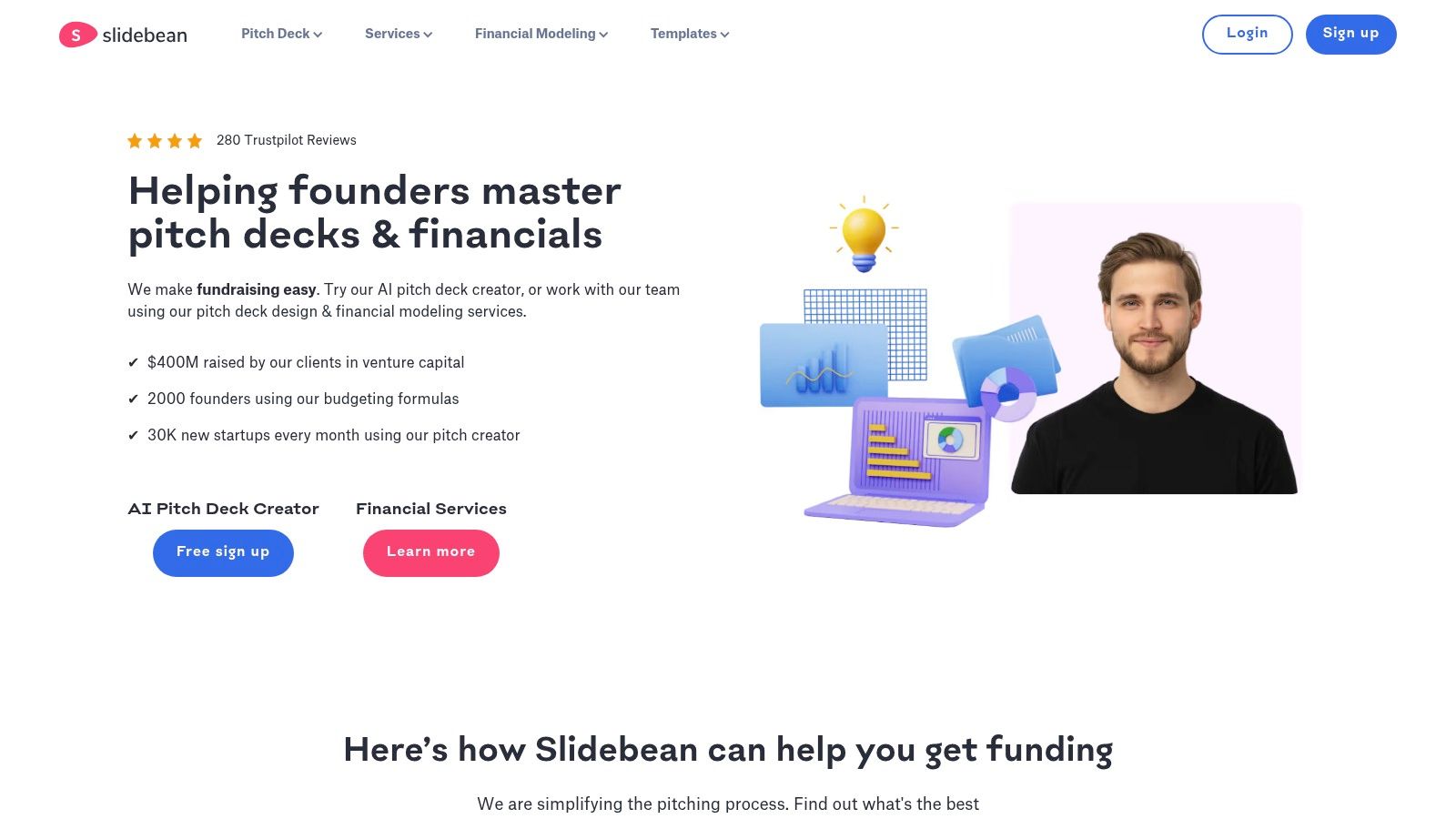
Slidebean offers redesigned, fill-in-the-blank templates for over 35 iconic decks, including Airbnb and Uber. This lets you apply the storytelling structures of successful startups to your own venture.
From inspiration to creation in one platform
Slidebean’s core value is its integrated workflow. You can study a famous deck, understand its narrative through their analysis, and then use their AI tool to generate a first draft in minutes.
- Integrated tooling: Combines examples, teardowns, and an AI builder in one place.
- Actionable templates: Provides ready-to-use templates based on proven decks.
- Founder resources: Offers financial modeling, cap table management, and expert consultation.
While you can view many examples for free, the real power is in the paid plans. Premium subscriptions give you full access to all templates, the AI presentation maker, and advanced features like view tracking. Read more on how to build a winning pitch deck.
- Example: Use Slidebean’s AI to generate a first draft. Then, watch their YouTube teardown of the Dropbox deck to refine your "Go-to-Market" slide for clarity and impact.
Website: https://slidebean.com
3. DocSend — for founders who need to track investor engagement
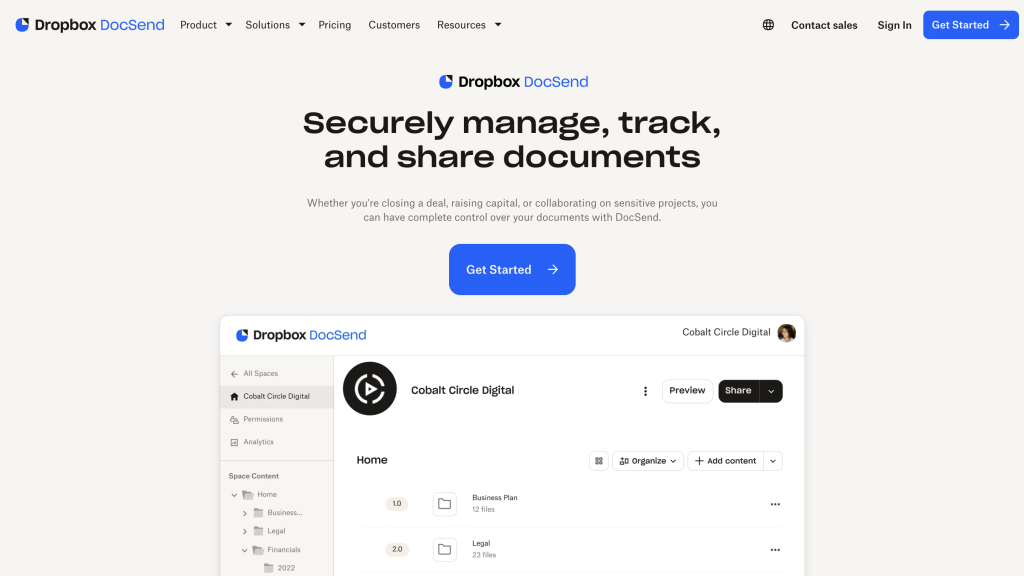
DocSend is a strategic tool for the entire fundraising process. It’s a secure document-sharing platform that gives you deep analytics on who views your deck and for how long. It turns fundraising from a guessing game into a measurable science.
DocSend also provides a wealth of educational content. Its blog features detailed analyses of successful pitch decks, often with unique commentary on what to fix. This research-backed perspective helps you understand investor psychology.
Data-driven fundraising management
DocSend’s primary value is its integration of deck hosting, sharing, and analytics. It provides actionable feedback based on real-world investor interaction.
- Investor analytics: Track who views your deck, which slides they focus on, and who they forward it to.
- Research insights: Publishes annual fundraising research with benchmarks and trends.
- Workflow tools: Includes one-click NDAs, dynamic watermarking, and version control.
DocSend operates on a freemium model. You can access its blog, research, and free templates without a subscription. The core analytics and security features are part of its paid plans.
- Example: You send your deck to three VC firms. DocSend shows that two of them spent over a minute on your financials slide, while the third skipped it. This data helps you tailor your follow-up emails.
Website: https://www.docsend.com
4. BaseTemplates — for founders who want a research-first approach
BaseTemplates offers a searchable gallery of over 200 real startup pitch decks. You can filter examples by funding stage, industry, and amount raised. It’s designed for founders who want to study real-world examples before building their own.
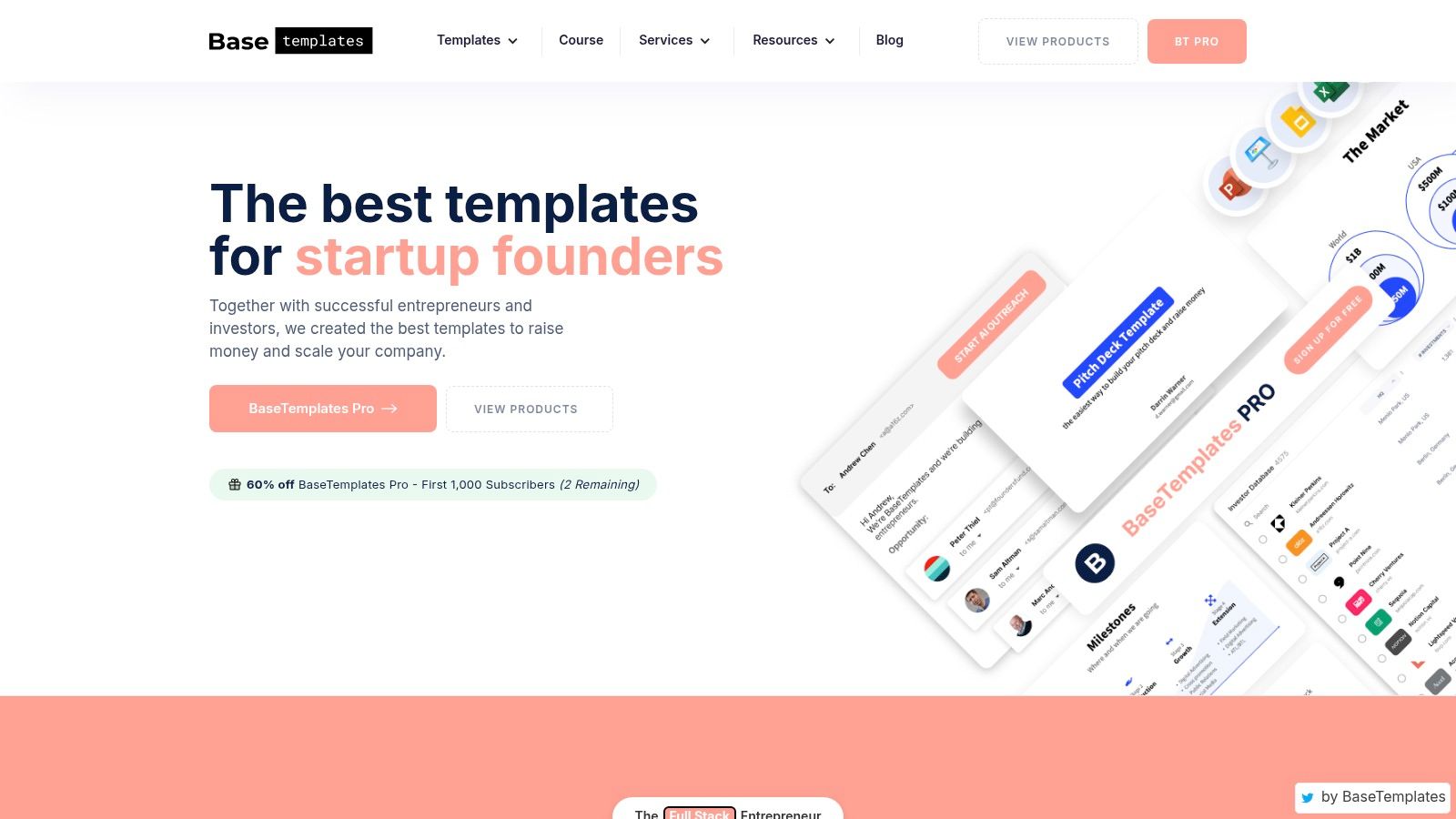
BaseTemplates focuses on two core offerings: a large collection of real decks and a separate library of premium, investor-ready templates. The templates include slide-by-slide guides with tactical advice.
A library of examples and a canvas to build on
BaseTemplates' strength is its pure-play library combined with high-quality, actionable templates. It’s ideal for founders who prefer to manually craft their narrative after studying what has worked for others.
- Extensive archive: Filter 200+ real decks by stage and funding amount for benchmarking.
- Action-oriented templates: Premium templates are structured frameworks with over 300 components.
- Multi-format support: Templates are available for PowerPoint, Keynote, and Google Slides.
The gallery is largely free to browse. The premium templates are a one-time purchase. They include comprehensive guides and components that justify the investment. Read more on how to nail the ask slide.
- Example: A B2B SaaS founder can filter for "Seed" and "Enterprise Software" to find 5-10 directly comparable decks, analyzing how they framed their problem and traction slides.
Website: https://www.basetemplates.com
5. Pitch Deck Hunt — for founders who want raw, unfiltered inspiration
Pitch Deck Hunt is a simple, no-frills library of real startup pitch decks. It’s a straightforward catalog for founders who want direct access to raw inspiration without paywalls or complex platforms.
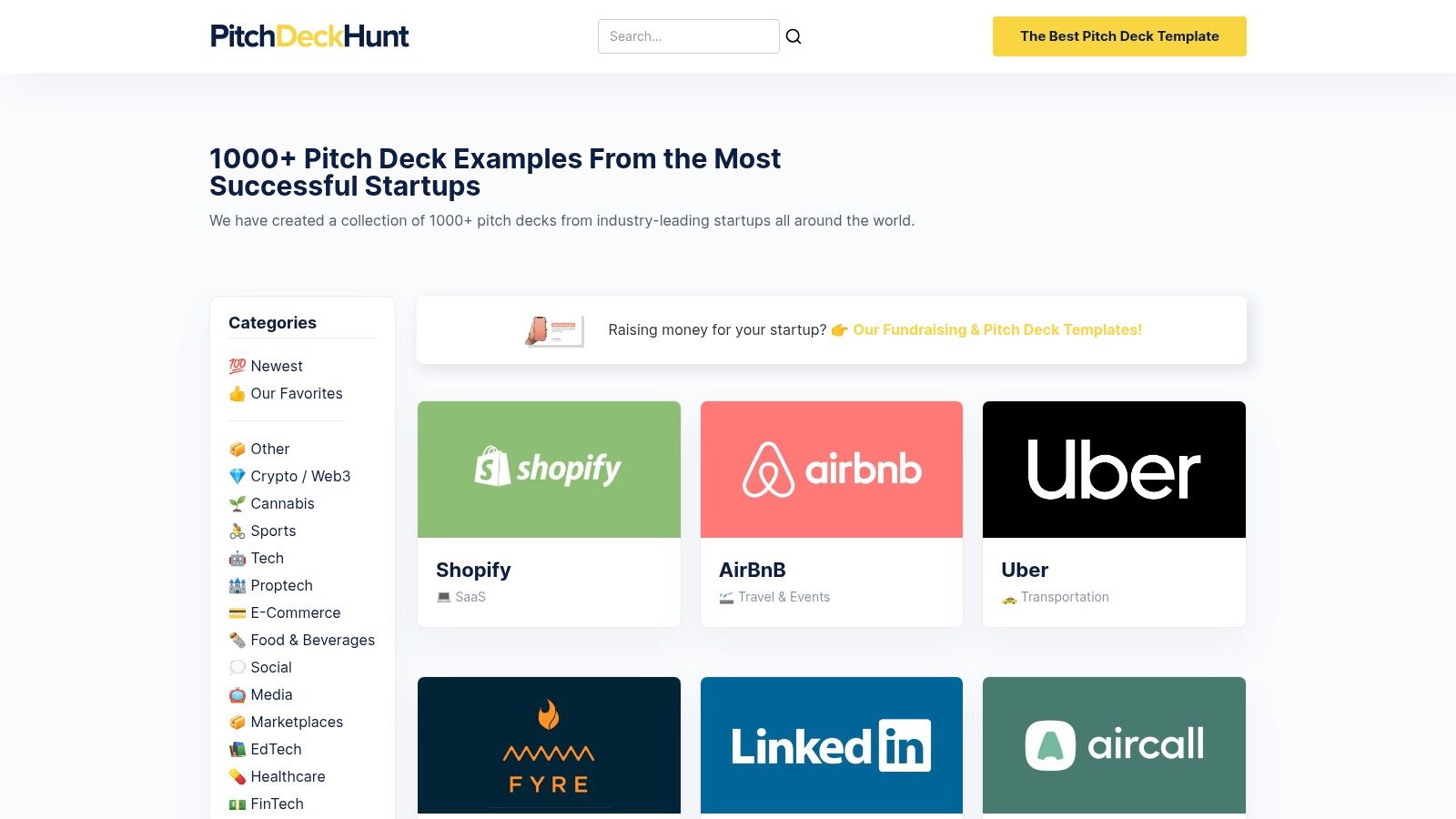
Pitch Deck Hunt’s mission is simple: provide direct access to the source material. Each entry includes context like the company’s name, funding stage, amount raised, and the year.
Direct access to source material
The value of Pitch Deck Hunt lies in its simplicity and speed. It removes all friction between you and the examples you need. There are no sign-ups, premium features, or AI-driven noise.
- Unfiltered access: Provides direct links to the original pitch deck PDFs.
- Essential context: Tags each deck with company info, funding stage, and year.
- Frictionless experience: Designed for rapid browsing without logins or payments.
Pitch Deck Hunt is completely free. This open-access model makes it an invaluable resource for early-stage founders who need high-quality, real-world examples to guide their deck creation.
- Example: Create a "swipe file" for your "Market Size" slide. Download 5 decks from Pitch Deck Hunt and screenshot that one slide from each to see different ways to visualize a TAM/SAM/SOM analysis.
Website: https://www.pitchdeckhunt.com
6. TechCrunch — for founders who want expert teardowns
TechCrunch’s "Pitch Deck Teardown" series is an invaluable educational resource. This ongoing column provides expert, slide-by-slide analysis of real pitch decks from startups actively fundraising. It gives you a raw, unfiltered look into what investors see.
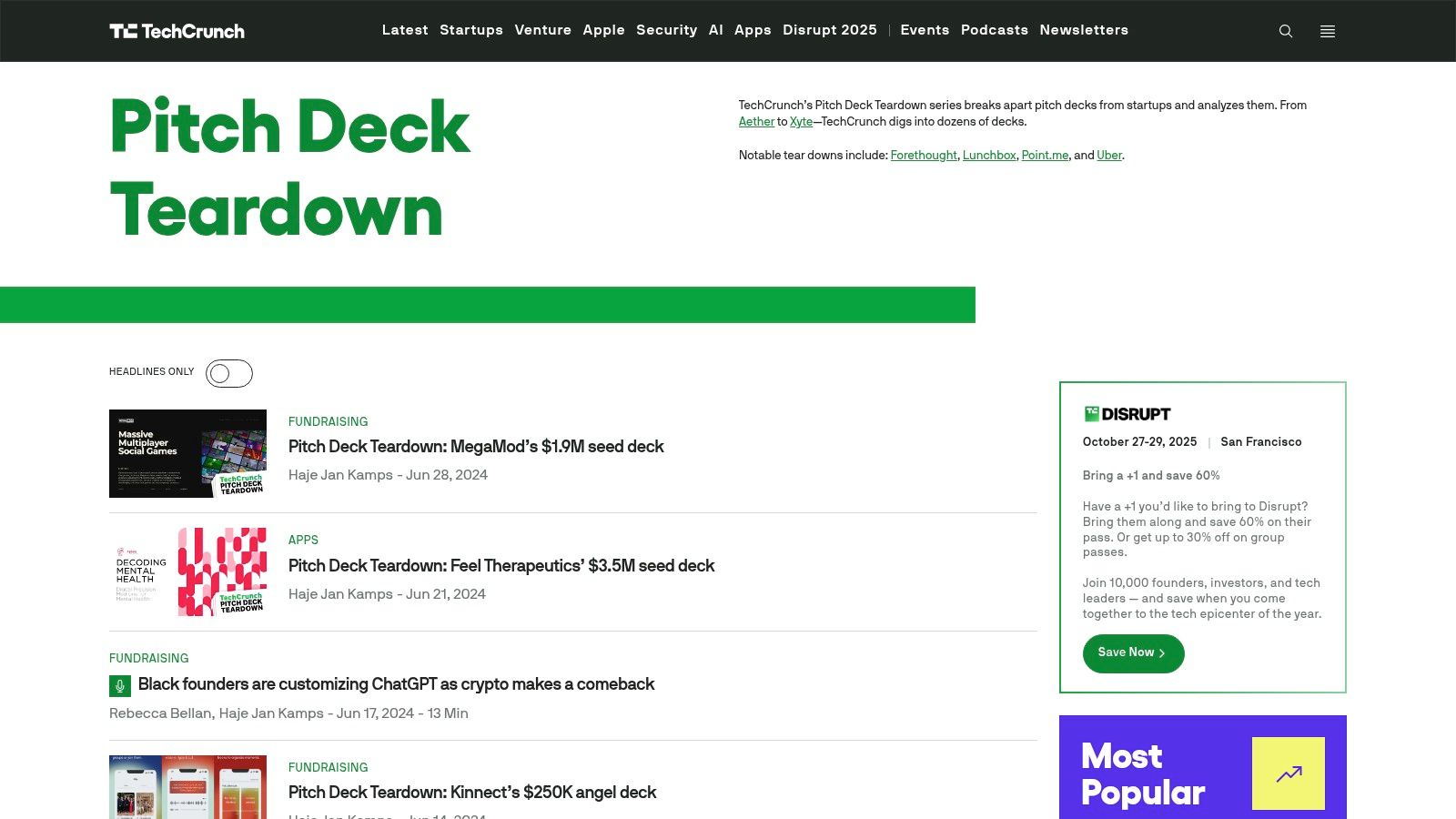
Each article is written by seasoned journalists, often with VCs, who dissect the narrative, design, and data. This approach offers a direct line of sight into the minds of investors, revealing common pitfalls and highlighting what resonates.
A masterclass in investor psychology
TechCrunch’s core value is its high-quality, credible critique of contemporary pitch decks. You’re analyzing decks being used in the market right now, giving you fresh insights into current fundraising trends.
- Investor-centric commentary: Focuses on what works from an investor’s perspective.
- Real-world application: Features a wide variety of companies across industries and stages.
- Editorial credibility: The analysis carries significant weight, offering trusted advice.
Many of the Teardown articles are free. However, newer or more in-depth analyses are part of TechCrunch+, the platform’s premium subscription service.
- Example: Read a teardown of a company in your space. The expert might critique their "Competition" slide for being too dismissive. You can apply that lesson to make your own competitive analysis more nuanced and credible.
Website: https://techcrunch.com/pdt/
7. Business Insider — for founders who want to see what’s funding now
Business Insider embeds pitch decks directly within its news coverage. This provides a constantly updated stream of decks from startups that just closed a funding round. It gives you access to what is working right now in the current market.
Business Insider’s value is its context. Each deck is presented alongside an article explaining the company, the round size, the lead investors, and key market trends. You understand why the deck was effective.
Real-time market intelligence
Business Insider’s advantage is timeliness. You see the actual materials that convinced top-tier VCs to invest in recent weeks, providing an unparalleled source of current storytelling and design trends.
- Real-world context: Decks come with rich journalistic context on the deal itself.
- Trend spotting: Helps you identify emerging trends in deck structure and key metrics.
- Authentic examples: You get access to real, unpolished decks that were used in the wild.
Many articles featuring full pitch decks are behind a paywall. A premium subscription is typically required to view the complete decks and in-depth fundraising articles.
- Example: You notice three recently funded fintechs covered by Business Insider all use a specific cohort analysis chart. This signals that VCs in that sector are currently focused on that metric.
Website: https://www.businessinsider.com
A quick comparison of pitch deck resources
| Platform | Best For | Key Feature | Cost |
|---|---|---|---|
| Pitchili | End-to-end deck creation | Strategic fundraising partner | Premium Service |
| Slidebean | Guided, AI-assisted building | AI builder & templates | Freemium |
| DocSend | Tracking investor engagement | View analytics | Freemium |
| BaseTemplates | Deep research & templates | Large, filterable archive | Free to Browse |
| Pitch Deck Hunt | Quick, raw inspiration | Unfiltered, free access | Free |
| TechCrunch | Learning from expert critique | In-depth teardowns | Freemium |
| Business Insider | Seeing current trends | Timely, real-world examples | Freemium |
How to turn examples into a deck that gets funded
Studying the best pitch deck examples is step one. Action is step two. The strongest decks are masterfully crafted stories. They articulate a massive problem, present an elegant solution, and back it up with undeniable traction.
Here’s a simple checklist to get you from inspiration to execution.
- Define your one-line story: Can you explain your problem, solution, and vision in one compelling paragraph? Nail this before you build a single slide.
- Structure before design: Outline your deck slide by slide. Focus on a logical flow where each slide builds on the last.
- Make data the hero: Find your single most impressive metric. Build your traction slide around it. Use data to validate every claim.
- Simplify every slide: Communicate one key idea per slide. Use fewer words. Clarity trumps complexity every time.
Remember, the goal is not to copy another deck. It is to borrow proven frameworks to tell your story more effectively. Use these blueprints to build a deck that is authentically yours and undeniably fundable.
Execution is what gets you funded. If you need a strategic partner to translate your vision into a deck that secures meetings, Pitchili combines VC-insider knowledge with data-driven design. Learn how we can help you raise your next round.
