
Struggling with the term "post-money valuation"? You’re not alone. It’s the single most important number in your funding round. It decides how much of your company you sell.
This guide gives you the tools to understand, calculate, and negotiate it. No fluff, just the essentials you need to close a strong deal.
So, what is post-money valuation?
Post-money valuation is your company’s value immediately after an investor’s cash is in the bank. It’s your company’s previous value plus the new investment.
This number matters because it sets the price per share and determines the investor’s ownership stake.
Think of it like this:
- Your company is an 8-slice pizza. This is your pre-money valuation.
- An investor adds 2 slices of their own (the investment).
- The new 10-slice pizza is the post-money valuation.

Why it matters
This number directly impacts your ownership. A higher valuation means you sell less equity for the same cash. A lower one means you give up a larger slice.
Understanding it helps you:
- Calculate dilution accurately. See exactly how your ownership shrinks.
- Negotiate effectively. Justify your valuation with clear math.
- Set future benchmarks. Establish a starting point for the next round.
The pre-money vs. post-money valuation table
Here’s a quick comparison of the two core concepts.
| Concept | Pre-money valuation | Post-money valuation |
|---|---|---|
| Timing | Value before investment | Value after investment |
| Formula | Post-money valuation – investment amount | Pre-money valuation + investment amount |
| Purpose | Sets the baseline worth of existing shares | Determines the new price per share for investors |
| Represents | Value of founders' and early investors' shares | The total value of all shares, including new ones |
These two numbers are connected. You can’t have one without the other. They are the building blocks of every term sheet.
- Example: A VC invests $4 million for a 10% stake. The math is simple: $4 million / 10% = $40 million post-money valuation.
How to calculate your valuation
Valuation isn’t magic – it’s math. The formulas are simple. Getting comfortable with them helps you lead fundraising conversations with confidence.
There are two ways to look at the calculation. One works forward from your company’s value. The other works backward from an investor’s ownership target.
Formula 1: the additive approach
This is the most direct way to calculate valuation. It’s a simple addition problem.
Pre-money valuation + investment amount = Post-money valuation
This formula shows that the post-money valuation is a blend of what you built and the capital you just raised.
- Example: You and an investor agree your startup is worth $8 million (pre-money). The investor adds $2 million.
- Pre-money valuation: $8,000,000
- Investment amount: + $2,000,000
- Post-money valuation: = $10,000,000
- The investor owns 20% ($2M is 20% of $10M).
Formula 2: the ownership approach
Investors often think in terms of ownership. They need to own a certain percentage for their fund’s model to work.
This formula calculates post-money valuation based on how big a slice an investor is buying.
Investment amount / investor’s desired ownership % = Post-money valuation
This approach reveals how an investor’s target dictates your valuation.
- Example: A VC wants to invest $5 million and needs to own 25% of your company.
- Investment amount: $5,000,000
- Desired ownership %: 25% (or 0.25)
- Calculation: $5,000,000 / 0.25
- Post-money valuation: = $20,000,000
- Your pre-money valuation must be $15 million ($20M – $5M).
Mastering these calculations is a core founder skill, just like learning how to build a financial model.
How valuation impacts your founder equity
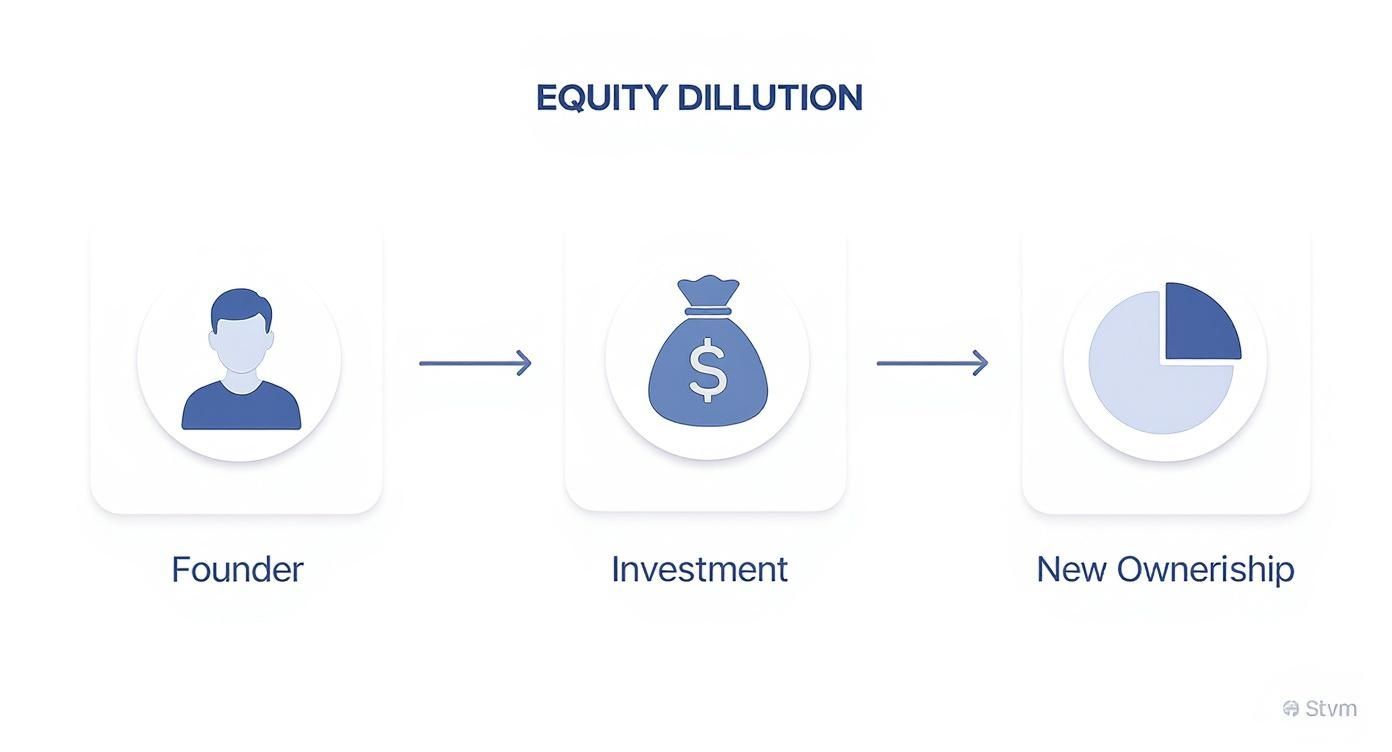
Valuation isn’t just a number. It’s the engine that determines how much of your company you own after the deal. This is called dilution.
A high valuation means less dilution. A low valuation means you sell a bigger piece of the company. Let’s see how this works.
The real cost of capital
When you take investment, you are no longer the sole owner. Your 100% stake shrinks to make room for your new partner.
The post-money valuation defines the terms of this exchange. The formula to calculate an investor’s ownership is:
Investor ownership % = investment amount / post-money valuation
This simple equation quantifies the dilution you’re taking on. Historically, a Series A company might land a pre-money valuation between $10 million and $50 million.
Founder’s dilution example: SaaSCo
Let’s use a startup called "SaaSCo." You’re the sole founder, owning 100%. You land a deal with these terms:
- Investment amount: $2,000,000
- Pre-money valuation: $8,000,000
- Post-money valuation: $10,000,000 ($8M pre-money + $2M investment)
Now, let’s calculate the investor’s stake:
- Investor ownership % = $2,000,000 / $10,000,000 = 20%
Your ownership drops from 100% to 80%. While your percentage dropped, the value of your stake did not. Before the deal, your 100% was worth $8 million. After, your 80% is also worth $8 million (80% of $10M).
You’ve traded a piece of the company for the fuel to make the whole pie bigger. Understanding what equity dilution is is essential.
- Example: Here’s a before-and-after look at the ownership structure.
- Before: Founder (100%), Investor (0%)
- After: Founder (80%), New Investor (20%)
Navigating real-world valuation complexities
Fundraising is rarely simple. The headline valuation is just the starting line. Several moving parts can change the real value of the deal.
Understanding these variables is your best defense. We’ll break down the most common curveballs.
The employee stock option pool (ESOP) shuffle
Investors will ask you to create an Employee Stock Option Pool (ESOP). This is a block of shares set aside for future key hires.
The negotiation is about when you create it. Investors insist the ESOP is created before their money comes in. This is a pre-money option pool.
Why does timing matter?
- It dilutes founders. A pre-money pool is carved out of existing shares, diluting only founders and early investors.
- It protects the new investor. Their ownership is calculated after the pool is created, shielding them from this dilution.
- Example: SaaSCo has an $8 million pre-money valuation. The investor adds $2 million and asks for a 10% pre-money ESOP.
- The 10% pool is carved out of the $8M pre-money value.
- This reduces the founders' effective pre-money value to $7.2 million.
- The post-money valuation is still $10 million. The investor’s $2M still buys 20%.
- But the founders' ownership is now 72%, not 80%. The other 8% is in the ESOP.
Demystifying SAFEs and convertible notes
Many early-stage startups use SAFEs (Simple Agreements for Future Equity) or convertible notes. These are promises to give an investor equity in a future priced round.
When they convert, the math gets tricky. They usually have two key terms: a valuation cap and a discount.
- Valuation Cap: A ceiling on the valuation at which the money converts. Protects early investors.
- Discount: A percentage discount on the future share price. Rewards early risk-takers.
When these notes convert, they add new shares to your cap table before the new investor’s shares are issued. This dilutes everyone. To get an accurate picture, you have to account for them. You can learn more about the impact on capitalization.
- Example: A startup raised $500,000 on a convertible note with a $5 million valuation cap.
- They later raise a Series A at a $10 million pre-money valuation.
- The note converts at the $5M cap, giving early investors 10% of the company before the new round closes.
- This conversion dilutes the founders before the new investor’s money even arrives.
How to negotiate a better valuation
Valuation isn’t a number you discover – it’s a number you build a case for. Too many founders react to valuations instead of shaping the conversation.
These are the steps to justify a strong valuation and negotiate from strength.
1. Anchor the conversation on traction
Investors fund momentum, not just ideas. Your traction is your most powerful negotiating tool.
- Lead with metrics. Start with your KPIs. Are you at $10k MRR? Growing 30% month-over-month?
- Connect traction to the future. "Our 15% drop in acquisition cost de-risks our 18-month growth plan."
- Show, don’t tell. Use your financial model and metrics dashboard to make progress tangible.
2. Create a competitive process
Nothing drives up a valuation like competition. Multiple interested investors force the market to price your company fairly.
- Batch your outreach. Start your top-tier investor meetings in a tight one-to-two-week window.
- Be transparent about timing. "We’re aiming to make a decision by the end of the month."
- Use one term sheet as a catalyst. Once you get one offer, you have leverage. Give other VCs a short window to make a competitive offer.
Cognition.ai recently raised at a $10.2B post-money valuation by bringing multiple investors into their round.
3. Justify your number with data
You can’t just pick a valuation out of thin air. Ground your "ask" in reality.
- Market Comparables. Research recent funding rounds for similar companies on PitchBook or Crunchbase. If peers raise at $10M post-money, asking for $30M sounds out of touch.
- Financial Projections. Your financial model should show how much capital you need and what milestones it unlocks.
Your negotiation checklist
Use this checklist to prepare for your fundraising conversations.
| Phase | Action Item |
|---|---|
| Phase 1: Homework | Build a real financial model. Show how you’ll use the cash. |
| Know the comps. Research similar rounds on PitchBook and Crunchbase. | |
| Clean your data room. Have all key documents ready. | |
| Craft your traction narrative. Turn metrics into a story of momentum. | |
| Phase 2: Negotiation | Lead with progress, not a number. Remind them why they’re excited. |
| Clarify the option pool early. Don’t let the ESOP be a surprise. | |
| Fight for clean terms. A high valuation with bad terms isn’t a win. | |
| Run a competitive process. This is your single best piece of leverage. | |
| Phase 3: Closing | Model the final cap table. Know exactly what you’ll own. |
| Hire a great startup lawyer. Do not try to navigate closing docs alone. | |
| Vet your new partner. Talk to other founders in their portfolio. |
Final thoughts: What is post-money valuation really about?
Post-money valuation is more than a number. It defines your relationship with investors and sets the stage for your company’s future.
A high valuation isn’t always the best deal. A slightly lower valuation from a top-tier firm can be more valuable than a few extra points from a passive investor.
Your goal is not to win a single negotiation. It’s to build a successful company for the long term. Choose the partner and the deal that best set you up for that journey.
Ready to build an investor-ready narrative for your next round? We combine VC insight with data-driven design to create pitch decks that get funded. Let’s build your deck.
