
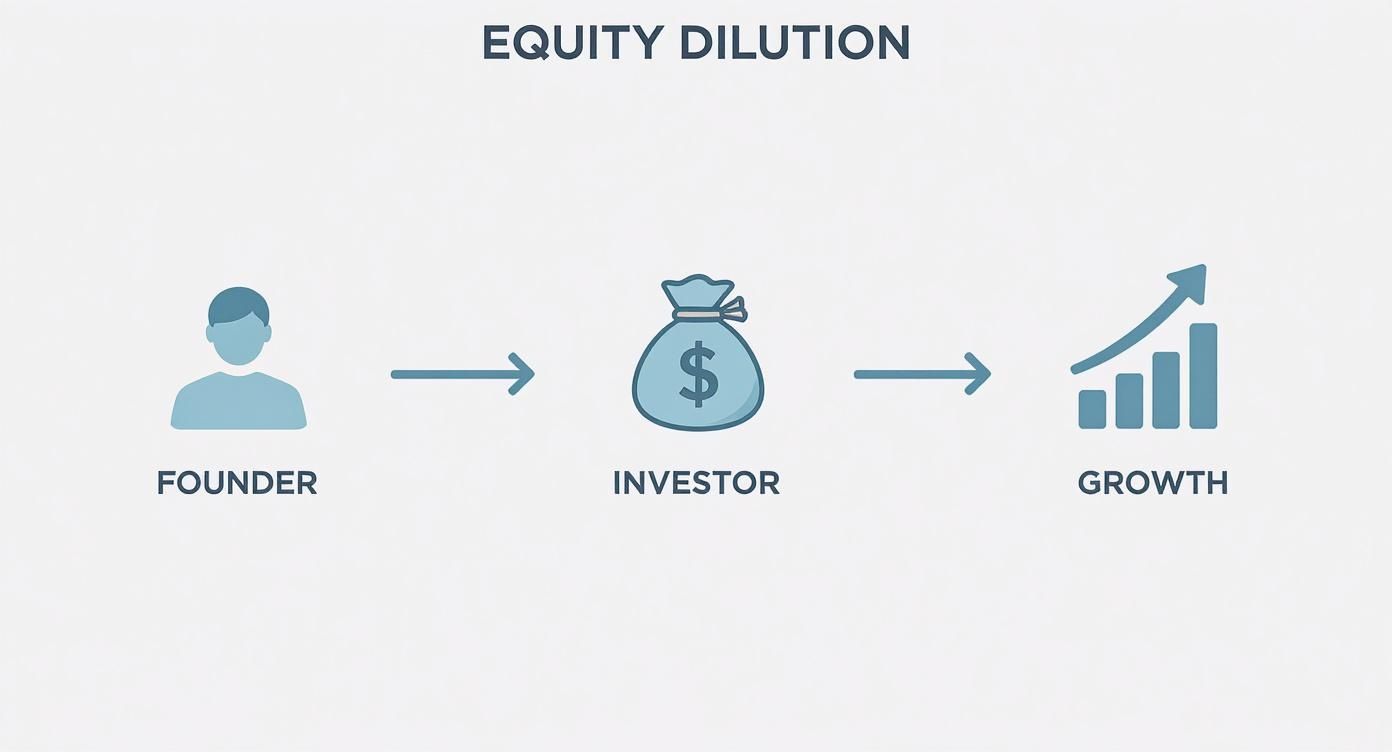
Equity dilution sounds complex. It’s not. It’s what happens to your ownership when your company issues new shares to raise money or hire talent.
The total number of shares goes up, so your piece of the pie gets smaller. This guide gives you a simple framework to manage it without the jargon.
Understanding equity dilution without the jargon

Building a great company costs money. Raising money almost always means diluting your equity.
When you create new shares for investors or employees, the total share count increases. Your original shares now make up a smaller percentage of that bigger total.
The goal isn’t avoiding dilution – it’s understanding it. Smart founders see it as a tool for growth.
The pizza analogy
Think of your startup as a pizza with 8 slices. At the start, you own all 8. That’s 100% ownership.
To grow, you need capital. You bring in a partner who invests cash. In exchange, you re-slice the pizza into 12 equal slices and give them 4.
You still have your original 8 slices, but your ownership drops from 100% (8 of 8) to 66.7% (8 of 12). That’s dilution. You own a smaller percentage, but you have the fuel to build a more valuable company.
- Example: You own a smaller slice, but its value is now much higher. Your goal is to own a meaningful piece of a giant pizza, not 100% of a small one.
Equity dilution at a glance
This table breaks down common dilution scenarios. Use it as a quick reference to make strategic, not emotional, decisions about your ownership.
| Scenario | What happens | Impact on founder |
|---|---|---|
| Priced funding round | New shares are created and sold to VCs for cash. | Founder’s ownership percentage decreases, but company valuation increases. |
| Employee stock options | An option pool (ESOP) is created, reserving new shares. | Ownership is diluted to attract and retain key talent. |
| Convertible notes | Debt converts to equity later, creating new shares. | Dilution is delayed until a future, hopefully higher, valuation. |
- Example: In each case, you trade a piece of the company for something valuable – cash to scale, talent to build, or a bridge to your next milestone.
How equity dilution actually happens
Dilution is a direct result of the choices you make to grow. You trade ownership for resources.
Every time you issue new shares, the total share count rises. Every existing shareholder’s piece of the pie gets a little smaller.
This process is fundamental. It’s how you turn illiquid private stock into cash and talent.
The main triggers for dilution
Dilution happens in a few key scenarios. Understanding them helps you manage your equity.
- Priced funding rounds: The classic VC exchange. You agree on a valuation, and an investor buys newly created shares for cash.
- Employee stock option pools (ESOPs): To attract top talent, you offer them equity. An ESOP is a block of new shares set aside for employees.
- Convertible instruments: Early funding from convertible notes or SAFEs starts as debt. It later converts into equity, usually at your first priced round. Our guide on what is a convertible note explains how these work.
A practical example of dilution
Let’s make this real. Your company has 1,000,000 shares, owned 50/50 by you and a co-founder.
You raise a $1 million seed round. A VC invests $1 million for 250,000 new shares.
Before Investment: 1,000,000 total shares. You own 50% (500,000 / 1,000,000).
After Investment: 1,250,000 total shares (1M original + 250k new).
Your New Ownership: Your 500,000 shares now represent 40% of the company (500,000 / 1,250,000).
Example: You were diluted by 10%, but the company now has $1 million to grow. Your smaller slice is now worth much more. According to dilution trends from Carta, median seed-stage dilution recently fell from 23% to 20.1%.
Calculating dilution with a simple formula
To manage dilution, you need to understand the math. It’s simpler than you think.
The core formula helps you model different scenarios and negotiate with confidence.
Your new ownership % = your shares / total new shares
That’s it. "Total new shares" is the sum of original shares, investor shares, and new option pool shares.
Setting the stage
Imagine you’re the sole founder of a SaaS startup. You own 100% of the company, represented by 8,000,000 shares.
A VC offers to lead your seed round. The terms are a $2 million investment at an $8 million pre-money valuation.
This gives you a post-money valuation of $10 million ($8M pre-money + $2M investment).
Calculating the investor’s stake
First, let’s figure out what percentage of the company $2 million buys.
- Investor ownership % = investment amount / post-money valuation
- $2,000,000 / $10,000,000 = 20%
The investor will own 20% of the company. Now let’s calculate the new total shares.
- Let 'X' be the total shares after investment.
- Your 8,000,000 shares will equal 80% of the new total.
- 8,000,000 / 0.80 = 10,000,000 total shares (X).
- The investor gets 2,000,000 new shares (10M total – 8M original).
Adding an employee option pool (ESOP)
Investors almost always require an ESOP to attract talent. Let’s say they want a 10% option pool based on the post-money valuation.
This is a key detail. The dilution from the ESOP comes from the founders' stake, not the new investor’s.
Your 8,000,000 shares will now represent only 70% of the company (100% – 20% for the investor – 10% for the ESOP). Let’s recalculate.
- 8,000,000 / 0.70 = 11,428,571 total shares (X).
The final breakdown:
Founder shares: 8,000,000 (70%)
Investor shares: 2,285,714 (20%)
ESOP shares: 1,142,857 (10%)
Example: Your 100% stake is now 70%. This is how a typical seed round impacts your ownership. Understanding what is a cap table is essential for tracking this.
Good dilution vs. bad dilution: A founder’s framework
Not all dilution is equal. The line between smart growth and losing control is thin.
Good dilution is a strategic trade. You give up a small piece of your company to make the whole pie much more valuable.
Bad dilution is a reactive move from a position of weakness. It shrinks your ownership without adding proportional value.
What is good dilution?
Good dilution is an investment in growth. You exchange equity for resources that have a multiplier effect.
It happens when raising at a strong valuation.
You bring on strategic investors who add value beyond cash.
Funds are used for a clear growth plan.
You fund an ESOP to attract A-level talent.
Example: You sell 20% of your company to hire an engineering team that triples revenue in 12 months. Your remaining 80% is now worth far more than your original 100%.
What is bad dilution?
Bad dilution is a survival tactic. It happens when you raise money because you have to, not because you want to.
This desperation leads to bad terms, eroding your ownership without a clear return.
It happens in "down rounds" – selling shares at a lower valuation than before. Or when you take money from unstructured investors just to make payroll.
- Example: You give up 15% of your company for just enough cash to survive for three more months, with no real growth plan. You’ve only delayed the problem.
Good vs. bad dilution checklist
Ask these questions before taking new capital. Honesty here is critical.
| Question to ask | Signs of good dilution | Signs of bad dilution |
|---|---|---|
| Why are we raising money? | To hit a specific, ambitious growth milestone. | To cover payroll or avoid running out of cash. |
| Is the valuation fair? | Yes, it reflects our recent traction and progress. | No, it’s a "down round" or flat round. |
| Who are the investors? | Strategic partners who bring expertise and a network. | Anyone who will write a check. |
| What will the money achieve? | It will unlock a new market, product, or team. | It will keep the lights on for another 3-6 months. |
| How does this affect our cap table? | It brings in long-term, aligned partners. | It adds complexity and misaligned investors. |
| What’s the alternative? | We could grow slower but still sustainably. | We would have to shut down or make drastic cuts. |
Strategies to manage and minimize dilution

You can’t avoid dilution, but you can manage it. Smart founders use it as a strategic tool.
The goal is to trade the smallest slice of your company for the biggest infusion of fuel.
Raise from a position of strength
The best way to minimize dilution? Raise money when you don’t desperately need it.
Hit your milestones and prove your model works before you talk to VCs. A higher valuation means you sell a smaller percentage for the same amount of cash.
- Example: Raising $1 million at a $5 million pre-money valuation costs you 20% of your company. But at a $10 million pre-money, that same $1 million only costs you 10%.
Use alternative financing instruments
Priced rounds aren’t the only option. Tools like convertible notes and SAFEs can help.
These instruments are debt that converts to equity later, usually at a higher valuation. This pushes the dilution calculation down the road.
- Example: An early $100k check on a SAFE note converts into equity during your Series A, giving the investor shares at a slight discount but protecting your ownership early on.
Practice rigorous financial discipline
The ultimate way to control dilution is to control your burn rate. Profitability is leverage.
When you don’t need outside cash, you choose if, when, and from whom you raise. You dictate the terms.
- Example: Reaching break-even allows you to turn down a mediocre term sheet and wait for a partner who offers better terms and strategic value.
One analysis shows the US equity market has seen an average dilution of 2.15% per year since 1926. You can explore the historical data on market dilution for more context. And before you sign anything, read our guide on what is a term sheet.
Ready to build a pitch deck that commands a strong valuation and minimizes dilution? Pitchili combines top-tier design with VC-side insights to help you build a narrative that turns investor attention into term sheets. Get your investor-ready deck.
FAQ
Does creating an ESOP dilute my ownership?
Yes, absolutely. An ESOP means creating new shares for your team. This increases the total number of shares, so every shareholder gets diluted. But this is "good" dilution. Without an ESOP, you can’t attract the talent needed to win.
What is a down round and how does it affect dilution?
A down round is when you raise money at a lower valuation than your last round. It’s "bad" dilution. You’re forced to sell a much bigger chunk of the company to raise the same amount of cash. This causes severe dilution and signals trouble to the market.
How do convertible notes or SAFEs impact dilution?
They don’t eliminate dilution, but they delay it. Instead of pricing your company now, these instruments let you take cash and convert it to equity later, hopefully at a much higher valuation. This protects your ownership in the early days.
