
Struggling to track who owns what in your startup? This guide shows you how to build and manage your cap table today.
What is a cap table?
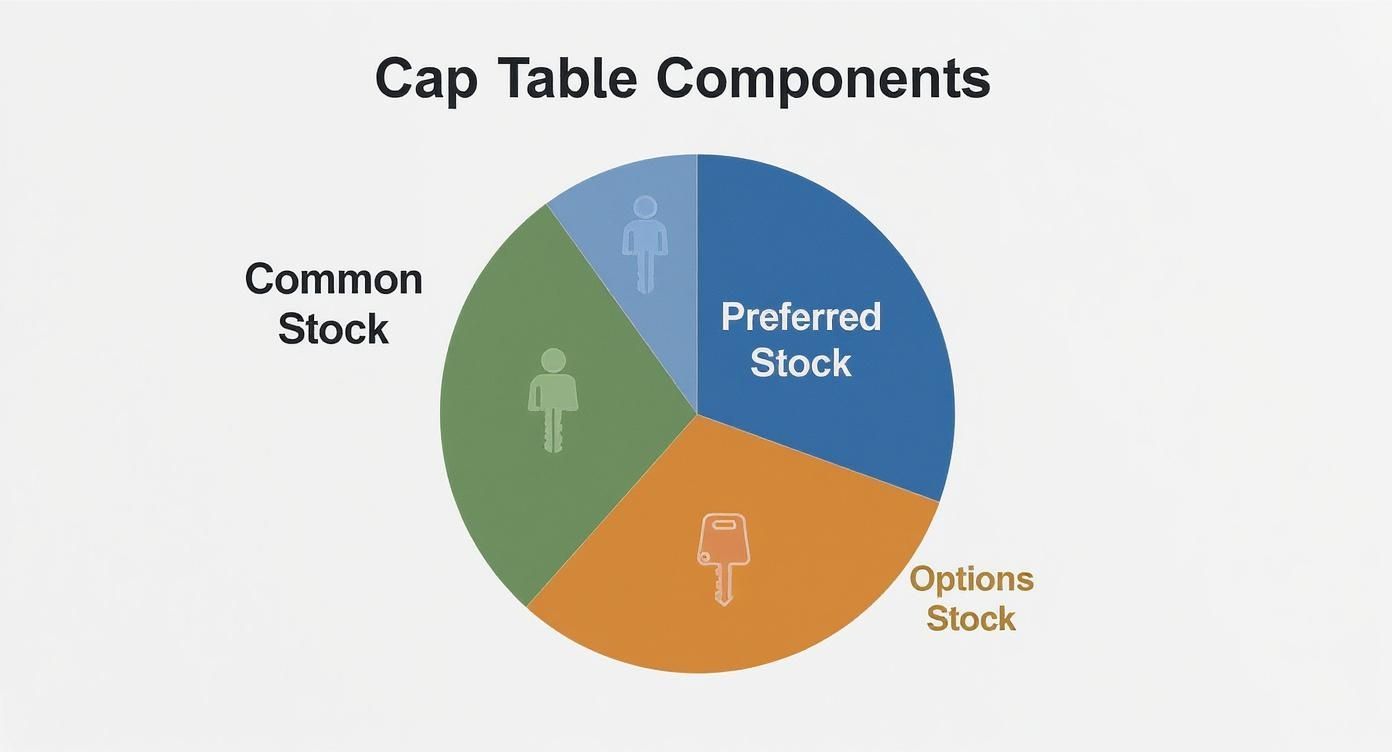
A cap table lists every security in your company with shareholder names, share counts, and ownership percentages. Use it as a single source of truth for founders, investors, options, and convertibles.
- Shows founder stakes, investor percentages, and option pools in one view
- Tracks share classes, warrants, and convertible notes
- Displays ownership alongside total shares outstanding
- Flags dilution before your next fundraise
- Serves as due diligence evidence for investors and auditors
Cap table key components summary:
| Component | Description |
|---|---|
| Common Shares | Equity held by founders and team |
| Preferred Shares | Investor stakes with specific rights |
| Options | Grants set aside to attract talent |
| Warrants | Rights to buy shares at a set price |
| Convertible Notes | Debt instruments that convert to equity |
For more, see Investopedia.
Example: A startup issues 1,000,000 common shares split evenly among three founders for 33.3% each.
Why it matters
A clean cap table helps you plan funding, spot dilution, and keep investors happy.
- Anticipate dilution impact before issuing new shares
- Model financing scenarios with fully diluted totals
- Size your option pool to attract talent without surprises
- Speed up due diligence and tax filings
For a deeper dive, check Carta’s guide to cap table fundamentals.
Example: An investor asked for a fully diluted cap table and funded the round one week faster.
How to set up your cap table
Follow these steps to build and update your cap table in minutes:
Define share classes
- List common and preferred shares
- Note rights and preferences for each class
Add stakeholders
- Include founders, investors, and option pool grantees
- Record share counts and issue dates
Record funding rounds
- Log each new share issuance
- Update prices and investor names
Reserve option pool
- Set aside 10–20% of total shares
- Adjust the pool size before major raises
Example: Defining a 15% pool upfront saved a startup from a mid-round restructure.
Real-world cap table examples
See how ownership shifts from seed to Series A: Equity distribution before and after funding.
| Stage | Founders (%) | Investors (%) | Employees (%) |
|---|---|---|---|
| Seed pre-money | 100% | 0% | 0% |
| Post seed | 80% | 20% | 0% |
| Post Series A | 45% | 50% | 5% |
How ownership shifts after Series A:
- Start with 1,000,000 founder shares
- Issue 250,000 shares to seed investors at $4 each
- Create a 10% option pool pre-Series A
- Sell 600,000 preferred shares at $8 apiece
- Recalculate fully diluted totals
For more on Series A strategy, read our guide on Series B Funding.
Example: Modelling these steps revealed a founder stake drop from 70% to 45%.
Best practices for maintenance
Play videoWhat is a cap table? A founder’s guide videoThis loads content from YouTube.
Keep your cap table audit-ready with this weekly checklist:
| Task | Frequency |
|---|---|
| Match share totals with accounting | weekly |
| Share updated cap table with CFO and board | weekly |
| Share the updated cap table with CFO and board | weekly |
| Share the updated cap table with CFO and board | weekly |
- Record grants, transfers, and conversions immediately
- Limit edit rights to your equity manager
- Review the cap table in every board meeting
Example: A weekly audit caught a misfiled option grant and saved 3% in dilution.
Common pitfalls to avoid
Avoid these mistakes to keep your cap table clean:
- Forgetting to log option grants hides dilution
- Mislabeling share classes costs founders equity
- Skipping pro forma models for SAFEs buries hidden dilution
- Using inconsistent conversion assumptions skews totals
- Letting multiple editors overwrite your sheet
Example: One founder caught a share-class mix-up and reclaimed 3% of her stake.
