
You proved your idea with seed and Series A capital. Now growth stalls. This guide shows you how to win Series B funding today.

Understand Series B funding
Series b isn’t about testing demand. It’s about scaling a proven business engine.
Investors want hard data on customer acquisition, revenue growth, and market share.
They need proof that extra capital multiplies results, not just more runway.
Example: a SaaS startup hits $3M ARR, 2.5x year-over-year growth, and shows a clear path to $10M ARR with more sales hires.
Build a repeatable sales machine
A predictable growth model is table stakes for Series B.
Investors expect every $1 spent on sales and marketing to return $3 or more.
Focus on:
- a defined multi-stage sales process you can defend with data
- a mix of 3–4 customer acquisition channels, not just one
- consistent sales cycles and clear close-rate metrics
Track your LTV/CAC ratio. Aim for at least 3:1, ideally 5:1.
Example: you invest $100k in paid ads, generate $300k in contracted ARR, and replicate it each quarter.
Build a scale-ready leadership team
Early founders wore every hat. For Series B, you need experts in place.
Investors back teams that can run a $50M revenue plan, not just an MVP.
- VP of sales with experience scaling from $5M to $50M ARR
- VP of marketing who built predictable, multi-channel lead funnels
- Head of product who manages a growing roadmap and PM team
- CFO or VP of finance who delivers reliable forecasts
Example: after hiring a VP of sales, your close rate jumps from 20% to 30% in 3 months.
Prove your market opportunity with data
Series B investors dig into traction and market size. You must show real market penetration.
Key metrics to highlight:
- ARR growth trajectory: aim for $3M–$5M ARR with 2x year-over-year growth
- Gross margins of 75% or higher for SaaS products
- Net revenue retention (NRR) of 120%+ to prove customer expansion
- A credible TAM backed by case studies and customer contracts
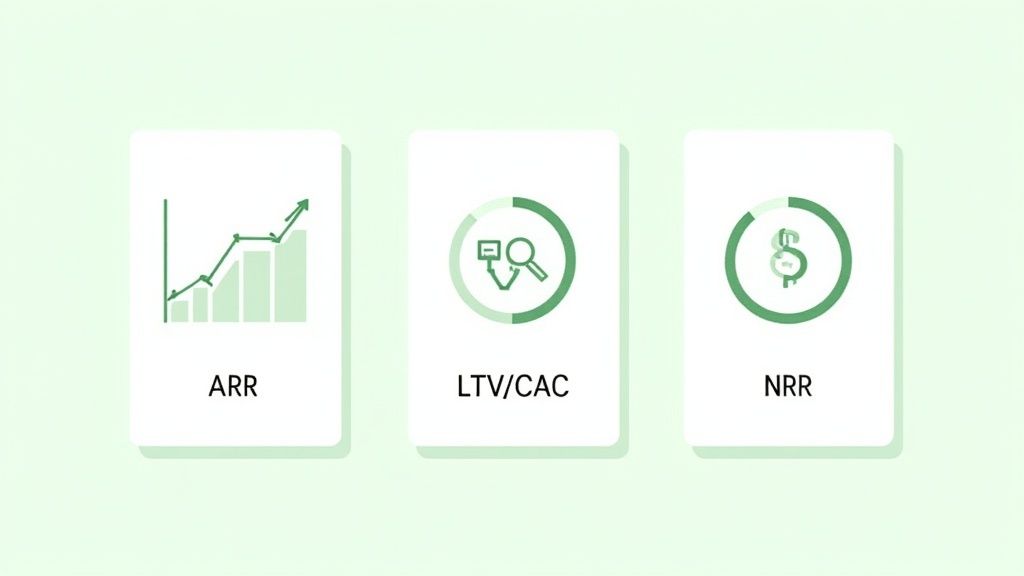
Example: you upsell 30% of customers, pushing NRR to 125% and proving a stickier revenue base.
Learn more about framing large markets in our market size slide.
Run a professional fundraising process
Series B fundraising is intense. You need the right investors and a pristine data room.
Identifying the right investor profile
Target 3 types of backers:
- Traditional VCs with growth funds for late-stage rounds
- Growth equity firms that specialize in scaling proven models
- Corporate venture capital like Snowflake Ventures for strategic partnerships
For trends, see the growth of Series B startups.
Securing a strong lead investor
Your lead sets valuation and terms. Look for:
- deep industry expertise and relevant exits
- a network that opens customer and partnership doors
- board-level guidance on execution and future rounds
Due diligence checklist
| Category | Key docs & metrics | Founder action |
|---|---|---|
| Financials | Audited statements, 3-year financial model, cap table, cohort analysis, unit economics | Have legal counsel pre-review docs |
| Legal & corp | Bylaws, board minutes, customer/vendor contracts, IP filings | Prepare an org chart and highlight gaps |
| Team & HR | Employee contracts, equity grants, org chart | Defend your market positioning with data |
| Product & tech | Product roadmap, tech stack, compliance reports (SOC 2) | Ready for a technical diligence session |
| Work with your CFO to clean and audit | Sales pipeline, MQL/SQL metrics, churn data, competitive analysis | defend your market positioning with data |
Play videoSeries B funding: A no-fluff guide for founders videoThis loads content from YouTube.
Example: Thatch raised $40M Series B led by Index Ventures after showing a 3:1 LTV/CAC ratio, 125% NRR, and a rock-solid go-to-market plan. Other backers included a16z and General Catalyst.
Ready to tell your inevitability story? Pitchili combines VC insight with data-driven design to build pitch decks that get funded. Learn more at /.