
You have the data. You have the product. But investors see hundreds of decks. Your problem isn’t your numbers – it’s your story.
A weak story gets you ignored. A strong narrative structure turns your data into a compelling argument. It’s what makes investors listen, remember you, and write the check. This guide gives you a founder-focused blueprint to build one.
Your pitch deck needs a story, not just slides
Investors are buried in pitches. After the tenth deck, most blur into a haze of data and hockey-stick charts. A deck without a story is just a report. It presents facts, but it fails to build conviction.
Think of it like this: a pile of bricks isn’t a house. You need a blueprint. Narrative structure is the blueprint for your pitch. It organizes your data, vision, and ask into a journey that walks an investor from "who are you?" to "where do I sign?"
From facts to persuasion
A strong narrative makes information persuasive. It builds a logical bridge from the problem you’re solving to the massive opportunity it represents. This shift makes your pitch feel cohesive, credible, and inevitable.
The goal is to build an airtight argument, slide by slide. Each part should flow naturally from the last. This is what separates a deck that gets a meeting from one that gets archived.
Why narrative is your unfair advantage
Many founders get stuck perfecting individual slides. They lose sight of the big picture. Understanding what is narrative structure gives you a massive strategic edge. It puts you in control of how investors process your information and feel about your company.
A great story makes your startup memorable. An investor won’t recall every data point you shared. They will remember the story of a founder tackling a painful problem for a huge market with a clear path to winning. Getting this part right is the first step in learning how to create a pitch deck that works.
A story turns your numbers into a movement. Your data provides proof, but the story closes the deal.
Example: Instead of just showing a churn metric, frame it as a story. "Our initial churn was 15%. After implementing feature X, which customers begged for, it dropped to 4% in 60 days. This proves we can listen and build what the market needs."
What is narrative structure in a pitch deck?
Play videoWhat is narrative structure? The founder's guide videoThis loads content from YouTube.
Let’s skip the textbook definitions. In a pitch deck, narrative structure is the intentional sequence of your slides. It’s the blueprint for your argument. It’s designed to walk an investor from "who are you?" to "here’s my money."
The point isn’t just to be creative. It’s to build tension, establish what’s at stake, and make your ask feel like the only logical conclusion.
The core elements of your pitch story
Every great story is built from a few key parts. This isn’t about writing fiction. It’s about making your facts persuasive.
- The protagonist: This is your customer. Your story starts and ends with them. Who are they? What painful problem keeps them up at night?
- The conflict: This is the problem. A weak conflict makes for a weak story. Make the pain tangible. Show its high cost in time, money, or frustration. This is your "why now."
- The rising action: Here you introduce your solution, traction, and unique insight. Your product is the weapon that helps the protagonist win. Show momentum – user data, key hires, market validation.
- The climax: This is your ask. After building a rock-solid case, state exactly what you need to scale the victory. It should feel inevitable.
- The resolution: This is your vision. What does the world look like after you win? Paint a picture of the market you will dominate. Give the investor a glimpse of the return.
Weaving data into a story is effective. Research shows data-driven storytelling can increase sales by 30%. You can dig deeper into the methodology for analyzing market data to see how these techniques work.
Each element has a job. The protagonist creates empathy. The conflict creates urgency. The rising action builds credibility. The climax forces a decision. The resolution inspires belief.
Example: Airbnb’s early deck didn’t just sell rooms. It sold a story. The protagonist was a traveler wanting authentic experiences. The conflict was lonely, sterile hotels. The solution (rising action) was a platform connecting people. The ask (climax) was capital to expand. The vision (resolution) was a world where anyone could "belong anywhere."
3 proven narrative structures for your pitch
You don’t need to reinvent the wheel. Investors recognize certain patterns because they work. They are logical, persuasive, and efficient. Start with a battle-tested framework.
Here are three effective structures for a startup pitch deck.
1. The problem-solution-vision framework
This is the classic for a reason. It’s direct, powerful, and works for nearly any early-stage company. The logic is simple: make the investor feel the pain, introduce your solution, then paint a picture of the massive future.
- Core logic: "Here’s a painful problem. Here’s our unique way to fix it. Here’s how big this can get."
- Best for: Most SaaS, B2C, and B2B startups with a clear, demonstrable problem.
- Why it works: It grounds the pitch in a real-world pain point. This makes your ambitious vision feel achievable.
Example: A fintech startup shows how small businesses waste 10 hours a week on manual invoicing (Problem). They introduce their one-click invoicing app (Solution). Then they show the $20B market they can capture (Vision).
2. The 'Why now?' framework
This narrative is for startups riding a specific wave – a shift in technology, regulation, or consumer behavior. The story isn’t just about solving a problem; it’s about seizing a unique, fleeting window of opportunity.
- Core logic: "A major shift just happened, creating an opportunity that didn’t exist before. We are the first and best team to capture it."
- Best for: Startups in emerging markets (AI, climate tech) or those with a timing-based advantage.
- Why it works: It creates FOMO (fear of missing out). It tells investors that waiting is not an option.
Example: An AI startup explains that the release of a new large language model (The Shift) suddenly makes automated legal contract review possible and affordable. They are the first team with the legal and tech expertise to build it (Why Now?).
3. The inevitable future framework
This is a bold, visionary approach. You start with a powerful vision of the future. You describe how the world will work, then position your company as the vehicle to make it a reality. This works best for category-defining ideas.
- Core logic: "The world is moving in this direction. Our company is building the infrastructure for that inevitable future."
- Best for: Deep tech, moonshot projects, or companies creating entirely new markets.
- Why it works: It positions the investment as a bet on a clear macro trend. It makes the investor feel like they are part of building the future. A study analyzing 130 years of news found that tracking economic narratives shape investor perceptions of risk, showing how future-focused stories influence financial outcomes.
Example: A self-driving truck company doesn’t start with today’s logistics problems. They start with a vision of fully autonomous shipping corridors by 2035 (Inevitable Future). Their company is building the essential AI navigation system to make it happen (The Bridge).
Choosing your pitch deck narrative framework
Which one is right for you? It’s not about which is "best." It’s about which best fits your company’s story. This table helps you decide.
| Framework | Core Logic | Best For | Key Slide Focus |
|---|---|---|---|
| Problem-Solution-Vision | "Here’s a pain, here’s our fix, here’s how big it gets." | Most B2B/B2C startups. | The Problem and Solution slides must be crystal clear. |
| The 'Why Now?' | "A massive shift created a temporary window for us to win." | Emerging tech or markets with a timing advantage. | The 'Why Now?' slide is your hook. It sets the stage for everything. |
| The Inevitable Future | "The world is heading here. We’re building the bridge." | Deep tech, moonshots, and category creators. | The Vision slide must be bold and believable. |
Your choice of narrative is a strategic decision. It frames every slide that follows. Choose the one that feels most authentic to your startup.
Mapping your narrative to your slides
Knowing your framework is one thing. Translating it into a slide deck is the real work. You need a map that connects each slide to its job in the story.
The goal is to make your company feel like a must-fund opportunity.
This visual shows the flow of the Problem-Solution-Vision structure. It’s the most common narrative for a reason.
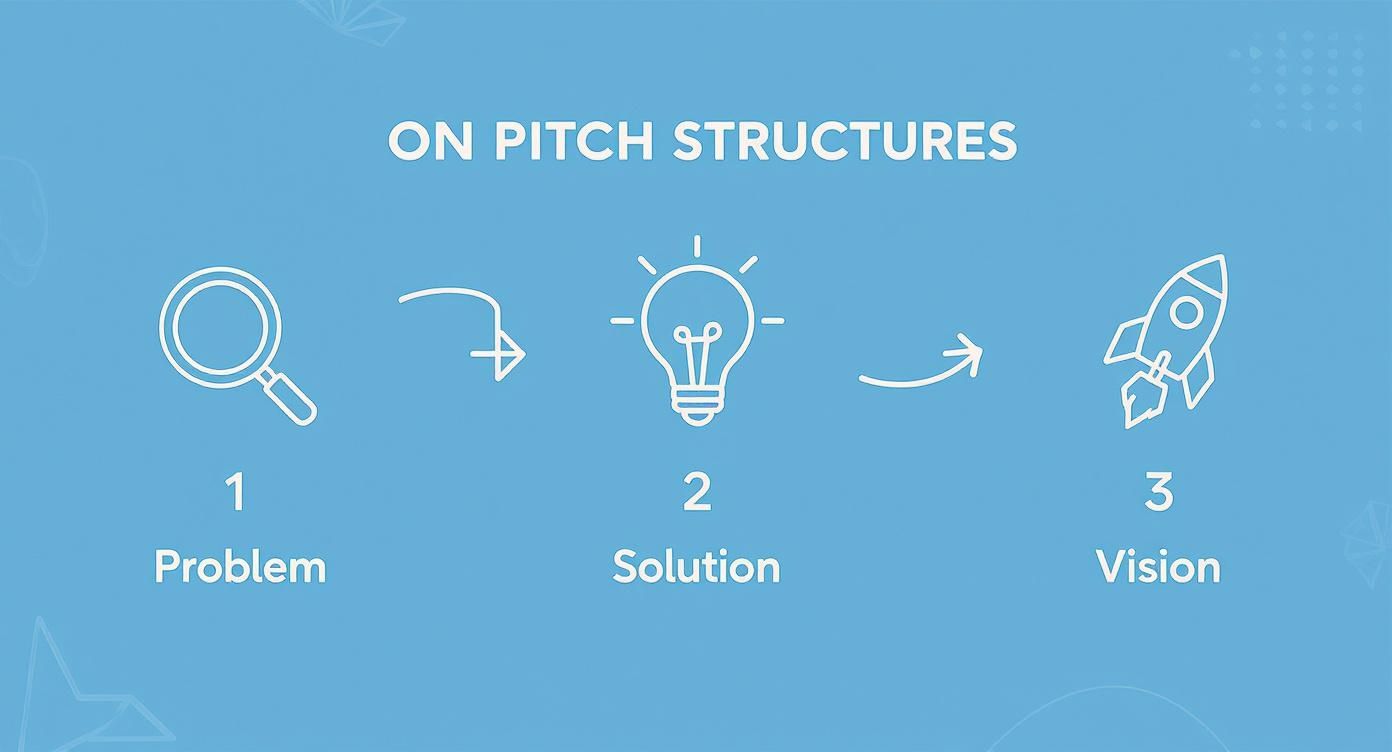
This sequence is critical. You establish a real, urgent need before you mention your product. That way, your solution feels necessary, not just another idea.
Building your deck with a narrative blueprint
Let’s get practical. Here is a concrete, 11-slide deck blueprint for the Problem-Solution-Vision framework. With a strong narrative, every chart serves the larger story. A good pitch deck template for startups can help ensure your design reinforces this story.
The table below is your slide-by-slide checklist. It defines the job of each slide and what to include.
The pitch deck narrative blueprint (problem-solution-vision)
| Slide # | Title | Narrative Purpose | Key Content Checklist |
|---|---|---|---|
| 1 | Cover | Establish your identity and value prop in one line. | • Company name & logo • Clear one-liner (e.g., "AI accounting for freelancers") • Contact info |
| 2 | Problem | Make the customer’s pain urgent, relatable, and expensive. | • A relatable customer story • Data on the cost of the problem • Who is most affected |
| 3 | Solution | Present your product as the clear answer to that pain. | • A simple statement of what you do • 3-4 key benefits, not features • How you uniquely solve it |
| 4 | Product | Show how your solution works in the real world. | • Screenshots or a short demo video • A simple visual of the user journey • Highlight the "magic moment" |
| 5 | Market Size | Prove the problem is big enough to build a massive company. | • TAM, SAM, and SOM numbers • Data showing market growth • Your specific target segment |
| 6 | Business Model | Explain exactly how you make money. | • Your pricing structure (e.g., tiers, per-seat) • Key metrics like ACV or LTV • Sales and distribution strategy |
| 7 | Traction | Provide hard proof that your model is already working. | • Key metrics: MRR, user growth • Customer logos or testimonials • Key partnerships or milestones |
| 8 | Competition | Show you understand the landscape and have a clear advantage. | • A 2×2 matrix comparing you to others • A clear definition of your "unfair advantage" • How you are different, not just better |
| 9 | Team | Prove you are the right people to win this market. | • Founder bios with relevant experience • Key advisors or early hires • Why your background gives you an edge |
| 10 | Vision | Paint a picture of the massive future you are building. | • Your long-term product roadmap • Adjacent markets you will enter • A bold statement about the future |
| 11 | The Ask | State exactly what you need for your next critical milestone. | • The amount you are raising (e.g., $1.5M seed) • A simple breakdown of fund use • Key milestones this funding unlocks |
This blueprint isn’t just about filling in slides. It’s about building an argument. By making each slide serve a purpose, you guide an investor from skepticism to a confident "yes."
Common narrative mistakes that kill investor interest
Even a great framework can fall flat. These common traps break your flow, confuse investors, and kill your momentum. A weak story signals a weak strategy. VCs see narrative gaps as red flags for deeper business issues.

The 'solution in search of a problem'
This is the most common pitfall. A founder loves their tech and details features before landing a clear, painful problem. The investor is left thinking, "cool tech, but who needs this?" Always start with the pain.
Example: A founder explains their AI algorithm for five minutes before mentioning the business problem it solves. The investor is already lost.
The 'data dump' without a story
This is burying investors in charts without a narrative. Data without a story is noise. It forces the investor to do the work. Every chart must serve your story. Tell the investor what the data means.
Example: Showing a slide with ten different user engagement metrics without explaining which one proves product-market fit.
The missing antagonist
Every great story needs a villain. In a pitch, your antagonist is a direct competitor or the status quo – "the way things have always been done." If you don’t identify this enemy, your startup feels less urgent. You have to show what you’re fighting against.
Example: A startup pitching a project management tool forgets to mention competitors or existing workflows like spreadsheets. The investor wonders if the market is real.
The vague vision
Many pitches build a solid case, then end with a weak vision. "We want to be the leader in our space" is a wish, not a vision. It tells an investor nothing about your ambition or strategy. Your vision must paint a clear, exciting picture of the future you’re building.
Example: A generic closing slide that says "our vision is to revolutionize the industry" instead of "we will expand from SMB accounting to become the financial operating system for all freelance businesses in the US."
Ready to build a narrative that gets investors to listen? At Pitchili, we help founders turn complex data into compelling stories that close rounds.
