
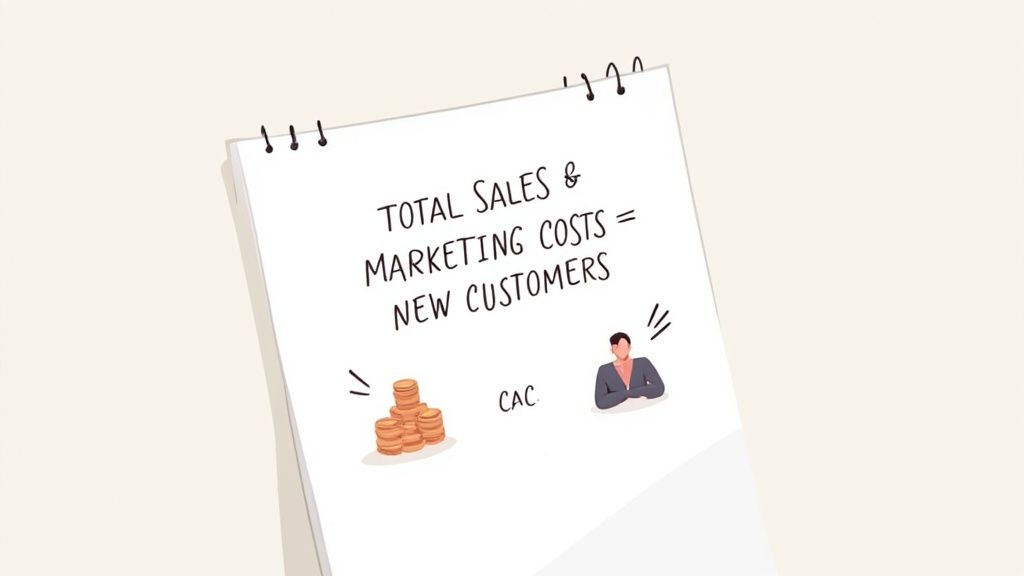
Figuring out your customer acquisition cost is simple on the surface. You take your total sales and marketing spend and divide it by your number of new customers. But getting this number right is more than an accounting task-it’s a vital health check for your startup.
Too many founders either guess their CAC or rely on a shaky formula. That’s a fast track to burning cash and missing opportunities.
This guide gives you a no-fluff framework to calculate an accurate CAC, prove your business model is sustainable, and make smarter spending decisions today.
Why your customer acquisition cost matters
Knowing your true acquisition cost is one of the most powerful metrics you have. It tells you exactly how much you spend to get one person to hit "buy." It proves your company has a sustainable path to growth.
Without a solid grip on this number, you’re flying blind. You can’t tell which marketing channels are working or if your pricing makes sense. A high CAC will bleed you dry, while a low one signals to investors that your growth engine is humming.
It’s proof that your strategy works and that you use capital wisely. Every VC will ask about it. You can see how CAC fits into different strategies by exploring these business model examples.
The LTV to CAC ratio is your key metric
CAC doesn’t live in a bubble. Its real power comes from its relationship with your Customer Lifetime Value (LTV)-the total revenue you expect from a single customer.
This comparison, the LTV:CAC ratio, is the ultimate report card on your profitability. It answers one simple question: are you spending more to get customers than they’re worth?
A healthy LTV:CAC ratio is widely considered to be at least 3:1. For every dollar you spend on acquisition, you should get at least three dollars back.
- Example: If your CAC is $100 and your LTV is $300, your LTV:CAC ratio is 3:1. This is a strong signal of a sustainable business.
What to include in your CAC calculation
An accurate CAC tracks every dollar spent to win a new customer. The most common mistake is only counting ad spend. This gives you a dangerously incomplete picture.
To get an honest number, you must account for everything related to sales and marketing. This means digging into salaries, tools, and overhead.
A true calculation gives you the clarity to make smart budget decisions.
Marketing expenses
This bucket includes all direct costs to generate leads and build awareness.
Ad spend: Money spent on platforms like Google Ads, Facebook, and LinkedIn.
Content creation: Costs for freelancers, agencies, or in-house creators.
Marketing tools: Subscriptions for SEO software (Ahrefs, Semrush), email platforms, and analytics.
Example: If you spent $5,000 on Google Ads, $1,500 on a freelance writer, and $500 on software, your total marketing program cost is $7,000.
Sales expenses and overhead
This is the human cost of closing deals. These are often forgotten but represent a huge chunk of your total spend.
Salaries and commissions: Full compensation for your sales and marketing teams.
Software costs: Your CRM subscription (Salesforce, HubSpot) and sales enablement tools.
Agency and contractor fees: Any external partners for PR, lead generation, or sales support.
Example: If your sales team salaries totaled $20,000 and your CRM cost $2,000, your total sales and overhead expense for the month is $22,000.
Cost checklist for an accurate CAC
Use this checklist to capture every relevant expense.
| Expense category | Specific examples | Notes for founders |
|---|---|---|
| Direct ad spend | Google Ads, Meta Ads, LinkedIn Ads, TikTok Ads, paid influencers. | This is just the tip of the iceberg. Don’t stop here. |
| Content & creative | Freelance writers, video production, graphic designers, agency retainers. | If an asset attracts customers, the cost to create it counts. |
| Team salaries | Full salaries (or a percentage) for marketing, sales, and content roles. | The biggest hidden cost. If their job is acquiring customers, their salary is part of CAC. |
| Commissions & bonuses | Sales commissions, performance bonuses tied to new customer acquisition. | These are direct costs of closing a deal. Always include them. |
| Software & tools | CRM (HubSpot), SEO tools (Ahrefs), email marketing platforms. | Every subscription supporting sales and marketing must be included. |
| Overhead | A pro-rated portion of office rent or utilities for the sales/marketing team. | This is advanced but necessary for a truly accurate CAC. |
How to use the CAC formula in practice
The core formula doesn’t change, but the costs you plug into it will. A simple e-commerce brand focuses on ad spend, while a B2B SaaS company has heavier costs tied to sales team salaries.
Let’s walk through two examples.
B2C e-commerce brand example
Imagine you run a direct-to-consumer brand selling sneakers. Last quarter, your growth efforts were mostly paid social media and influencer campaigns.
- Instagram and TikTok ads: $10,000
- Influencer collaboration fees: $5,000
- Total spend: $15,000
During that period, these campaigns brought in 550 new customers.
The calculation is simple:
$15,000 / 550 customers = $27.27 CAC
Each new customer cost you just over $27. This number is now your benchmark and a critical input for your startup financial projections template.
B2B SaaS startup example
Now, let’s look at a B2B SaaS startup. The sales cycle is longer, and the costs are more complex.
Here’s a breakdown of their monthly costs:
- Sales team salaries and commissions: $25,000
- Marketing software (CRM, automation): $2,000
- LinkedIn ad spend: $3,000
- Total spend: $30,000
In that month, the team onboarded 50 new clients.
The calculation looks like this:
$30,000 / 50 clients = $600 CAC
That $600 is much higher but typical for B2B models. It also reflects a broader trend-CAC has risen over 60% in the last five years. You can discover more insights about rising acquisition costs on amraandelma.com.
Analyse your CAC by marketing channel
A single, blended CAC is a vanity metric. Real insights come from breaking it down channel by channel. A low overall CAC can mask expensive, underperforming channels.
To get smart with your spend, you need a channel-specific CAC. This means attributing costs and customers back to their original source.
This is non-negotiable for data-driven decisions. It shows you where your money is working hardest, so you can double down on what’s working and cut what isn’t.
How to calculate channel-specific CAC
This requires more tracking, but the payoff is huge. Isolate the total spend for each channel, then divide it by the customers that channel brought in.
Track channels like:
- Paid search: All costs for your Google Ads or Bing Ads campaigns.
- Organic search (SEO): Costs for content, SEO tools, and agency fees.
- Paid social: Ad spend on Meta, LinkedIn, or TikTok.
- Email marketing: The cost of your email platform and dedicated staff time.
CAC varies wildly by business model, which often dictates the channels you use.
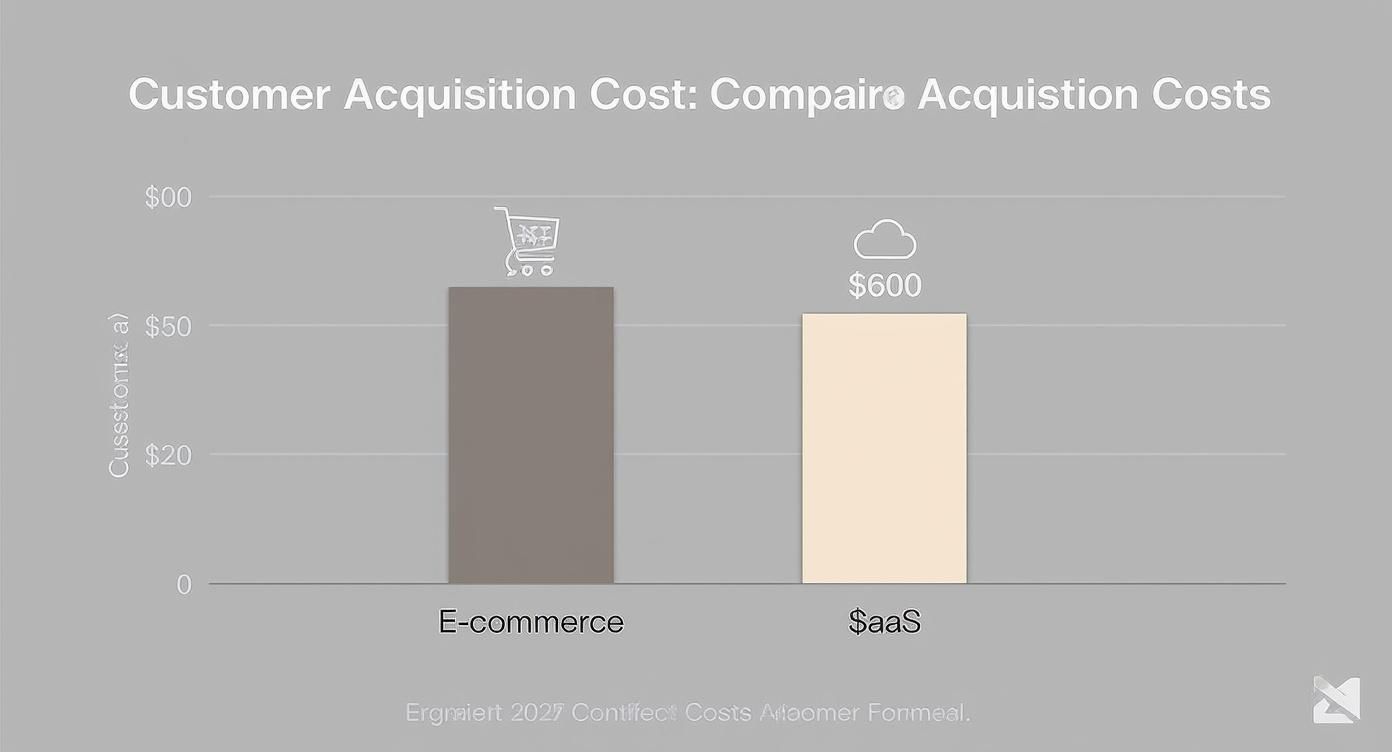
There’s a massive gap between acquisition costs for high-volume, low-price models (e-commerce) and high-touch, high-value ones (SaaS).
Let’s look at an example. Here’s a sample analysis for a B2B SaaS company over one quarter.
Sample CAC analysis by marketing channel
| Channel | Total Spend | New Customers | CAC per Channel |
|---|---|---|---|
| Paid Search (Google Ads) | $15,000 | 50 | $300 |
| Organic Search (SEO) | $6,000 | 120 | $50 |
| Paid Social (LinkedIn) | $12,000 | 30 | $400 |
| Email Marketing | $2,000 | 25 | $80 |
The table makes it obvious. SEO is the most efficient channel at $50 per customer. LinkedIn ads are costing $400 per acquisition.
By segmenting your CAC, you can stop guessing and start allocating your budget with precision.
Why your CAC is rising and how to lower it
If your CAC is creeping up, you’re not alone. Costs are climbing due to crowded markets and ad competition.
But a rising CAC isn’t a dead end. It’s a signal to get smarter about how you grow. Focus on spending better, not just spending more.
Optimise your conversion rates
Before you pour another dollar into ads, get the most out of the traffic you already have. This is where conversion rate optimization (CRO) is your best friend.
Look at every step of your customer’s journey:
- Landing pages: Are they clear, fast, and focused on one action?
- Sign-up forms: Are you asking for too much information upfront?
- Checkout process: Is it frictionless, or is that where people drop off?
A/B test your headlines and calls-to-action. A 1% lift in your conversion rate means you acquire more customers for the same ad spend, which directly lowers your CAC.
Focus on retention and referrals
The cheapest customer to acquire is the one you already have. Shifting focus from acquisition to retention is a powerful move to control costs.
Happy customers don’t just stick around-they become your best marketing channel.
A strong referral program turns your existing customers into a low-cost acquisition engine. This isn’t a "nice-to-have." Data shows that CAC has jumped significantly in recent years, forcing smart brands to lean on retention. You can see more customer acquisition statistics on inbeat.agency.
Explore lower-cost channels
Don’t get stuck with expensive paid channels. Diversify your marketing mix to stabilize your CAC. As a product moves through its lifecycle, different channels become more or less effective. See our guide on examples of the product life cycle.
Consider investing in:
- Organic SEO: Content and SEO are long-term plays that generate qualified leads at a fraction of the cost.
- Community building: A genuine community on Slack or Discord fosters loyalty and word-of-mouth growth.
- Partnerships: Team up with non-competing businesses that share your audience.
Ready to build a pitch deck that showcases your strong CAC? At Pitchili, we combine VC insight with data-driven design to help you create a narrative that converts investor attention into term sheets. Learn more about our pitch deck services.
FAQ
What is a good LTV to CAC ratio?
The magic number is 3:1. It’s the benchmark for a healthy, scalable business. For every dollar you spend to get a customer, you should get three dollars back.
– A ratio below 3:1 is a red flag. You might be spending too much.
– A ratio much higher, like 5:1, can mean you’re not investing enough in growth.
How often should I calculate CAC?
Calculate it monthly and quarterly. Monthly check-ins spot trends in real-time. They let you react fast. Quarterly calculations smooth out bumps and give you a stable baseline for financial models and board updates.
What’s the difference between blended CAC and paid CAC?
Confusing these two leads to bad budget decisions. Blended CAC is your all-in number. It’s your total sales and marketing spend divided by all new customers from any channel. Paid CAC is surgical. It only counts costs from paid campaigns (like Google Ads) and divides that by customers who came directly from those efforts.
