
A great idea is nothing without a business model. Founders often struggle to connect their product to a clear revenue strategy. This isn’t theoretical – it’s the engine that convinces investors and determines if your startup survives.
This guide breaks down 10 proven business model examples. We’ll show you how they work, what KPIs to track, and how successful companies use them.
1. Subscription model
The subscription model locks in customers with a recurring fee, usually monthly or annually. This creates a predictable revenue stream. It shifts focus from one-off sales to long-term relationships and customer lifetime value (LTV).
It’s one of the most popular business model examples for SaaS and media companies.

How it works
The model exchanges consistent value for consistent payment. Success hinges on customer retention.
- Key metric: The ratio of Customer Lifetime Value (LTV) to Customer Acquisition Cost (CAC). A healthy SaaS business aims for an LTV:CAC ratio of 3:1 or higher.
- Core challenge: Fighting churn – the rate customers cancel. High churn kills profitability.
- Growth levers: Acquiring new subscribers, upselling existing ones, and minimizing churn.
Quick example: Netflix
Netflix turned a massive content library into a low-cost monthly habit. The value is ongoing entertainment, making the subscription feel essential.
2. Freemium model
The freemium model offers a basic product for free. Users can upgrade to a paid version for advanced features. This model acts as a marketing funnel. It lets the product’s value drive conversions.
It is one of the most effective business model examples for product-led growth.
How it works
The free tier must be valuable enough to attract users but limited enough to encourage upgrades. It’s a balancing act.
- Key metric: The Free-to-Paid Conversion Rate. A rate of 2-5% is considered healthy for most B2B SaaS businesses.
- Core challenge: Preventing the free tier from being too good. If users have no incentive to upgrade, you lose revenue.
- Growth levers: Maximizing free user signups and optimizing the conversion path to paid plans.
Quick example: Slack
Slack’s free version is powerful enough for small teams. As a team grows, they hit limits on message history and integrations. This creates a natural trigger to upgrade to a paid plan.
3. Marketplace model
A marketplace connects buyers and sellers on a single platform. It earns revenue from commissions or listing fees. The model’s power comes from network effects – more sellers attract more buyers, and vice versa.
Play video10 essential business model examples for founders videoThis loads content from YouTube.
This model can create huge, defensible businesses. Scaling often requires significant capital, like Series B funding.
How it works
Marketplaces thrive on liquidity. This means a seller can easily find a buyer, and a buyer can easily find a seller.
- Key metric: Gross Merchandise Volume (GMV). This is the total value of all transactions on the platform. It signals scale.
- Core challenge: Solving the chicken-and-egg problem. You need both buyers and sellers to have a valuable platform.
- Growth levers: Increasing active users, improving the match rate, and raising the average transaction value.
Quick example: Uber
Uber solved the chicken-and-egg problem by subsidizing one side of the market. They offered incentives to drivers to build up supply, which then attracted riders looking for a reliable taxi alternative.
4. Advertising/ad-supported model
The advertising model offers a free product to users. Revenue comes from selling ad space to third parties. This model monetizes user attention and data.
It is one of the most scalable business model examples for platforms that attract a massive audience.

How it works
This model must balance the needs of users and advertisers. Success requires massive scale and high user engagement.
- Key metrics: Daily Active Users (DAU) and Average Revenue Per User (ARPU). High engagement creates ad inventory, and effective targeting drives up ARPU.
- Core challenge: The user experience vs. monetization trade-off. Too many ads will drive users away.
- Growth levers: Growing the user base, increasing engagement, and improving ad targeting technology.
Quick example: Meta (Facebook)
Meta uses personal data to deliver highly targeted ads. For Meta, the user is not the customer – they are the product sold to advertisers. This precision makes its ad space extremely valuable.
5. Licensing model
The licensing model grants others permission to use your intellectual property (IP). This can be patents, trademarks, or software. In exchange, you get a licensing fee or royalty.
This is a high-margin way to monetize assets you’ve already created.
How it works
The model’s success depends on the strength of your IP. The goal is to create an asset once and sell the rights to use it many times.
- Key metric: Royalty Revenue. This is often a percentage of the licensee’s sales.
- Core challenge: IP protection and enforcement. You must prevent unauthorized use and ensure licensees follow the terms.
- Growth levers: Signing new licensees, expanding into new markets, and increasing the value of your IP to command higher rates.
Quick example: Qualcomm
Qualcomm doesn’t sell phones. It licenses its essential wireless patents to nearly every smartphone maker in the world. This generates billions in high-margin revenue from its R&D.
6. Freemium tiered/SaaS model
This model blends a free entry point with multiple paid subscription levels. It attracts a wide user base with a valuable free product. It then converts some users to paid tiers for more features or higher limits.
The free product is the primary marketing engine, lowering customer acquisition costs.
How it works
This model requires a careful balance. The free product must be useful, but the paid tiers must offer clear, compelling value.
- Key metric: Free-to-Paid Conversion Rate. A benchmark of 2-5% is typical for B2B SaaS.
- Core challenge: Value attribution. You must decide which features go in which tier without crippling the free product.
- Growth levers: Maximizing top-of-funnel signups and optimizing the upgrade path.
Quick example: Notion
Notion offers a powerful free version for individuals. As users create more content or collaborate with a team, they hit block limits. This creates a natural incentive to upgrade to a paid team plan.
7. Agency/services model
The agency model generates revenue by providing specialized expertise to clients. You trade time and knowledge for money. This is done through project fees, hourly rates, or retainers.
It’s one of the most direct business model examples.
How it works
The model’s success is tied to the value of its people and its operational efficiency.
- Key metric: Billable Utilization Rate. This measures the percentage of an employee’s time billed to clients. High utilization means high efficiency.
- Core challenge: Scalability. Growth is often tied to headcount, which can lead to linear, not exponential, growth.
- Growth levers: Increasing rates, securing long-term retainers, and "productizing" services into repeatable packages.
Quick example: design agencies
A design agency might shift from one-off logo projects to a "Brand in a Box" package. This productized service has a fixed scope and price, making it easier to sell and scale. The key is a strong value proposition.
8. Direct-to-consumer (D2C/DTC) model
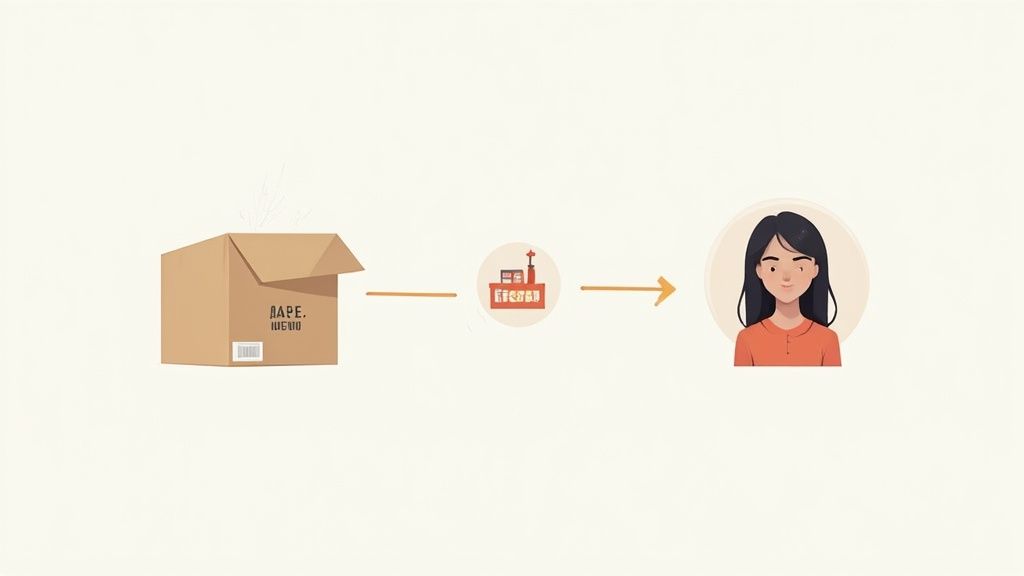
A D2C brand sells its products directly to consumers. It bypasses traditional retailers. This gives the brand full control over its customer relationships and data.
Cutting out the middleman often leads to higher profit margins.
How it works
The D2C model owns the entire customer journey. This direct relationship is a powerful asset.
- Key metrics: Customer Acquisition Cost (CAC) and Lifetime Value (LTV). The goal is a low CAC and a high LTV.
- Core challenge: Customer acquisition. D2C brands must generate their own traffic, which often means high marketing spend.
- Growth levers: Effective digital marketing, a strong brand identity, and using customer data for personalization.
Quick example: Warby Parker
Warby Parker disrupted the eyewear industry by selling stylish, affordable glasses online. By owning the entire process, they offered lower prices and a better customer experience than traditional retailers.
9. Dropshipping model
Dropshipping is an e-commerce model where you sell products without holding inventory. A third-party supplier ships products directly to your customer.
This asset-light approach lowers the barrier to entry for starting an online store.
How it works
Success in dropshipping is about marketing and branding, not logistics. You are the demand generation expert.
- Key metric: Profit Margin per Sale. You must maintain a healthy margin after product, shipping, and customer acquisition costs.
- Core challenge: Differentiation. Competition is fierce. Building a unique brand is essential to stand out.
- Growth levers: Effective digital marketing, identifying profitable niche products, and optimizing the customer experience.
Quick example: niche stores
Many successful dropshippers focus on a specific niche, like gear for pet owners. They build a strong brand around this niche and become the go-to source, even if they don’t hold any inventory themselves.
10. Affiliate marketing model
Affiliate marketing is a performance-based model. Businesses pay partners (affiliates) a commission for generating sales or leads.
It’s a highly efficient customer acquisition channel. You only pay for results.
How it works
The model relies on a win-win relationship. Merchants get low-risk traffic, and affiliates monetize their audience’s trust.
- Key metric: Conversion Rate. The percentage of referred clicks that turn into sales.
- Core challenge: Attribution. You need to accurately track which affiliate drove which sale.
- Growth levers: Recruiting high-quality affiliates and optimizing commission structures to incentivize top performers.
Quick example: Amazon Associates
Amazon’s affiliate program turned millions of bloggers into a distributed sales force. A tech review blog can link to products on Amazon and earn a commission on every sale they refer.
A quick comparison of business models
| Business Model | How it Works | Key Metric |
|---|---|---|
| Subscription | Customers pay a recurring fee for access. | LTV:CAC Ratio |
| Freemium | Offer a free basic product, charge for premium. | Free-to-Paid Conversion |
| Marketplace | Connect buyers and sellers, take a cut. | Gross Merchandise Volume (GMV) |
| Advertising | Offer a free product, sell ads to businesses. | Average Revenue Per User (ARPU) |
| Licensing | Sell rights to use your intellectual property. | Royalty Revenue |
| Freemium Tiered | Free entry-point with multiple paid tiers. | Free-to-Paid Conversion |
| Agency/Services | Sell specialized expertise and labor. | Billable Utilization Rate |
| D2C | Sell your own products directly to consumers. | CAC & LTV |
| Dropshipping | Sell products online without holding inventory. | Profit Margin per Sale |
| Affiliate Marketing | Pay partners a commission for sales they refer. | Conversion Rate |
Final thoughts
Your business model is the engine of your company. It translates your solution into scalable growth.
- Align with value. Your revenue must connect to the value your customers get.
- Mind your unit economics. A great idea with bad numbers is a ticking time bomb.
- Combine models. The most resilient companies mix and match models to build a competitive moat.
Don’t just read about these business model examples. Map out your current model. Then, try to imagine your business with two different models from this list. This exercise can unlock new paths to growth.
A well-defined business model is the foundation of a compelling pitch. Pitchili helps you translate your strategy into a clear, investor-ready narrative that gets funded.
