
You’re running out of cash. It’s the number one reason startups die.
This guide gives you a simple way to calculate your burn rate. You’ll learn how to find your real runway and make smarter spending decisions today.
First, understand the two types of burn rate
Your burn rate is the speed at which you spend cash. Knowing it isn’t optional – it’s how you survive.
Running out of money is why 29% of startups fail. This isn’t just a number. It’s a warning.
To get started, you need to know the difference between gross burn and net burn. For a reality check, you can compare your numbers to these SaaS burn rate benchmarks from Phoenix Strategy Group.
Gross burn: your total monthly spending
Gross burn is the total cash you spend each month.
It’s a simple sum of all expenses-salaries, rent, ads, and software. It ignores all revenue.
This number shows you the minimum cash required to keep operating. It’s your worst-case spending scenario.
Net burn: your true monthly cash loss
Net burn is your true financial picture.
It’s your total expenses (gross burn) minus your incoming cash (revenue). This is the number that really matters.
It tells you how much cash you actually lose each month. You’ll use this figure to calculate your startup’s runway.
Net Burn = Gross Burn – Monthly Revenue
Example: A SaaS startup spends $80,000 per month. That’s their gross burn. They generate $20,000 in revenue. Their net burn is $60,000.
Gross burn vs. net burn: a quick comparison
Gross and net burn tell different stories. This table clarifies the difference.
| Metric | What it measures | Why it matters |
|---|---|---|
| Gross burn | Total monthly cash expenses, ignoring revenue. | Shows your total operational cost and worst-case scenario. |
| Net burn | Total monthly cash expenses minus total monthly revenue. | Reveals your actual monthly cash loss and is used to calculate runway. |
Gross burn shows the cost of running the machine. Net burn shows how much fuel you’re losing. You need both to make smart decisions.
How to calculate your gross and net burn rate
It’s time to run the numbers. This is a real-time health check for your startup.
We’ll walk through both gross and net burn with a simple example. Let’s use a bootstrapped e-commerce brand to see how it works.
Calculate your gross burn
Your gross burn is your total monthly cash spend. To find it, you just add up every cash expense.
Start by listing all your monthly costs.
- Fixed costs: Predictable expenses like salaries, rent, and software.
- Variable costs: Expenses that change with activity, like ad spend and inventory.
Example: An e-commerce brand’s monthly expenses.
- Payroll & benefits: $15,000
- Rent (warehouse): $3,000
- Software (Shopify, etc.): $500
- Marketing (ad spend): $5,000
- Inventory purchases: $10,000
- Shipping & fulfillment: $4,000
The brand’s total gross burn is $37,500.
Calculate your net burn
Net burn tells you how much cash you are actually losing each month.
The formula is simple:
Net Burn = Gross Burn – Cash Revenue
Let’s stick with our e-commerce brand. Say they brought in $30,000 in cash revenue last month.
Example: The same brand’s net burn calculation.
- Gross burn: $37,500
- Cash revenue: $30,000
- Net burn ($37,500 – $30,000) = $7,500
The company’s cash balance dropped by $7,500 that month. This is the number that dictates runway.
How to calculate your startup’s runway
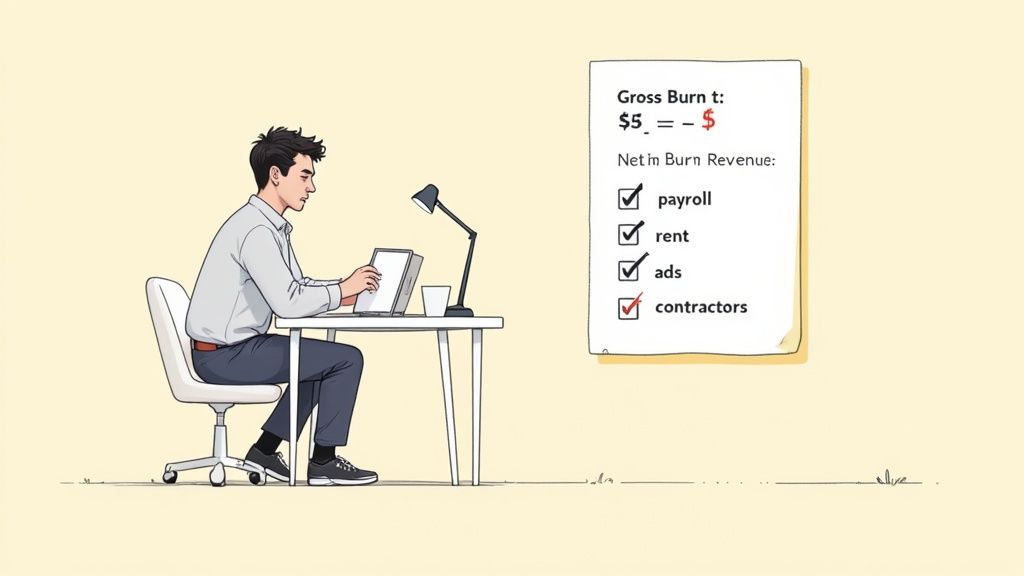
Knowing your burn rate is step one. Knowing how much time it buys you is everything.
This is your runway – the number of months until you run out of cash.
Roughly 45% of new businesses fail by year five, often due to running out of runway. The team at Pilot has some great insights on this.
The basic runway formula
The math is straightforward.
Runway = Total Cash Balance / Monthly Net Burn
Let’s say you have $500,000 in cash and your net burn is $50,000 a month. Your runway is 10 months.
This is your hard deadline to raise money or become profitable. Use a good startup financial projections template to keep your numbers clean.
Don’t rely on a single month’s data
Basing your runway on one month’s data is a mistake.
A big marketing spend or a great sales month can skew the numbers. You might get a false sense of security or panic.
The smart move is to average your net burn over the last three months. This smooths out the bumps for a more honest view.
Example: Using a 3-month average.
- Cash on hand: $500,000
- Month 1 net burn: $60,000
- Month 2 net burn: $45,000
- Month 3 net burn: $50,000
Your average monthly burn is $51,667. Your runway is now 9.7 months ($500,000 / $51,667). Every week counts.
How to reduce burn without killing growth

A high burn rate is stressful. But panicked budget cuts can do more harm than good.
The goal isn’t to stop spending. It’s to spend smarter. This means making strategic cuts that extend runway without hurting momentum.
Audit your subscriptions and tools
Your software stack is the first place to look for quick wins.
Export a list of every recurring software expense. Then ask these questions:
- Is it essential? If it doesn’t directly contribute to revenue or product, cut it.
- Is there overlap? Are you paying for two project management tools? Consolidate.
- Are we on the right plan? Can you downgrade or switch to annual billing for a discount?
Example: A Series A startup found they were paying for 50 design tool licenses but only 15 were active. By changing their plan, they saved $4,200 per month.
Optimize your marketing spend
Instead of cutting your marketing budget, reallocate it.
Shift cash from low-ROI channels to high-performing ones. This requires knowing your numbers. You must know how to calculate customer acquisition cost.
Pause experimental campaigns that aren’t working. Double down on what is proven to deliver.
Rethink your hiring strategy
Payroll is usually your biggest expense. Before opening a new full-time role, consider alternatives.
- Freelancers for projects: Cheaper for a website redesign or content campaign.
- Part-time roles: An expert working part-time is often better than a full-time junior.
This keeps fixed costs lean while giving you access to the talent you need.
Your monthly burn rate analysis checklist
Tracking your burn rate is a monthly discipline. This checklist makes it simple.
Run through it at the end of every month. It forces you to be honest about your spending and stay ahead of surprises.
| Category | Action item | Done (✓) |
|---|---|---|
| Expense review | Categorize all expenses from the past 3 months into ‘essential’ and ‘non-essential.’ | |
| Revenue tracking | Compare this month’s cash revenue against your financial projections. | |
| Calculation | Calculate your 3-month average net burn to account for variability. | |
| Runway analysis | Recalculate your startup runway using your current cash balance and average net burn. | |
| Strategy | Identify one non-essential expense to cut or one high-ROI channel to double down on. |
Treat this as a non-negotiable meeting with your co-founders each month. A consistent review process is what keeps you alive.
Play videoHow to calculate burn rate: A simple founder's guide videoThis loads content from YouTube.
Knowing your burn rate is one part of the puzzle. The next is telling a story that gets investors excited. Get a deck that raises capital.
FAQ
What is a "good" burn rate?
This is the wrong question. There is no magic number. A "good" burn rate is relative to your stage and industry. A deep-tech startup might burn $200k+ a month on R&D. A bootstrapped SaaS company might aim for profitability from day one. Instead, ask: "Is my burn efficient?" If you spend $50,000 a month to acquire users who bring in $5,000 of new revenue, that burn is productive. If you spend it on office perks with no measurable impact, that’s just burning cash.
How often should i calculate it?
Monthly. This is non-negotiable. Track a three-month rolling average. This smooths out any spikes or dips and gives you a more stable number for forecasting your runway.
Do non-cash expenses count?
No. Burn rate is all about cash. Items like stock-based compensation or depreciation are accounting entries. They don’t drain your bank account. Focus only on the real dollars leaving your business.
How do VCs view my burn rate?
Investors see burn as a proxy for capital efficiency. A high burn isn’t an automatic deal-breaker if it fuels growth. They want proof you are deploying their capital intelligently. An out-of-control burn with flat growth shows a lack of discipline. A strategic, high burn that unlocks a massive market gets them excited. It’s all about the story your numbers tell when you look for ways to find investors.
