
Your pitch deck is your startup’s first product. Investors are its first users. A sloppy design signals a lack of attention to detail – a red flag for anyone evaluating your business.
Strong visual communication isn’t just about looking good. It’s about building credibility and making complex ideas instantly understandable. This guide covers the essential design disciplines that will transform your pitch from forgettable to fundable.
1. Logo and identity design
Logo and identity design creates the entire visual system for your brand. It’s more than a symbol. It’s the colors, typography, and imagery that make your startup instantly recognizable.
A strong brand identity ensures every interaction feels cohesive. It translates your company’s core values into a consistent experience for your audience. For example, Apple’s minimalist aesthetic creates an immediate connection and builds lasting loyalty.
Actionable tip for your pitch deck
- Show, don’t tell. Use a slide to display your logo, color palette, and primary typography. This shows a mature approach to your business.
- Be consistent. Apply your brand identity to every slide. Use your brand fonts and colors in all charts and graphs.
- Connect identity to values. Explain how your design choices reflect your mission. A bold font might reflect a disruptive tech startup.
Example: A dedicated slide in your deck shows your logo, your primary color palette with hex codes (e.g., #0A0A0A, #4A90E2), and your chosen header and body fonts.
Want to explore different visual marks? See this guide on the 7 styles of logos on pitchili.com.
2. UI/UX design
UI/UX design creates seamless digital product interactions.
- User Experience (UX) is the overall feeling a user has. It covers research, strategy, and logic.
- User Interface (UI) is the visual part. It includes the graphic layout, buttons, and interactive elements.
Effective UI/UX directly impacts user retention. Over 70% of online businesses fail due to bad usability. It’s not just about looking good – it’s about solving the user’s problem effortlessly.
Actionable tip for your pitch deck
- Show the flow. Include high-fidelity mockups or a short video of your app’s user flow.
- Highlight key metrics. Showcase data like task completion rates or reduced churn to prove your design’s impact on business goals.
- Explain your process. Briefly mention user interviews or A/B testing. This shows you build based on evidence, not assumptions.
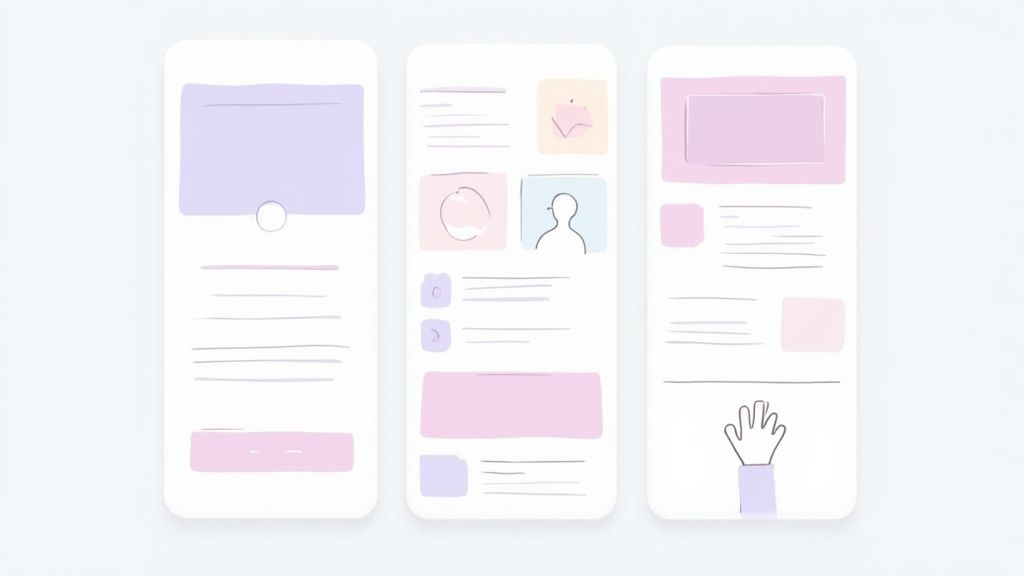
Example: A slide shows three mobile screens side-by-side, illustrating the user journey from login to checkout in your app.
Great design is foundational to growth. Explore professional user experience design services on pitchili.com to elevate your startup.
3. Motion graphics design
Motion graphics brings static design elements to life with animation. It transforms data visualizations, explainer videos, and brand introductions into engaging visual experiences.
This discipline is powerful for communicating messages dynamically. It captures attention and simplifies complex information in a digestible format. Think of the dynamic brand animations used by companies like Adobe.
Play video8 types of graphic design every founder should know videoThis loads content from YouTube.
Actionable tip for your pitch deck
- Create a dynamic opening. Use a short, professional animation of your logo on your title slide. It grabs attention from the first second.
- Animate your data. Use subtle motion to make charts more impactful. Animate a bar chart growing to show revenue trajectory.
- Produce a short explainer. If your product is complex, embed a 30-60 second motion graphics video.
Example: Instead of a static bar chart, the bars animate upwards to their final values when the slide appears, visually emphasizing growth.
4. Web design
Web design is the art of creating websites that are both visually engaging and functionally intuitive. It combines UX/UI principles, typography, and layout to build user-friendly digital experiences.
Good web design requires consideration for responsiveness across devices, accessibility, and performance. An effective site guides users seamlessly toward their goals. It ensures your site loads quickly and is easy to navigate for everyone.
Actionable tip for your pitch deck
- Showcase mobile-first design. Include mockups of your product on a smartphone. Most users – and investors – will see your site on mobile first.
- Highlight key user flows. Show a 3-step visual flow of a core action, like signing up. This proves your design is a functional business tool.
- Optimize for presentation. Ensure website screenshots are high-resolution. Use callouts to focus attention on critical features.
Example: A slide displays your website’s homepage on a laptop mockup and a key product page on a phone mockup to show responsiveness.
To understand modern layouts, explore the resources at CSS-Tricks.
5. Illustration and icon design
Illustration uses custom-drawn visuals to communicate stories and concepts. It offers a unique and emotionally resonant way to connect with an audience.
This discipline gives brands a distinct personality, like Mailchimp’s friendly mascot. It simplifies complex ideas and makes technology feel more human. A consistent illustrative style makes your visual language cohesive and distinctive.
Actionable tip for your pitch deck
- Humanize your data. Use simple spot illustrations or icons to bring charts to life.
- Establish a unique brand world. A consistent illustrative style across your deck sets you apart from competitors.
- Simplify complex concepts. Use illustrations to create a visual metaphor if your product is highly technical.
Example: On your market size slide, use simple icons to represent different user segments instead of a generic bulleted list.
6. Typography design
Typography is the art of arranging type to make written language legible, readable, and appealing. It involves font selection, size, hierarchy, and spacing.
Great typography enhances communication and sets the tone. It ensures a message is not just seen, but felt. It guides the reader’s eye seamlessly through content. Effective typography makes information accessible and strengthens the design aesthetic.
Actionable tip for your pitch deck
- Create a clear hierarchy. Use 3-5 distinct sizes for headlines, subheadings, and body text. This makes slides easy to scan.
- Limit your font families. Stick to a maximum of two fonts. A primary font for headings and a secondary for body copy looks professional.
- Prioritize readability. Ensure your text has sufficient contrast against its background. Use a line height around 1.5x the font size.
Example: Your slide titles are 32pt bold, subtitles are 20pt regular, and body text is 14pt regular, creating an immediate visual order.
For a deeper dive, check out Ellen Lupton’s book, Thinking with Type, on her website, elupton.com.
7. Data visualization design
Data visualization presents complex data in a clear and compelling format. It transforms raw numbers into insightful graphics like charts and infographics.
This discipline makes complex information understandable at a glance. It’s about telling a story with data, enabling audiences to see patterns and trends. Effective data visualization helps people make informed decisions quickly.
Actionable tip for your pitch deck
- Clarify your key metric. Don’t just show a chart. Highlight the single most important data point with a contrasting color or annotation.
- Choose the right chart. Use a bar chart for comparison, a line chart for trends, and a pie chart for parts of a whole. The wrong format can confuse your audience.
- Keep it clean. Remove anything that doesn’t add understanding, like gridlines or 3D effects. Every element should make your data story clearer.
Example: Your revenue growth line chart uses a thicker line and a brighter brand color for the current year’s projection, drawing the eye immediately.
See Edward Tufte’s foundational work on visualizing quantitative information.
8. Advertising and marketing design
Advertising design creates visual content to persuade and engage audiences. It covers everything from digital banners and social media ads to integrated campaigns.
The goal is to capture attention and drive a specific action. Powerful campaigns like Nike’s "Just Do It" show how creative visuals and compelling messages can build iconic brands. It’s a blend of art, psychology, and business strategy.
Actionable tip for your pitch deck
- Showcase traction with ad mockups. Include a slide with your best-performing social media ads. Display the creative next to key metrics like CTR and CAC.
- Demonstrate brand consistency. Ensure your ad mockups reflect the same visual identity used throughout your presentation.
- Outline your GTM with visuals. Use visuals from an ad campaign to illustrate your go-to-market strategy. This makes abstract plans tangible.
Example: A slide shows a Facebook ad mockup on the left and bullet points on the right detailing its 2.5x ROAS (Return on Ad Spend).
Founder’s graphic design checklist
Use this simple framework to ensure your pitch deck leverages the right design principles.
| Design Discipline | Key Question | Yes / No | Action Item |
|---|---|---|---|
| Logo & Identity | Is my branding (logo, colors, fonts) used consistently on every slide? | ☐ | Create a master slide template with the correct brand assets. |
| UI/UX Design | Do my product mockups clearly show how a user solves a problem? | ☐ | Add a 3-step visual user flow instead of static screenshots. |
| Motion Graphics | Could a subtle animation make my key data point more impactful? | ☐ | Animate the title slide logo or the primary growth chart. |
| Web Design | Have I shown that my product works well on a mobile device? | ☐ | Add a smartphone mockup next to the desktop view. |
| Illustration & Icons | Are my slides easy to scan and visually engaging? | ☐ | Replace text-heavy bullet points with simple icons. |
| Typography | Is there a clear visual hierarchy between titles, subtitles, and text? | ☐ | Check font sizes and weights to ensure scannability from a distance. |
| Data Visualization | Does my most important number on each chart stand out immediately? | ☐ | Use a bold color or callout box to highlight the key metric. |
| Marketing Design | Do my visuals prove I have a clear go-to-market strategy? | ☐ | Include a mockup of a top-performing ad with its key metrics. |
Design isn’t a cost – it’s a competitive advantage
Understanding the different types of graphics design is a strategic necessity for founders.
Your pitch deck is a product. Every design choice influences how investors see your company’s potential. Strong data visualization turns dense numbers into persuasive evidence. A polished brand identity conveys professionalism and a clear vision.
Think of these design types as tools.
- For clarity: Use data visualization and typography.
- For connection: Use brand identity design.
- For engagement: Use UI/UX and motion graphics.
- For impact: Use advertising design principles.
This strategic application of design is what separates a good pitch from a funded one.
Ready to turn your vision into a venture-backed reality? Pitchili combines expert storytelling with world-class design to build pitch decks that get funded. We use all the different types of graphics design to ensure your startup’s story is not just seen, but felt. Build your winning pitch with us.
