
It’s a classic mix-up for founders, but the difference between a business model and a business plan is simple. Your model is the logic of how you make money. Your plan is the roadmap for executing that logic. Getting this right is critical because investors fund businesses, not just ideas, and they need to see you’ve mastered both.
This guide will break down the crucial differences, show you why investors focus on the model first, and give you a framework for translating both into a pitch deck narrative that gets you funded.
Key takeaways
- A business model explains how you create, deliver, and capture value – the what and the why.
- A business plan is the operational roadmap for executing the model – the how and the when.
- Investors scrutinize your model first for scalability, defensibility, and unit economics.
- Your pitch deck should weave key elements of your plan into a compelling story that supports your model.
- Professional design isn’t a luxury; it’s a tool that signals credibility and makes your vision clear.
Your business model vs. business plan explained
Founders often use these terms interchangeably. But for an investor, they represent two different – and equally vital – pieces of the puzzle. Nailing both is non-negotiable if you want to build a fundable company.
Your business model is the why it works. Your business plan is the how you’ll make it work. One can’t exist without the other.
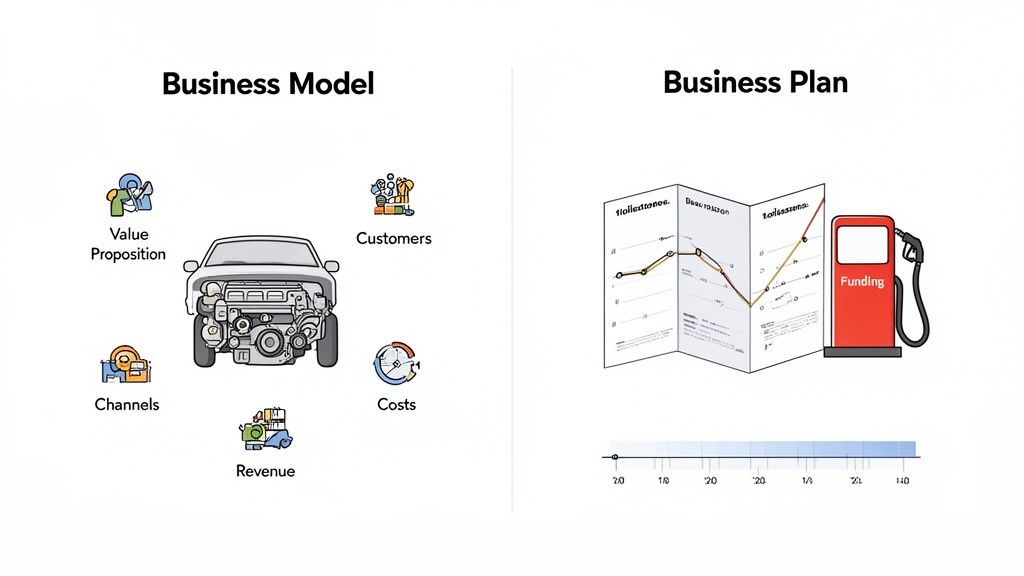
What is a business model?
Your business model explains how your company creates, delivers, and captures value. It answers the one question every investor asks first: “So, how does this make money?”
It’s the high-level architecture of your venture. A solid model clearly defines a few key things:
- Value Proposition: What problem are you solving, and for whom?
- Customer Segments: Who, specifically, are you selling to?
- Channels: How do you reach and sell to those customers?
- Revenue Streams: How do you get paid? Is it a one-time sale, a subscription, a usage fee?
- Cost Structure: What are the major costs required to run this model?
A great tool for sketching this out is the Business Model Canvas. To go deeper, check out our guide where the Business Model Canvas is explained with examples.
What is a business plan?
If the model is the architecture, the business plan is the detailed construction schedule. It’s a tactical document that lays out your strategy for bringing the model to life, usually over the next three to five years.
It’s less of a "what if" and more of a "here’s how." Research from Shopify highlights that a business plan isn’t just for investors; it forces you to think through every operational detail. A comprehensive plan gets into the weeds with things like:
- Market Analysis: Deep research on your industry, market size, and competitors.
- Marketing & Sales Strategy: Your playbook for attracting and converting customers.
- Operations Plan: Who does what, what tech you need, and your day-to-day workflow.
- Financial Projections: Detailed forecasts of your revenue, expenses, and cash flow.
To make the distinction clear, here’s a quick comparison.
Business model vs. business plan at a glance
| Attribute | Business Model | Business Plan |
|---|---|---|
| Purpose | To explain the logic of how the business creates value and generates revenue. | To provide a detailed roadmap for executing the business model over time. |
| Focus | "What" & "Why" (Value creation, core mechanics) | "How" & "When" (Strategy, operations, execution) |
| Format | Often a one-page canvas or conceptual diagram. | A comprehensive, multi-page document. |
| Audience | Primarily internal (founders, team) but also crucial for investors. | Primarily external (investors, lenders, partners) and internal for leadership. |
| Timeframe | Dynamic; can pivot and evolve quickly. | Static snapshot; typically covers a 3-5 year period. |
| Core Components | Value proposition, customer segments, revenue streams, cost structure. | Market analysis, marketing strategy, operations, financial projections. |
You can’t have a credible plan without a viable model, and a great model is just an idea without a solid plan. Investors need to see that you have both working in perfect harmony.
Why investors focus on your business model first
Venture capitalists see thousands of pitches. They’ve learned to spot patterns, and the biggest red flag isn’t a slightly optimistic financial forecast – it’s a broken business model. A brilliant, 100-page business plan can’t save a business with flawed logic at its core.
Investors look at the business model and business plan through different lenses. They obsess over the model first because it reveals the engine of your business. If the engine can’t generate power efficiently, the route is irrelevant.
The three pillars investors scrutinize
When an investor dissects your business model, they’re testing its strength against three core pillars. These pillars determine whether your startup has the potential for the 10x return they need.
- Scalability: Can this business grow exponentially without a proportional spike in costs? A SaaS company can serve 10,000 customers with nearly the same infrastructure as 1,000. In contrast, a consulting firm’s revenue is tied to hiring more people, making it less scalable.
- Defensibility: What stops a competitor from copying you? This could be proprietary tech, a powerful brand, or network effects. Your plan might list marketing tactics, but the model must have a built-in “moat.”
- Profitability: How sound are your unit economics? Investors will immediately calculate your Customer Lifetime Value (LTV) against your Customer Acquisition Cost (CAC). According to a report from First Round Capital, a healthy LTV to CAC ratio is a top indicator of product-market fit. If it costs you $500 to acquire a customer who will only ever pay you $300, you have a leaky bucket.
A strong business model shows massive potential, even with a few unknowns in the execution plan. A weak model with a perfect plan is still a bad investment.
A tale of two models
Let’s compare two hypothetical startups seeking seed funding.
- Startup A: "SaaSCo" has a classic SaaS model. They charge $100/month for a B2B software tool. Their CAC is $600, and the average customer sticks around for 24 months.
- Startup B: "GadgetCo" sells a physical product for $100. Their CAC is $40, and the cost to produce each gadget is $50. Most customers only buy once.
SaaSCo’s plan might be fuzzy on marketing channels, but an investor sees a clear path to profit. The LTV is $2,400 ($100 x 24), which is 4x the CAC of $600. That’s a healthy, scalable engine.
GadgetCo, on the other hand, makes just $10 per sale ($100 price – $50 cost – $40 CAC). Even with a flawless plan, the business will struggle to generate VC-level returns. Building investor-ready financial modeling for startups is key to making sure your model tells the right story.
A thoughtful plan proves you understand your market and are a capable operator. It serves as supporting evidence for the model, not the main event. Your plan validates the assumptions you’ve made about CAC, market size, and sales cycles. To get a handle on how investors think about financial health, check out our guide on what is unit economics.
Translating your business model into a pitch deck narrative
Your business model is the engine. Your pitch deck is the sales pitch that gets investors excited to take a ride.
Your job isn’t to present a dry summary of your model. It’s to weave it into a compelling story that makes your company’s success feel inevitable. VCs give decks less than three minutes of their time on average, according to DocSend research. The decks that cut through the noise have a story that immediately answers two questions: "how do you make money?" and "can this get huge?"
If you need a framework for structuring your story, check out this ultimate guide to a winning pitch deck for investors. It breaks down the entire flow.
Start with the problem and solution
Before you explain your business model, investors have to understand why it needs to exist.
- The Problem Slide: This is your hook. Clearly and emotionally define the pain point. Use a relatable example or a jaw-dropping stat to make the problem feel urgent and massive.
- The Solution Slide: Present your company as the simple, elegant answer. This slide should feel like the perfect "after" to the "before" you just described.
This one-two punch sets the stage. Now investors are ready to hear how you’ll make money from it.
Nail the business model slide
This is where you show them the money. If it’s confusing, you’ve lost. The goal is dead-simple clarity.
Think of this slide as a simple formula for how you make money, one an investor can grasp in under 30 seconds. Ditch the jargon. Use visuals, icons, and clean headings. If you want to dig deeper into weaving these slides into a cohesive story, our guide on what is a narrative structure can help.
Here’s a quick checklist for this slide:
- Revenue Streams: List exactly how you get paid. SaaS with tiered subscriptions? A marketplace that takes a transaction fee? Be specific.
- Pricing Strategy: Show your pricing. For software, that could be a simple three-tier table. For a marketplace, show your commission rate.
- Core Unit Economics: Highlight your key metrics, especially Customer Acquisition Cost (CAC) and Lifetime Value (LTV). Showing a healthy LTV-to-CAC ratio – ideally 3:1 or better – is one of the most powerful signals you can send.
This is how an investor’s focus shifts from your concept to your strategy.
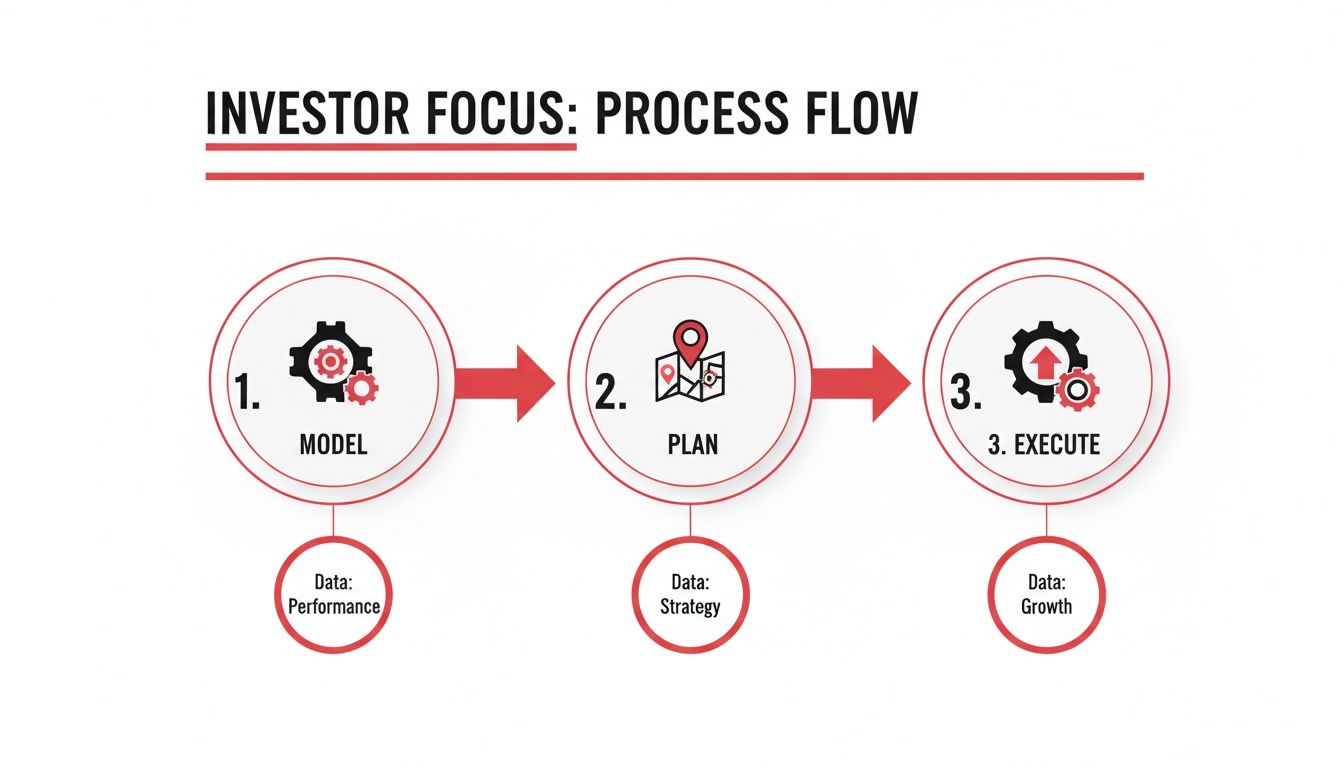
As you can see, the model is the engine. It drives the plan for growth and execution.
Use storytelling to illustrate the model
Numbers are essential, but stories are what people remember. Use a quick customer journey to bring your business model to life.
Instead of saying "We have a 5% transaction fee," say: "When a creator sells a $100 course on our platform, they keep $95, and we earn $5. With 10,000 creators, you can see how the revenue scales quickly."
This simple story makes your model tangible. It helps investors see how small actions add up to a massive business.
Integrating your business plan into your pitch deck
While investors get excited about your business model, it’s your business plan that proves you can pull it off. Your deck is the perfect place to showcase the strategic highlights from your plan. The goal is to distill your detailed thinking into a few powerful slides that build confidence. We’ll focus on turning three key parts of your plan into essential pitch deck slides: marketing, operations, and financials.
Crafting a credible go-to-market slide
Your business plan has a deep dive into your marketing and sales strategy. In your pitch deck, this becomes a single, high-impact Go-to-Market (GTM) slide. This isn’t a laundry list of channels; it’s a sharp plan for how you’ll land your first customers and scale.
Your GTM slide needs to answer:
- Who is your beachhead market? Define your initial, specific customer segment.
- What are your primary acquisition channels? Name the top 2-3 channels you’ll use for early traction. Think targeted LinkedIn outreach, content marketing, or partnerships.
- What are your initial CAC estimates? Show you’ve done the math by providing a realistic estimate for your Customer Acquisition Cost. For a deeper look, you can explore the basics of a strong marketing plan.
Showcasing your execution-ready team
Investors bet on the jockey, not just the horse. Your business plan’s section on your management is the raw material for your Team slide. Don’t just list everyone’s full bio. This slide should argue why your specific team is the only one that can make this venture succeed.
An investor should look at your Team slide and think, "They’ve solved this exact type of problem before."
For each key person (usually 2-4 founders), include:
- Their name and title.
- A high-quality, professional headshot.
- One sentence that highlights their most relevant accomplishment. Instead of a generic title, say: "Led product at Acme Inc., growing the user base from 10k to 1M."
Presenting your financials and the ask
The financial section of your business plan is where the detailed numbers live. For your deck, you need a summary that tells a story of growth. This usually takes two slides: Financial Projections and The Ask.
Your Financial Projections slide should show a simple, high-level forecast for the next 3-5 years. Stick to the metrics that matter most:
- Revenue
- Key Drivers (e.g., number of customers, average contract value)
- EBITDA or Net Profit
Below the chart, list 2-3 core assumptions that drive your model. This demonstrates your numbers are based on thoughtful logic.
Finally, your Ask and Use of Funds slide translates your financial plan into a clear request. State how much money you’re raising and show how you’ll spend it. A simple pie chart works well here, breaking down the allocation into key categories like Product Development (40%), Sales & Marketing (35%), and Hiring (25%).
How professional design communicates a winning vision
A brilliant business model buried in a confusing, amateur deck is dead on arrival. Professional design isn’t a luxury – it’s a strategic tool that signals credibility and helps secure that first meeting. A clean design tells an investor that you are serious, detail-oriented, and respect their time. This first impression shapes how they perceive your entire business model and business plan.
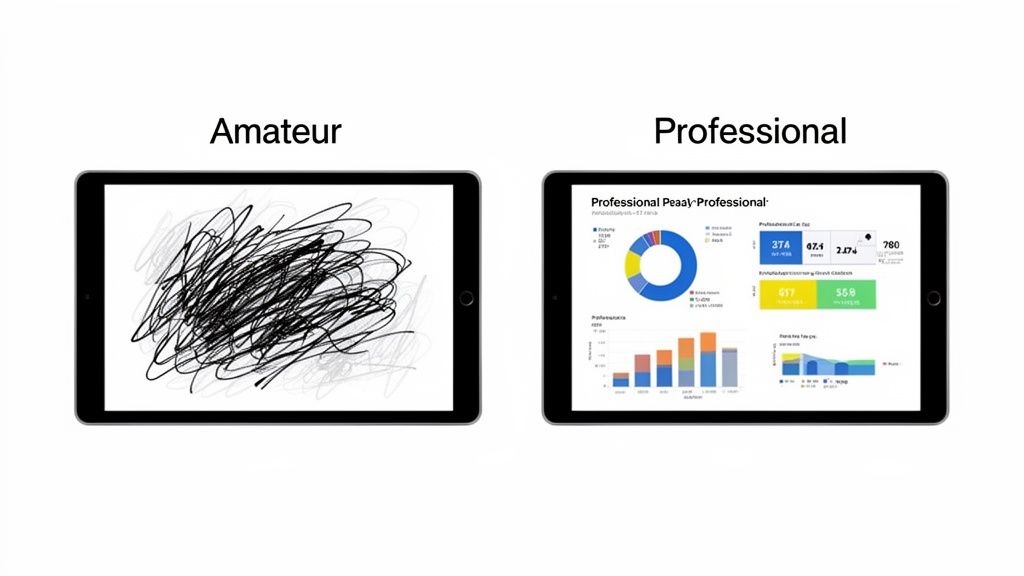
The image above says it all. The amateur side is chaotic. The professional side presents clear, data-driven insights that build trust instantly.
Data-driven design that makes an impact
Good pitch deck design is more science than art. It uses visual hierarchy to guide attention to the numbers that make or break your case:
- Highlighting Key Metrics: Using color and size to make your LTV-to-CAC ratio jump off the page.
- Simplifying Complex Data: Turning a messy spreadsheet into a clean chart that tells a clear story of growth.
- Ensuring Readability: Choosing fonts and layouts that make your deck scannable.
This ensures your message lands with clarity and authority.
Shifting your mindset from cost to investment
Investing in professional pitch deck design isn’t an expense – it’s a multiplier. Startups with pro-designed decks see higher success rates in funding rounds. Research shows professionally designed decks achieve significantly higher seed success rates and investor follow-up rates. You can dig into more data on startup pitch deck success rates to see the full picture.
Ultimately, a professionally designed pitch deck acts as a proxy for your ability to execute. It sends a powerful message to investors:
"We are a team that pays attention to detail. We communicate clearly, and we are professional. We have a credible plan to execute our business model."
When an investor sees a polished deck, they see a team that is prepared and has the professionalism to build a billion-dollar company.
A founder’s pre-pitch checklist
Before you send that deck, it’s time for one last quality check. A great pitch translates your business model and business plan into a story that gets investors hooked. Use this quick checklist to pressure-test your narrative from an investor’s point of view.
Your business model and core story
- The 30-Second Test: Can you explain how your business works in 30 seconds, clean and simple?
- The Business Model Slide: Is your model explained on a single, clean slide? Does it visually break down your revenue streams, pricing, and unit economics?
- Value Proposition: Are you solving a massive, urgent problem? Does your solution feel like a painkiller, not just a vitamin?
Go-to-market and execution plan
- Go-to-Market Strategy: Does your GTM plan feel specific and credible? Have you zeroed in on your first customer segment?
- Team Slide: Does your team’s background directly de-risk the challenges ahead? Is it obvious why you are the right people to win?
- Financial Projections: Are your numbers ambitious but backed by assumptions that make sense?
- The Ask: Is your funding request specific and tied directly to milestones you can hit?
A tight story, a solid model, and a clear plan – that’s what gets you from a sent email to a signed term sheet. Now that you have the framework, the one thing to do next is to pressure test your own deck against this checklist.
We at Pitchili can help turn your complex business model and business plan into a compelling pitch deck narrative that gets investors to lean in. See how we do it at /.
FAQ
What’s the difference between a business model and a business plan?
A business model describes the logic of how you create and capture value – it’s your money-making engine. A business plan is the detailed, operational roadmap that outlines how you will execute that model over a 3-5 year period, covering marketing, operations, and financials.
How detailed should my business plan be for a pre-seed deck?
For a pre-seed pitch, distill your plan into highlights. Investors won’t read a 50-page document. Your deck should include a clear go-to-market slide, a team slide that shows relevant experience, and a simple 3-year financial forecast based on clear assumptions. The goal is to prove you’ve done the strategic thinking.
Can my business model change after I get funding?
Yes, and investors expect it to. An early-stage business model is a hypothesis. The market provides data that will force you to adapt. The key is to be transparent with investors, using data to explain why a pivot makes sense. A solid business plan might even mention potential pivots you’ve considered.
What is the most important slide for my business model and business plan?
The ‘Business Model’ slide is the most critical. It answers the investor’s primary question: "How do you make money?" In 30 seconds, it must clearly show your revenue streams, pricing, and core unit economics (like your LTV to CAC ratio). If this slide is confusing, you’ve likely lost their interest.
Should I use a Business Model Canvas or a full business plan?
Your value proposition should be the first thing visitors see on your website’s homepage, often called the "hero" section. It should also be prominent in your marketing materials, sales pitches, and at the beginning of your investor pitch deck. Consistency is key to reinforcing your core message across all channels.
