
Trying to cram your entire business vision onto one slide? The business model canvas is your fix.
It’s a one-page framework that forces you to visualize your business, find clarity, and tell a powerful story investors will actually listen to.
Why a one-page plan wins investors
Traditional 50-page business plans are dead. VCs don’t have time to read them. They need to grasp your business in minutes, not hours.
The business model canvas (BMC) makes this happen. It’s a blueprint that maps how your company creates, delivers, and captures value using nine connected blocks.
It forces you to answer tough questions before an investor does:
- Who are your exact customers?
- What unique value do you deliver?
- How will you make money and at what cost?
The BMC went mainstream around 2009 and is now used by major companies worldwide. By the end of this guide, you’ll know how to turn your complex idea into a clear, fundable plan.
The 9 building blocks of a business model
A business is a system of interconnected parts. The BMC breaks this system into nine core blocks.
Think of it as the engine of your startup. Some parts are customer-facing (the "front stage"), while others power things behind the scenes (the "backstage").
Nailing these nine blocks proves to investors that your business is a machine built for growth.
The canvas maps this simple arc: you find a painful problem, deliver a solution, and achieve a successful outcome. This is exactly what an investor needs to see.
Here’s a quick-glance table breaking down the nine blocks.
The 9 blocks of the business model canvas
This table is your cheat sheet for understanding each component, the core question it answers, and common red flags for investors.
| Building Block | What It Answers | Investor Red Flag to Avoid |
|---|---|---|
| Customer Segments | "Who are our most important customers?" | Defining the market as "everyone." |
| Value Propositions | "What value do we deliver to the customer?" | Listing features instead of customer outcomes. |
| Channels | "How do we reach our customers?" | No clear or scalable path to market. |
| Customer Relationships | "What relationship does each segment expect?" | A high-cost model for a low-margin product. |
| Revenue Streams | "How will we make money?" | A single, unvalidated revenue stream. |
| Key Activities | "What are the most important things we must do?" | Focusing on busy work, not the 2-3 core actions. |
| Key Resources | "What critical assets do we need?" | Vague resources like "a great team." |
| Key Partnerships | "Who are the key partners we need?" | Lacking strategic thought on who you need to win. |
| Cost Structure | "What are the most important costs?" | A fuzzy understanding of unit economics. |
Now, let’s unpack each of these blocks.
1. Customer segments
This is where it all begins. Who are you building this for? Saying your customer is "everyone" is the fastest way to get a "no" from an investor.
You need to be surgically precise about the specific groups you serve.
VCs want to see that you understand their pains, goals, and the "jobs" they’re trying to get done.
- Mass Market: Targeting a huge, broad population (e.g., Coca-Cola).
- Niche Market: Laser-focused on a specialized group (e.g., gear for pro esports teams).
- Segmented: Serving multiple groups with different needs (e.g., a bank).
- Multi-Sided Platforms: Serving two interdependent groups (e.g., Airbnb needs hosts and guests).
An investor’s core question is: “Is this market big enough to build a venture-scale business?”
Example: Stripe
Stripe didn’t target "all businesses." They focused on a hyper-specific niche: developers at startups fed up with clunky payment gateways. This was their beachhead market.
2. Value propositions
Once you know who you’re serving, you define what you’re offering. Your value proposition is the reason a customer chooses you over a competitor.
This isn’t a list of features. It’s the promise of an outcome.
Strong value propositions are either:
- Quantitative: Focused on a measurable benefit like lower price or faster performance.
- Qualitative: Focused on an emotional benefit like superior design or brand status.
Investors fund solutions to massive problems, not just cool tech looking for a home.
Example: Airbnb
Airbnb’s value proposition is two-sided. For travelers, it offers unique, affordable places to stay. For hosts, it provides a simple way to monetize their empty space.
3. Channels
Channels are how you reach your customers to deliver your value. These are all the touchpoints across the customer journey.
Think through the whole lifecycle:
- Awareness: How do people discover you? (e.g., social media ads, content marketing).
- Evaluation: How do you help them understand your value? (e.g., website, free trial).
- Purchase: How do they buy? (e.g., online checkout, sales team).
- Delivery: How do you get the product to them? (e.g., software download).
- After Sales: How do you provide support? (e.g., help desk).
A brilliant product with no viable path to customers is a non-starter for investors.
Example: Warby Parker
Warby Parker blew up the eyewear industry by creating a direct-to-consumer (DTC) channel. Their "Home Try-On" program was a key element that erased the friction of buying glasses online.
4. Customer relationships
This block defines the type of interaction you have with your customers. Are you high-touch and personal, or completely automated?
Relationships can range from:
- Personal Assistance: Direct human interaction.
- Dedicated Personal Assistance: A single account manager for a high-value client.
- Self-Service: You provide tools for customers to help themselves.
- Automated Services: Personalized self-service, like Amazon’s recommendations.
- Communities: Online forums where users can help each other.
- Co-creation: Involving customers in the product, like YouTube creators.
Your choice must align with your cost structure. A high-touch model is only sustainable for high-margin products.
Example: Slack
Slack built its early relationships through a community-centric, self-service model. As they moved upmarket, they added dedicated personal assistance for enterprise clients.
5. Revenue streams
This is where you capture the value you’ve created. It answers the make-or-break question: "How do we make money?"
Investors look for sophistication here. Is the pricing model scalable? Defensible? Dig deeper with our guide to revenue models.
Common models include:
- Asset Sale: Selling ownership of a physical product.
- Usage Fee: Revenue from using a service (e.g., AWS server time).
- Subscription Fees: Recurring revenue for continuous access (e.g., Netflix).
- Licensing: Getting paid for the use of your intellectual property.
- Brokerage Fees: Earning a commission as an intermediary.
Example: Salesforce
Salesforce pioneered the SaaS subscription model. Instead of a huge, one-time fee, they charged a recurring monthly fee per user. This created predictable, recurring revenue – a metric VCs love.
6. Key activities
These are the most important things your company must do to make its business model work.
Key activities usually fall into one of three buckets:
- Production: Designing, making, and delivering a product.
- Problem-Solving: Coming up with new solutions for customers.
- Platform/Network: Managing and growing a platform like Airbnb.
Don’t list everything you do. Focus on the 2-3 activities that are absolutely essential to driving value.
Example: Microsoft
For Microsoft, a key activity is platform development. Its model for Windows and Office revolves around creating and maintaining a robust software platform.
7. Key resources
These are the most important assets required to run your business. They are the inputs you need to perform your key activities.
Resources can be:
- Physical: Factories, buildings, machinery.
- Intellectual: Brands, patents, copyrights.
- Human: Your team, especially in knowledge-intensive industries.
- Financial: Cash, lines of credit.
Get specific. "A great team" is a weak resource. "An engineering team with deep expertise in ML algorithms for fraud detection" is a strong one.
Example: Amazon Web Services (AWS)
The primary key resource for AWS is its physical infrastructure of data centers. This massive network of servers is the asset that lets them offer cloud services at scale.
8. Key partnerships
Very few companies do it all alone. This block describes the network of suppliers and partners that make your model work.
Companies form partnerships to optimize operations, reduce risk, or acquire resources.
There are four main types:
- Strategic Alliances: Between non-competing companies.
- Coopetition: Strategic partnerships between competitors.
- Joint Ventures: To develop a new business.
- Buyer-Supplier Relationships: To ensure a reliable supply chain.
VCs want to see you’ve thought strategically about who you need on your side to win.
Example: Apple (for the iPhone)
Apple designs the iPhone in-house (a key activity) but partners with companies like Foxconn for manufacturing. This network lets Apple focus on its core strengths: design, software, and marketing.
9. Cost structure
This block lays out all the costs you’ll incur to operate. Creating value, maintaining relationships, and generating revenue all cost money.
Costs can be broadly divided into two approaches:
- Cost-Driven: The model is built around minimizing costs (e.g., budget airlines).
- Value-Driven: The focus is on premium value creation (e.g., luxury hotels).
Understanding your costs is table stakes. An investor must see you have a firm grip on your numbers.
Example: Netflix
Netflix has a massive cost structure dominated by content and technology. Licensing and producing shows is a huge expense. The tech infrastructure to stream that content globally is also staggering.
How to fill out your first business model canvas
A blank canvas can seem intimidating. The trick is to start with your customer and value, then work backward to operations.
This turns a blank page into a strategic roadmap.
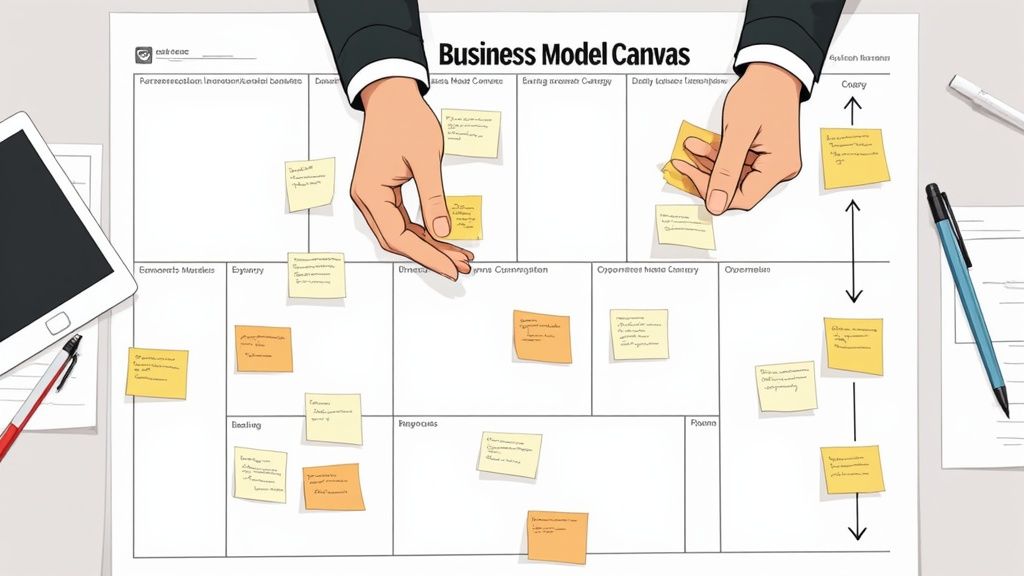
Your first draft is just that: a draft. The real power comes from treating the canvas as a living document.
Start on the right side: customer first
The right side of the canvas is your "front stage." It’s everything your customer sees and interacts with.
Start with these two blocks. They are the heart of your business model:
- Customer Segments: Who are you serving? Be brutally specific.
- Value Propositions: What urgent problem are you solving for them?
Once you have clarity on who and what, the other right-side blocks fall into place:
- Channels: How will you reach your customers?
- Customer Relationships: What kind of interaction will they expect?
- Revenue Streams: How will you make money?
Starting with the customer forces you to build your business from the outside in. A German study found that over 75% of startups use the canvas to get this kind of clarity.
Move to the left side: operations last
The left side of the canvas is your "backstage." These are the internal mechanics that make the front stage possible.
Work your way through the remaining blocks:
- Key Activities: What are the most critical actions you must perform?
- Key Resources: What essential assets (team, tech, capital) do you need?
- Key Partnerships: Who can you work with to de-risk your model?
These three blocks define your operational core. Finally, it all comes together at the bottom:
- Cost Structure: What are the major costs tied to your activities and resources?
Filling out the left side last ensures your operational plan is purpose-built to support your customer strategy.
SaaS startup example: ProjectFlow
Let’s make this real with a fictional SaaS startup, ProjectFlow, an AI tool for remote marketing agencies.
Here’s how their canvas might look:
- Customer Segment: Remote marketing agencies (10-50 employees) struggling with project bottlenecks.
- Value Proposition: "We cut project delivery times by 30% by automating workflow assignments."
- Channels: Content marketing, direct outreach on LinkedIn, integrations with Slack.
- Customer Relationships: Self-service model with great documentation, plus dedicated account managers for enterprise clients.
- Revenue Streams: Tiered monthly subscription (SaaS).
- Key Activities: Software development (core AI algorithm), platform maintenance.
- Key Resources: Skilled engineering team with AI talent, robust cloud infrastructure (AWS).
- Key Partnerships: Strategic integration partners like Slack, Figma, and Google Drive.
- Cost Structure: Salaries (engineering, marketing), cloud hosting fees.
Turning your canvas assumptions into facts
A canvas filled with unproven ideas is fiction. To get investors interested, you must turn assumptions into facts.
This is about moving from "we think" to "we know." Your mission is to run cheap experiments that test your most critical hypotheses.
The most dangerous ones live in Value Propositions and Customer Segments. If you’re wrong about who your customer is or what they value, the rest of the model collapses.
This validation process shows investors you’re building with discipline, not just hope.
Design your first experiments
Before you spend a dollar on development, get out of the building. Your first goal is to talk to actual people in your target market.
Start with low-fidelity tests to validate the core problem.
- Customer Interviews: Ask open-ended questions about their pains and workflows. Your goal is to confirm the problem is real, urgent, and expensive for them.
- "Smoke" Tests: Set up a simple landing page that states your value proposition. Drive a small amount of targeted traffic and measure sign-ups for early access. According to Unbounce, the average landing page conversion rate is around 9.7%, which is a solid benchmark.
The point is to learn as cheaply and quickly as possible. Every conversation is a data point that refines your canvas.
Build, measure, learn with an MVP
Once early tests show promise, it’s time for a Minimum Viable Product (MVP). An MVP is the simplest version of your product that delivers your core value.
It’s a tool to test your biggest assumption: will people actually use this thing?
- Measure Engagement: Are users completing the core action? How often do they return?
- Analyze User Feedback: What are users asking for? Where are they stuck?
- Test Pricing: Can you convince your first 10 customers to pay? This is the ultimate validation. To learn more, see our guide on what is unit economics.
Example: Dropbox
Before writing any code, Dropbox founder Drew Houston created a simple explainer video showing how file-syncing would work. He posted it on Hacker News, and the beta waitlist exploded from 5,000 to 75,000 people overnight. That low-cost experiment validated massive demand.
Your investor-ready BMC checklist
Play videoBusiness model canvas explained: A founder's guide videoThis loads content from YouTube.
Before sharing your canvas, it’s time for a reality check. Investors hunt for weak links in your logic.
This checklist reframes each block as a tough question a VC will ask. Use it to find gaps in your model before they do.
Your goal isn’t just to fill the canvas. It’s to replace every assumption with a hard data point.
Investor-ready business model canvas checklist
Use this table to pressure-test your BMC and find the gaps before an investor does.
| Canvas Block | Action Item or Key Question | Status (Not Started / In Progress / Validated) |
|---|---|---|
| Customer Segments | Have you spoken to at least 20 potential customers? | |
| Value Propositions | Can you state your value in one sentence without jargon? | |
| Channels | Have you found one scalable, repeatable acquisition channel? | |
| Customer Relationships | Does the cost of your relationship model align with your customer LTV? | |
| Revenue Streams | Have you confirmed customers are willing to pay your price? | |
| Key Activities | Are your key activities directly tied to delivering your unique value? | |
| Key Resources | Have you identified any unique, defensible resources (IP, data)? | |
| Key Partnerships | Are your partnerships strategic necessities or just “nice-to-haves”? | |
| Cost Structure | Do you have a clear grasp of your CAC and burn rate? |
Once you can confidently mark every item as "Validated," your business model canvas isn’t just a document – it’s a fundraising tool.
Common mistakes to avoid when using the canvas
The canvas is a powerful tool, but its simplicity is a trap. Spotting these pitfalls is the fastest way to turn it into a strategic weapon.
Treating it like a one-and-done checklist
The most common mistake? Filling out the canvas once and letting it gather dust.
The canvas is a living document, a snapshot of your current hypotheses. It’s meant to be challenged and rebuilt as you learn.
The "lone genius" approach
Another misstep is the founder who creates a "perfect" canvas in a silo.
You’re missing critical perspectives from sales, marketing, and engineering. A canvas built in isolation is built on flawed logic.
Confusing features with value
Perhaps the most damaging mistake is obsessing over product features instead of customer value.
Your canvas shouldn’t list what your product does. It should scream about the problem it solves.
- Weak: "AI-powered scheduling algorithm."
- Strong: "Saves sales teams 10 hours per week by eliminating manual scheduling."
This focus on tangible outcomes is what connects with customers and investors. The official creators at Strategyzer offer more insights on this.
Never actually testing anything
The ultimate sin is building a beautiful canvas and failing to validate it. Without real-world testing, your canvas is just a collection of unproven ideas.
Get out of the building. Talk to customers. Turn your assumptions into facts.
FAQ
How is a business model canvas different from a business plan?
Think blueprint versus novel. A business plan is a dense, static document that’s likely wrong the second you print it. The canvas is a dynamic, one-page visual built for speed and constant change. You use the canvas to find clarity, and a business plan to document that clarity later.
How often should I update my canvas?
Your canvas is a living document. Revisit it anytime you learn something new that challenges a core assumption. For an early-stage startup, this could be weekly. For a more established company, a quarterly review is a good rhythm.
Can I use the canvas for a non-profit organization?
Absolutely. The logic is identical. Instead of Customer Segments, you’ll have Beneficiaries and Donors. Instead of Revenue Streams, you’ll call them Funding Streams. It’s a flexible tool for mapping out how you’ll achieve your mission.
