
Your startup has a great idea. But ideas don’t pay the bills. The real question is: how will you make money?
Your revenue model is your plan for getting paid. It’s the engine that turns a cool product into a real business. Most startups don’t die from bad ideas – they die because they can’t figure out how to generate cash. This guide gives you a clear framework to build a model that works.
What your revenue model actually does
A revenue model is your blueprint for making money. It answers the hard questions: Who pays? For what? How much? And why will they keep paying?
It’s the strategic link between your product and your customer’s wallet. Without a clear model, you’re running a project, not a business. A strong one gives you a path to profitability and is the first thing investors look for.
It proves you’ve thought beyond the product and have a plan to build a sustainable company.
The four core components of a revenue model
Every solid revenue model has four building blocks. Getting these right helps you see your business like an investor does – focused on viability and scale.
Here’s a breakdown of what they are and the questions they answer.
| Component | What It answers | Example (for a SaaS tool) |
|---|---|---|
| Value Proposition | What problem are you solving for the customer? | Our tool saves creative teams 10 hours a week on admin tasks. |
| Pricing Strategy | How much will customers pay and how is it structured? | We offer three tiers: Free, Pro ($20/user/month), and custom Enterprise plans. |
| Revenue Source | Where does the money actually come from? | Our primary source is recurring monthly subscription fees. |
| Payment Method | How do customers physically pay you? | Customers pay via credit card through our billing system (e.g., Stripe). |
If you can’t clearly articulate each one, your model has a hole in it.
More than just a price tag
Your revenue model isn’t just a price. It’s woven into your entire business strategy. It dictates your marketing, sales, and product roadmap. A subscription model, for example, demands a relentless focus on customer retention.
Juniper Research projected the subscription economy would reach $996 billion globally by 2028, up from $593 billion in 2024. Read the underlying market study.
Your model also impacts your financial projections. Before you can forecast, you need to know your customer and how your pricing fits the market. Our guide on what is market sizing can help you define this.
Your revenue model tells investors how your idea becomes a great business.
The 5 most common revenue models for startups
Choosing how to make money is tough. The wrong choice can sink your startup. The key is to learn from models that consistently work, not reinvent the wheel.
VCs see the same handful of models again and again for a reason: they are proven to scale. Understanding these frameworks is your first step.
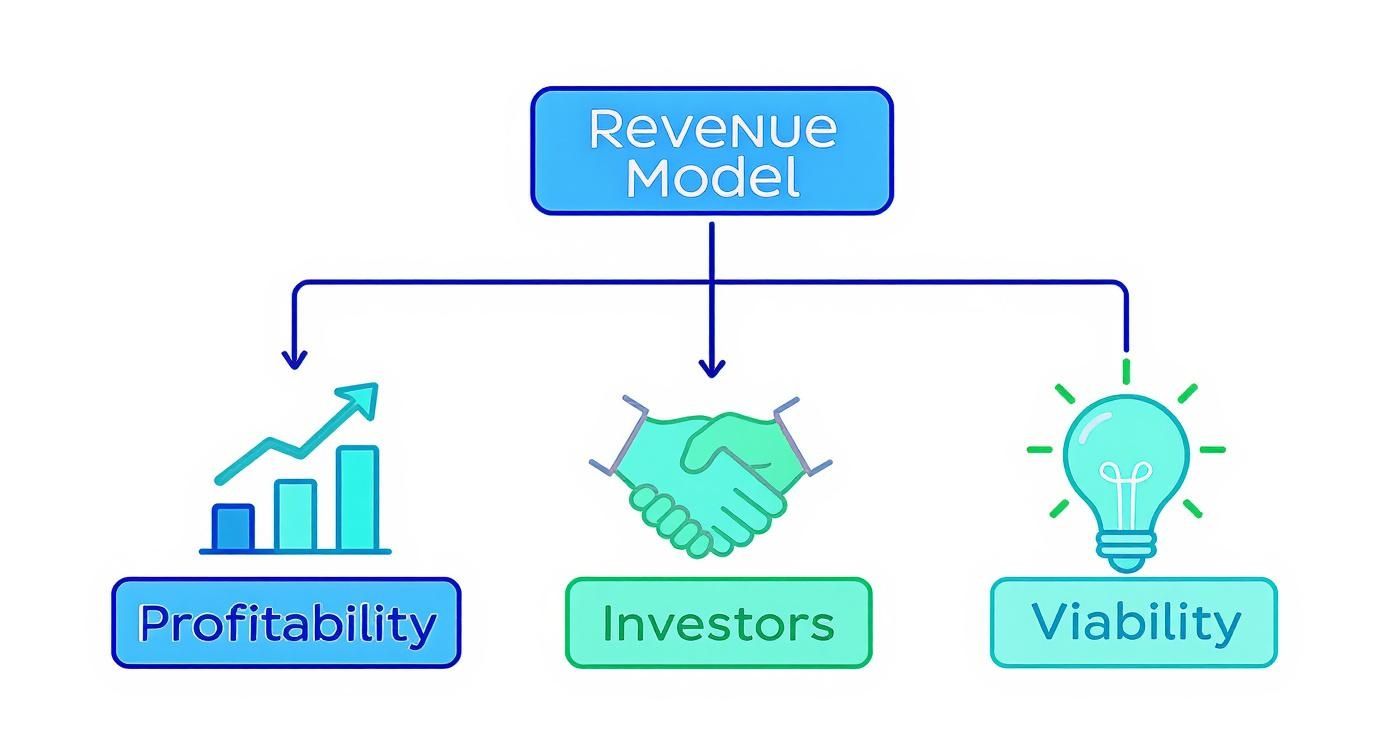
As you can see, your revenue model is the engine for profitability, your story for investors, and the foundation for long-term viability.
1. Subscription model
The subscription model is king in the software and content world. Customers pay a recurring fee – usually monthly or annually – for ongoing access. This creates predictable revenue, which investors love.
This model is about relationships, not transactions. You must constantly deliver value to keep customers from churning.
- Best for: SaaS companies, content platforms, and direct-to-consumer (DTC) brands.
- Why it works: It builds stable recurring revenue (MRR/ARR) and increases customer lifetime value (LTV).
Example: Slack offers tiered subscriptions. Its free version is the hook. As companies grow, they upgrade to paid tiers like the Pro plan ($8.75/user/month) for more features.
2. Transactional model
This is business at its most basic: you sell a product or service and get paid once. Think e-commerce, marketplace commissions, or pay-per-use services.
Revenue is a direct function of sales volume. Success comes from many small transactions or a few high-value sales.
- Best for: E-commerce stores, marketplaces like Airbnb or Uber, and consulting services.
- Why it works: It’s simple for customers to understand, and every sale directly boosts your top line.
Example: Stripe takes a tiny slice of every transaction it processes. Its volume-based pricing (2.9% + 30¢ per transaction) means Stripe’s revenue scales with its customers' success.
3. Advertising model
Your product is free for users. You make money by selling their attention to advertisers. This model dominates social media and search engines.
To make this work, you need a massive and engaged user base. Your real product is the audience you deliver to brands.
- Best for: Social networks, high-traffic content sites, and mobile apps with millions of users.
- Why it works: Free access removes barriers to entry, enabling explosive user growth.
Example: Reddit gives its platform away for free. It cashes in by selling ad space to brands targeting hyper-specific communities.
4. Licensing model
You sell the rights to use your intellectual property (IP) without selling the IP itself. This could be software, a patent, or a brand name. The buyer pays a fee or ongoing royalties.
This lets you monetize a single asset over and over with low operational costs.
- Best for: Companies with strong, defensible IP (patents, unique software), established brands, or proprietary data.
- Why it works: It generates high-margin revenue and can be scaled globally with low overhead.
Example: OpenAI licenses its AI models like GPT-4 through an API. Developers pay for access, allowing OpenAI to monetize its core tech without building every end-user application.
5. Hybrid model
Most successful startups don’t stick to just one model. A hybrid model blends elements from two or more models to create multiple revenue streams.
This approach can de-risk your business but adds complexity. Your different models must complement each other, not compete.
- Best for: Mature platforms looking to diversify or companies serving different user groups (e.g., individuals and enterprise clients).
- Why it works: It diversifies income and lets you capture value from different user behaviors.
Example: LinkedIn is a master of the hybrid model. It combines a freemium subscription for power users (Premium Career, $29.99/month), transactional revenue from recruiters, and an advertising model for B2B marketers.
How to choose the right model for your stage
The model that gets your first dollar might kill you by year three.
What works for a two-person team is wrong for a Series A company. Your revenue model must evolve with your business. Choosing a model isn’t a one-time decision. You must revisit it at every growth stage.
Pre-seed and seed stage: your goal is validation, not profit
Your early job isn’t to maximize revenue. It’s to prove you’ve built something people will eventually pay for. Your model should be a tool for learning, not a cash register.
You need to reduce friction and get your product into as many hands as possible.
- Your priorities:
- Validate the problem is real.
- Acquire early adopters for feedback.
- Test price sensitivity gently.
A freemium model or a deeply discounted offer is often best. These tear down barriers to entry. Engagement metrics are your North Star, not revenue.
Example: Early on, Dropbox used a simple freemium model. It gave away 2GB of storage for free – just enough to get users hooked. This sparked viral growth long before Dropbox became a revenue machine.
Series A and beyond: your goal is scalability
Once you have product-market fit and funding, the game changes. Investors expect a clear, repeatable path to making money. Your model must become a predictable growth engine.
This is where you obsess over unit economics. The question shifts from "do people want this?" to "can we make money on every customer?"
- Your focus:
- Maximize Lifetime Value (LTV) with tiered plans and upsells.
- Optimize Customer Acquisition Cost (CAC) for profitable growth.
- Build predictable recurring revenue (MRR/ARR).
It’s time to professionalize your pricing. Build clear tiers based on value metrics like user count or features. This proves you have a real business, not just a cool product.
Example: After finding its footing, HubSpot evolved into a sophisticated tiered subscription model. Its plans (Starter, Professional, Enterprise) are designed to grow with a customer’s business, maximizing LTV.
Startup stage vs. revenue model fit checklist
Use this checklist to align your model with where your company is today.
| Consideration | Pre-Seed/Seed Stage | Series A+ Stage | Your Self-Assessment |
|---|---|---|---|
| Primary Goal | Validate the product and acquire users. | Scale revenue and optimize unit economics. | |
| Ideal Model | Freemium, introductory pricing. | Tiered subscriptions, usage-based. | |
| Key Metric | User engagement, active users. | MRR, LTV/CAC ratio, churn rate. | |
| Pricing Complexity | Very simple, one or two options. | Tiered and segmented by customer value. | |
| Sales Process | Founder-led, direct to customer. | Dedicated sales and marketing teams. |
Matching your model to your stage builds a stronger foundation for growth. It’s a core piece of the story you’ll need when you build a financial model for your next round.
How to pitch your revenue model to investors
A great model on paper means nothing to investors. They need numbers that prove it works. Your pitch is about the cold, hard math showing your business is a smart bet.
Investors speak the language of metrics. Learn it. It moves the conversation from "here’s our idea" to "here’s our scalable machine."
Here are the four metrics that matter most.
1. MRR and ARR: the pulse of your business
For any subscription startup, Monthly Recurring Revenue (MRR) and Annual Recurring Revenue (ARR) are your vital signs. They track the predictable revenue you can count on.
A steady climb in MRR tells investors you have a sticky product. It’s the engine of your growth and proof of a sustainable model.
Example: A SaaS startup has 100 customers paying $50/month. Its MRR is $5,000. If they sign up 20 new customers, their new MRR is $6,000. That’s clear progress.
2. CAC and LTV: the economics of growth
Is your growth profitable? That’s where Customer Acquisition Cost (CAC) and Lifetime Value (LTV) come in. Together, they reveal the health of your business model.
- CAC: Total sales and marketing cost to win one new customer.
- LTV: Total revenue you expect from one customer over their entire relationship.
The LTV/CAC ratio is key. VCs want to see at least 3:1. It shows how much value you generate for every dollar you spend. To nail these numbers, you need to understand your what is unit economics in detail.
Example: If your CAC is $200 and your LTV is $800, your LTV/CAC ratio is 4:1. For every $1 you spend on marketing, you get $4 back. That’s smart growth.
3. Churn rate: the silent killer
Churn is the percentage of customers who cancel their subscription in a given period. It’s the silent killer of subscription businesses. High churn means you have a "leaky bucket."
Investors watch churn like a hawk. A low churn rate (ideally under 5% annually for SaaS) is powerful proof of product-market fit.
Even transaction-based models feel this pressure. The global payments industry is projected to hit $3.0 trillion by 2029 despite intense competition, as noted in this trend from McKinsey.
Example: If you start with 500 customers and 10 leave, your monthly churn is 2%. Compounded over a year, that small leak can sink your growth.
Putting it all in your pitch deck
Your revenue model deserves its own slide, usually titled "Business Model" or "Monetization." Place it right after you explain your product and before you dive into market size.
- The flow: You’ve shown what you do. Now you answer, "how will you get paid?"
Simplicity is key. A cluttered slide screams that you haven’t figured it out. Your slide must answer three questions in 30 seconds:
- Who pays? (e.g., small teams, large enterprises)
- What do they pay for? (e.g., premium features, more usage)
- How much do they pay? (e.g., pricing tiers)
A clean pricing table is the gold standard for subscription models. It’s visual, easy to scan, and communicates a ton of information instantly.
Your business model slide sets the stage for your financial projections. It’s the "how," and your financials are the "how much." Investors need to see a 3-5 year forecast showing your model can generate venture-scale returns. These projections are the direct output of your revenue model. To learn more, check out our guide on how to build a financial model that VCs will trust.
Common pitfalls and when to pivot
Choosing a revenue model isn’t a one-time decision. Too many founders cling to a broken model. This is a fast track to burning cash.
The goal isn’t perfection on day one. It’s building a business that’s resilient enough to change course. A pivot isn’t failure – it’s a strategic move toward a model that actually works.
The red flags to watch for
Your metrics are an early warning system. Ignoring them is a fatal mistake. The market is giving you direct feedback – you just have to listen.
- High customer churn: Are you losing customers as fast as you gain them? The perceived value doesn’t justify the price.
- Low free-to-paid conversion: For freemium models, a conversion rate below 2-5% is a huge red flag that your paid tier isn’t compelling.
- Stalled or negative LTV/CAC ratio: If it costs more to land a customer than you make from them, the math doesn’t work. You need a ratio of 3:1 or better.
- Widespread pricing complaints: If support tickets are full of users calling your pricing confusing or unfair, it’s a massive warning.
Common traps founders fall into
Be brutally honest – have you fallen into one of these?
- Underpricing your product: A race to the bottom is a race nobody wins. It signals a lack of confidence.
- Overly complex pricing tiers: If a customer needs a PhD to understand your pricing page, you’ve already lost them. Simplicity sells.
- Ignoring the value metric: Your price should scale with the value your customer gets. Tie your price to projects completed or revenue generated, not just user seats.
Pivoting your model doesn’t mean starting from scratch. It’s about making a smart, data-driven shift. Test your way into a new model by running small, controlled experiments on new user segments.
Your revenue model is the heartbeat of your startup. A clear plan for making money turns a good idea into a fundable business.
Ready to build a story that gets investors to lean in? Get the pitch deck that gets you funded.
FAQ
What’s the difference between a revenue model and a business model?
Think of your business model as the entire car – the engine, chassis, marketing, everything. It describes how all the parts work together to create value. Your revenue model is just the engine. It’s the specific part that answers one question: "how do we get paid?"
How many revenue streams should a startup have?
One. In the beginning, your only job is to prove a single, core revenue stream works and can scale. Spreading your focus across multiple models too early is a rookie mistake. Nail one model until it’s a well-oiled machine.
How do I validate my revenue model?
Validation isn’t asking if people would pay. It’s getting them to pull out their credit card. Move from conversations to transactions as fast as possible.
– Run a pricing survey: Show customers a few specific pricing tiers and ask which one they’d choose.
– Launch a paid beta: Offer both free and paid plans. Even a few upgrades are concrete proof someone is willing to pay.
– A/B test your landing page: Create two versions with different pricing and see which converts better.
