
Investors spend just 3 minutes and 44 seconds on a pitch deck. Research from DocSend shows you have only 8 seconds to grab their attention. If your pitch is a one-way monologue, you’re losing capital.
This guide gives you actionable ideas to turn your pitch into a two-way conversation. You’ll learn how to pull investors in, build conviction, and make your vision memorable. Let’s make your next pitch an engaging experience that secures a meeting.
1. Use live polls to start a conversation
Live polling turns your monologue into a dialogue.
Use a tool like Slido to ask questions in real-time. The audience answers on their phones, and results appear instantly. This pulls investors directly into your narrative.
Why it works
- Gauges the room: See if investors understand your key points.
- Validates the problem: Show investors they share the pain point.
- Gives you feedback: Anonymity encourages honest answers on your assumptions.
How to do it
- Tools: Use Slido or Mentimeter. Investors scan a QR code to join.
- Questions: Keep them simple, multiple-choice, and tied to your pitch.
- Setup: Test your polls beforehand. Have a backup plan for bad Wi-Fi.
Where to use it
Use a poll right after your intro or on the problem slide. A good question makes the problem personal and hooks investors immediately.
Example: "Quick question – using your phones, how many of you manage more than five SaaS tools for your team? Let’s see... over 70%. That complexity is the exact pain point we solve."
2. Frame your pitch as a story
Don’t just present data. Tell a story.
Frame your pitch with a hero (your customer), a villain (the problem), and a resolution (your solution). This makes your message more memorable and emotionally resonant.
Why it works
- Connects emotionally: Stories are more powerful than logic alone.
- Simplifies complexity: A narrative makes complex data easy to follow.
- Shows vision: Investors back founders who can tell a compelling story about the future.
How to do it
- Create an arc: Structure your pitch with a clear beginning, middle, and end.
- Add choice points: Ask the audience, "We saw two paths. Which one do you think we took?" This creates a feeling of co-creation.
- Use visuals: Your pitch deck design should support the story’s emotional tone.
Where to use it
This is the framework for your whole presentation. Start the story on your opening slide and carry it through to the end. Use interactive choice points when discussing a key product decision or your go-to-market strategy.
Example: "We had two options: a broad platform for everyone, or a focused tool for a niche user. What would you have done? ... Exactly. We chose the niche. Here’s why that unlocked our traction."
3. Gamify your data to make it stick
Gamification adds game-like elements to your pitch.
Use points, leaderboards, or quizzes to turn your presentation into a challenge. This leverages competition and achievement to hold attention and make key messages memorable.

Why it works
- Shows creativity: It proves you can think outside the box to capture attention.
- Makes data digestible: A quiz makes market stats or tech specs less dry.
- Breaks down barriers: Friendly competition fosters a more collaborative atmosphere.
How to do it
- Tools: Use platforms like Kahoot! or AhaSlides.
- Mechanics: Keep it simple. A short, 3-5 question quiz is enough.
- Setup: Prepare questions that reinforce your value proposition.
Where to use it
A quiz works well before the solution slide or during the market opportunity section. Use it to reveal common misconceptions that your solution addresses.
Example: "The market is misunderstood. Let’s play a quick game. Join the quiz at this link. First question: what percentage of SMBs still use spreadsheets for forecasting? ... Nearly 60%. The winner just highlighted the massive market we are capturing."
4. Run a mini-workshop to show, not tell
Turn part of your meeting into a collaborative workshop.
Instead of just listening, investors engage in a short, hands-on activity. This could be a problem-solving exercise or brainstorming session. It shifts the dynamic from a pitch to a partnership.
Why it works
- Shows confidence: This bold move shows you have a collaborative mindset.
- Makes the need tangible: Investors feel the pain point firsthand.
- Creates early buy-in: Investors feel like part of the team, not just evaluators.
How to do it
- Tools: Use sticky notes, whiteboards, or simple worksheets. For virtual meetings, use a tool like Miro.
- Activity design: Keep the exercise simple. It should have a clear goal and take 5-10 minutes.
- Setup: Define the rules and time limits upfront. Have all materials ready.
Where to use it
A workshop works best after the problem slide but before your solution. It serves as a powerful bridge, letting investors feel the problem before you present the cure. Learn more about optimizing your presentation length on Pitchili.com.
Example: "We’ve talked about prioritizing sales leads. Now, experience it. On these notecards are three lead profiles. Take two minutes to decide which one you would call first... Interesting. This exact ambiguity is what our platform eliminates."
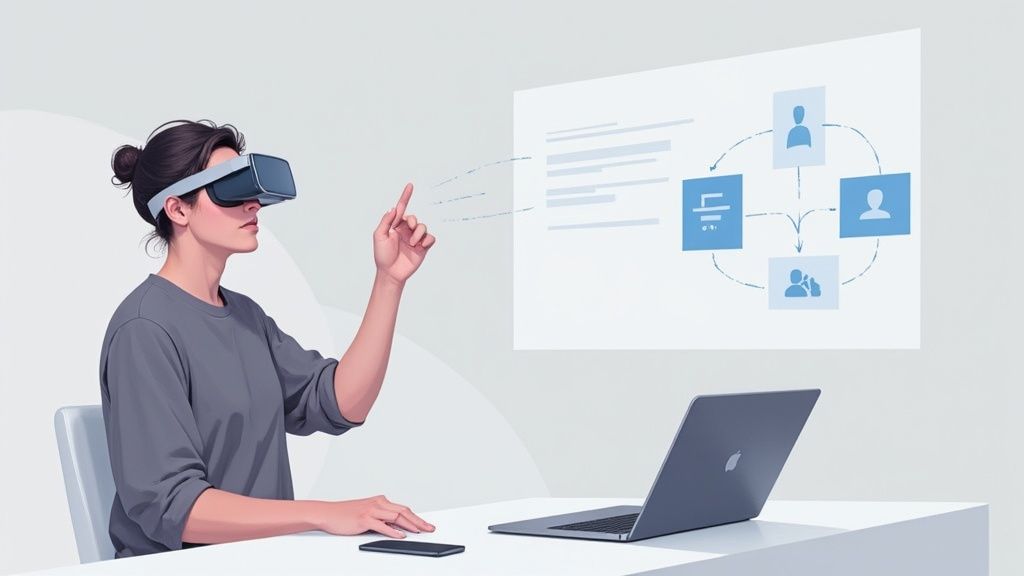
5. Use VR/AR for an immersive experience
For hardware or deep tech, VR and AR are powerful tools.
These technologies transport investors from a conference room into your product’s world. This moves beyond slides to create a memorable, sensory experience that demonstrates value.
Why it works
- Cuts through the noise: It demonstrates value instead of just describing it.
- De-risks the investment: It offers a deep understanding of a complex product.
- Creates a "wow" factor: A VR experience makes your pitch unforgettable.
How to do it
- Tools: Use accessible platforms like Meta Quest or develop a simple AR app.
- Experience design: Keep it short, intuitive, and focused on one key value prop.
- Setup: Rehearse the entire process. Have a non-VR backup (like a video) ready.
Where to use it
The ideal moment for a VR/AR demo is during the product or solution slide. After establishing the problem, this immersive demo powerfully reveals how your technology solves it.
Example: "Describing our surgical training module is one thing. I’d rather show you. Put on this headset, and you’ll see exactly how our haptic feedback system makes simulated surgery feel real."
6. Run a live demo to prove it works
A live demo makes your product tangible.
Instead of just describing what it does, you show it in action. This creates a powerful "seeing is believing" moment that builds immediate credibility.
Why it works
- De-risks the tech: It proves your team can execute and the product is real.
- Answers the key question: It shows investors "it actually works."
- Signals confidence: A successful live demo shows you have deep command of your product.
How to do it
- Practice relentlessly: Rehearse until it’s second nature. Test it everywhere.
- Narrate the action: Explain what you’re doing and why it matters to the user.
- Have a backup: Always have a pre-recorded video of the demo ready to go.
Where to use it
The best spot for a live demo is right after your solution slide. After describing your product conceptually, the demo serves as the ultimate proof point.
Example: "We built a platform to automate this workflow. Let me show you. I’m logging into a live environment... in just three clicks, we’ve analyzed data that used to take hours."
Quick guide: interactive presentation techniques
| Technique | Complexity | Good for | Founder takeaway |
|---|---|---|---|
| Live polls | Low | Gauging the room | Quickly validate your problem with real-time data. |
| Storytelling | Medium | Emotional connection | Make your pitch memorable and your vision clear. |
| Gamification | Medium | Making data fun | Show creativity and make complex info stick. |
| Mini-workshop | High | Building buy-in | Turn investors into collaborators from the start. |
| VR/AR demo | Very high | "Wow" factor | Make a complex physical product unforgettable. |
| Live demo | High | Proving it works | De-risk the tech and show you can execute. |
Make your pitch a conversation, not a monologue
The old way of pitching is dead.
Founders who turn their pitch into a dialogue gain a massive advantage. They transform passive listeners into active participants and skeptical investors into engaged collaborators.
This isn’t about flashy gimmicks. It’s about strategically using interaction to prove your core points in a more compelling way. Your pitch deck isn’t the end product- it’s the start of a partnership.
Ready to build a deck that does more than present? Pitchili helps you craft compelling narratives that turn investor meetings into partnerships.
