
Your executive summary is a 60-second elevator pitch, not a report. Investors see hundreds of decks a week – your summary decides if they keep reading or hit archive.
This guide gives you a framework and examples to write a summary that gets you the meeting.
Why your executive summary is your most important pitch
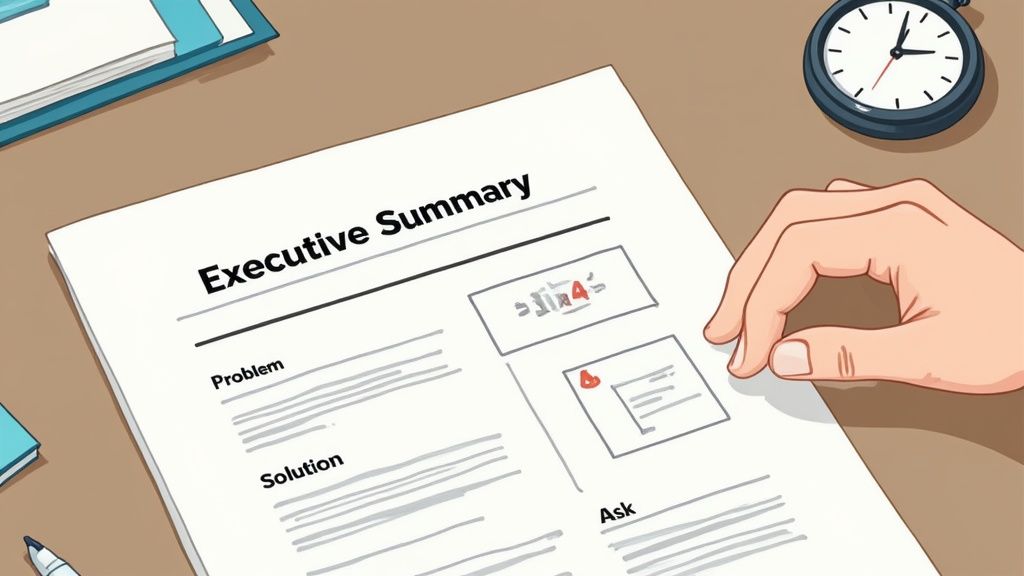
A VC’s inbox is flooded. Your executive summary is the first filter.
It’s not just a preface; it’s the entire audition. This one-page doc is your best shot at getting a meeting.
Its only job is to convince a busy investor that your company is worth a closer look.
The 60-second test
Investors make snap judgments. Your summary has to pass the 60-second test.
Can they grasp your business – what you do, who you serve, and why it’s a huge opportunity – in under a minute? If not, you’ve lost.
A HubSpot survey found 85% of organizations use executive summaries to help decision-makers absorb info fast. For founders, this means your summary must be a strategic weapon.
Example: Instead of a dense paragraph, a scannable summary helps an investor decide in seconds if your deal fits their thesis.
Frame it as an answer, not a report
A great summary answers the unspoken questions every VC has:
- Is this a big problem? VCs hunt for solutions to painful, widespread problems.
- Is this the right team? Signal you have the unique insight to win.
- Why now? What market shift makes your solution urgent today?
- Can this scale? Hint at a venture-scale opportunity, not a small business.
Example: Framing your summary this way turns a boring report into a must-read opportunity that shows you get what investors really care about.
The anatomy of an investor-ready executive summary

Structure isn’t optional. VCs expect a specific flow. A confusing document signals a founder who can’t communicate clearly.
This framework moves an investor logically from problem to solution to ask.
Nail the one-liner opening
Start with one sentence explaining what your business does. No fluff.
It should instantly answer, "What is this company?" so the investor can categorize it.
Example: "Aura is a HIPAA-compliant SaaS platform that helps private therapists automate client billing and reduce administrative overhead by 90%."
The problem and your solution
Dive into the problem. Make it painful and relatable.
Then, introduce your solution. Explain how your product addresses that pain point in a unique way.
- Problem: Articulate the specific, costly pain your target customer faces.
- Solution: Describe your unique approach. Why is it better than alternatives?
Example: "Private therapy practices lose up to 15% of revenue to inefficient billing. Aura’s AI platform automates this workflow, ensuring therapists get paid on time."
Market size and business model
Investors need to see a massive opportunity. Define your Total Addressable Market (TAM).
Next, clearly state your business model. How do you make money?
Learn more about calculating your market size in our complete guide.
Example: "The US market for private practice management software is $6.4 billion. We operate on a tiered SaaS model, charging $99–$299 per month."
Your team and unfair advantage
Why is your team the one to win? Highlight relevant experience.
Follow this with your "unfair advantage." What makes your business defensible?
Example: "Our CEO is a former therapist and our CTO led billing integration at a major health tech firm. Our proprietary algorithm has a 5% higher claims success rate than industry software."
Traction and key financials
Show, don’t tell. Use bullet points to list your most impressive metrics.
- Key metrics: Focus on MRR, user growth (MoM), CAC, and LTV.
- Milestones: Mention key product launches or major customer wins.
- Financials: Include current revenue and a high-level 3-year projection.
Example: "Launched six months ago, we hit $35k MRR with 25% MoM growth. Our CAC is $450 with a projected LTV of $7,200. We project $1.2M ARR by next year."
The ask and use of funds
End with a clear, direct ask. State how much you are raising and the round type.
Briefly explain how you will use the capital. Tie the funds to specific growth milestones.
Example: "We are raising a $2M Seed round to scale our sales team, expand into two new states, and achieve $2.5M in ARR within 18 months."
Weave a narrative with data and urgency
Investors don’t just read data – they interpret stories.
Data woven into a compelling story of momentum gets you a meeting. Your job is to frame numbers to create a sense of inevitable success and urgency.
From static numbers to dynamic stories
Investors see impressive MRR all day. The magic is in the context.
Don’t just state a fact; tell the story behind it.
- Weak: "We have 10,000 users."
- Strong: "We acquired 10,000 users with a $5k ad spend, proving an efficient $0.50 CAC where competitors pay $5.00."
The second one tells a story of capital efficiency. You can build a strong narrative structure for your pitch by connecting data points like this.
Example: This approach transforms your summary from a report into a persuasive argument, proving you can turn capital into growth.
Quantify urgency and the cost of delay
Your narrative needs to create urgency. Why does this investment need to happen now?
Show that waiting is more expensive than investing. Create FOMO, backed by strategy.
Example: "The telehealth market is projected to grow 30% annually, but new regulations opening up interstate licensing will be finalized in Q4. Our $2M raise allows us to capture first-mover advantage."
Use active voice and strong verbs
Language matters. Active voice makes you sound like a founder who makes things happen.
Scrub your summary for passive phrases. Be direct.
- Passive: "Market share was gained from our competitors."
- Active: "We captured 10% market share from our competitors."
- Passive: "Our platform is used by customers to reduce costs."
- Active: "Our platform cuts customer costs by 30%."
Example: Strong verbs create forward motion. Every sentence should reinforce that your team is in the driver’s seat.
Avoid these common executive summary mistakes
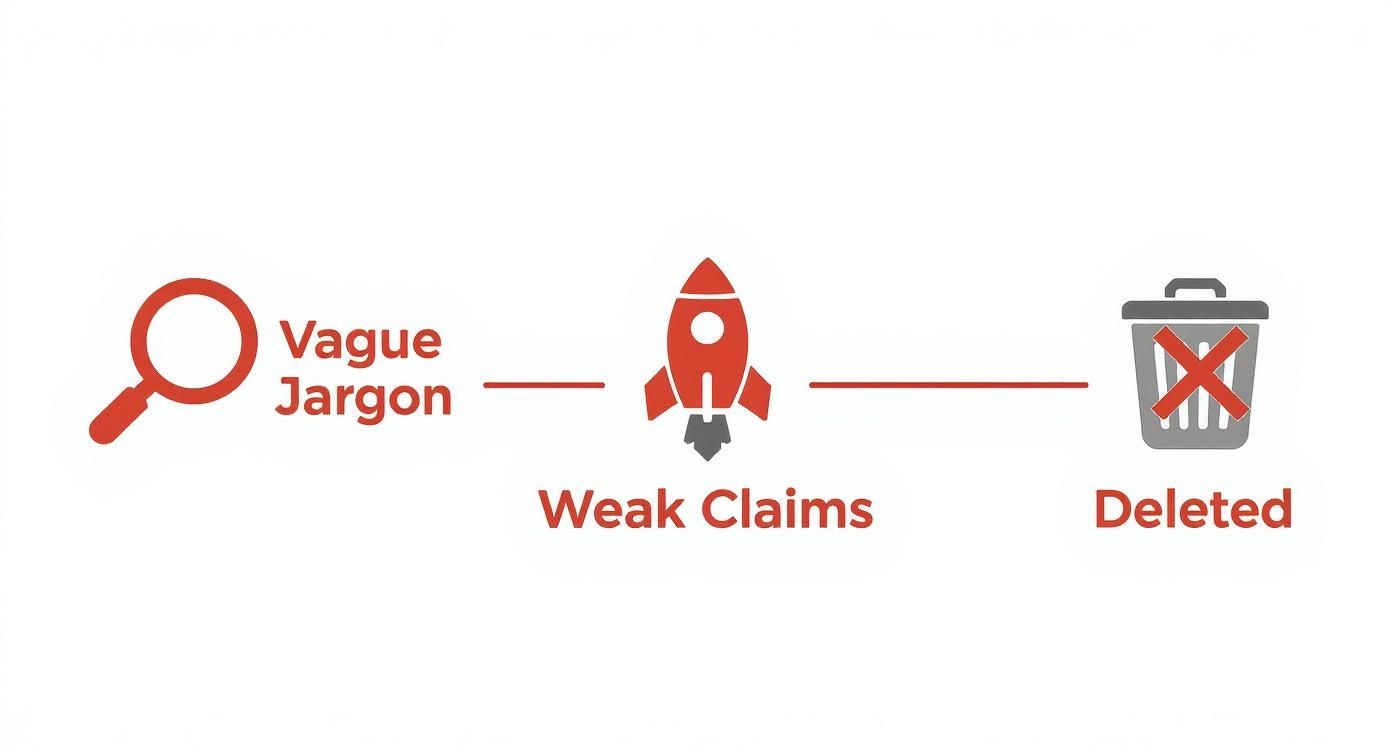
Simple, avoidable mistakes get promising startups ignored.
These are strategic missteps that tell an investor you’re not ready for their capital. A sloppy summary suggests a sloppy operation.
Focusing on features instead of the problem
Investors don’t fund features. They fund solutions to expensive, painful problems.
A summary that reads like a product manual is an instant turn-off.
- Weak (feature-focused): "Our SaaS platform uses a proprietary AI algorithm and real-time data syncing."
- Strong (problem-focused): "Supply chain managers lose $50M annually from routing inefficiencies. Our platform cuts these losses by 30%."
Example: The second one frames the business around a multi-million dollar problem. That’s a hook.
Using vague jargon and empty buzzwords
"Synergistic," "disruptive," "paradigm-shifting" – these words mean nothing without proof.
Vague jargon is a red flag. It usually masks a lack of substance. Investors want crisp, direct language.
- Before: "We are leveraging AI to revolutionize the B2B marketing landscape."
- After: "Our AI platform helps B2B marketing teams cut customer acquisition costs by 40%."
Example: The "after" version is powerful because it’s specific, quantified, and speaks to a clear business outcome.
Making unsubstantiated "next Google" claims
Hyperbole is the enemy of credibility. The second you claim "no competition," you undermine your authority.
Every business has competitors, even if they’re indirect. Acknowledge the landscape, then explain your unique advantage.
- Weak: "We are the only platform in this space."
- Strong: "While competitors focus on enterprise clients, our self-serve model captures the underserved $2B SMB market."
Example: This shows strategic awareness. You’ve identified a specific market segment and built a model to win it.
Real executive summary examples (Seed vs. Series A)
Play videoHow to write an executive summary VCs will read videoThis loads content from YouTube.
Theory only gets you so far. Let’s look at real (anonymized) summaries from funded startups.
Each one is tuned to answer the specific questions investors ask at that stage.
Seed stage: the vision and team bet
At Seed, investors bet on a massive market and a killer team. You likely have little traction, so you sell the dream and your team’s ability to build it.
Company: HealthSync (AI for clinical trial data)
Summary:
HealthSync is a SaaS platform using AI to structure clinical trial data, cutting drug development timelines by 20%. Pharma companies burn $50B a year on inefficient data management. Our software turns messy datasets into analysis-ready insights in hours, not months. Our team includes a PhD from Stanford’s AI lab and a former data architect from Genentech. We are raising a $1.5M Seed round to secure HIPAA compliance and land our first ten enterprise customers.
Why it works:
- Clear problem: Kicks off with a huge, expensive problem ($50B).
- Team credibility: Founder backgrounds (Stanford AI, Genentech) build instant trust.
- Focused ask: Use of funds is tied to tangible milestones.
Series A: the product-market fit machine
By Series A, investors need proof of product-market fit and a scalable growth engine. The summary shifts from what you will do to what you are doing.
Company: Connectly (Project management for remote teams)
Summary:
Connectly is the project management platform for distributed enterprise teams, serving 75 paying customers, including IBM and Salesforce. Our platform drives a 30% jump in project completion rates. We’ve grown from $20k to $110k MRR in six months with a $1.2k CAC and $18k LTV, proving a repeatable growth model. We are raising $10M to scale our sales team and target $5M ARR in 18 months.
Why it works:
- Traction first: Leads with impressive logos and a solid $110k MRR.
- Unit economics: A 15x CAC to LTV ratio proves profitable growth.
- Velocity: Showing the MRR jump creates powerful momentum.
Your pre-flight checklist
Before you hit "send," stop. This one click matters.
Use this final check to make sure your summary is sharp, persuasive, and tuned for an investor’s brain. Be ruthless. Every word must earn its spot.
- Clarity: Is the one-liner crystal clear? Can an outsider get it?
- Brevity: Is every sentence under 20 words? Is the summary under one page?
- Data: Is every key metric framed with context (e.g., MoM growth)?
- Flow: Does it follow the Problem → Solution → Traction → Team → Ask arc?
- Formatting: Is there enough white space? Are paragraphs short?
- Proofread: Did you get a final proofread from a fresh set of eyes?
Executive summary checklist
| Check point | Status (yes/no) |
|---|---|
| Clarity: Is the one-liner understandable in <5 seconds? | |
| Brevity: Is the entire summary under one page? | |
| Problem First: Is the pain point in the first paragraph? | |
| Jargon-Free: Have all buzzwords been eliminated? | |
| Contextual Metrics: Is every key number shown with growth? | |
| Bolded Wins: Are the most impressive stats highlighted? | |
| Clear Ask: Is the funding amount tied to milestones? | |
| Scannable Format: Are paragraphs short and bullets used? | |
| Logical Flow: Does the narrative follow the Problem → Solution → Ask arc? | |
| Proofread: Has someone else read it for typos? |
Completing this review ensures your summary is ready for the venture capital due diligence process, which starts the second an investor opens your email.
Ready to build a narrative that gets VCs to listen? At Pitchili, we help founders transform their vision into a compelling story backed by data. Let’s build your investor-ready pitch deck.
