
Written by: Ruslana Yurchenko
Published: August 2025
Most founders confuse market size with market opportunity. They lead with big numbers and skip the one thing investors actually care about at the start: what’s broken, shifting, or underserved, and why your team is built to solve it now.
That’s the job of the market opportunity slide, and many decks fail it. Nail this, and everything else in your pitch makes sense. Miss it, and your market size slide just feels like wishful math.
This article breaks down how to craft a market opportunity slide that frames the problem, builds narrative tension, and earns the right to show your numbers.
What is a market opportunity slide, and why does it matter?
The market opportunity slide is your strategic opening as it frames the commercial logic behind your startup. This is where you show VCs the market tension you’re capitalizing on: what’s broken, what’s changing, and why your timing is right. It’s less about raw numbers, more about revealing the wedge that makes your business necessary and investable.
For example, let’s say you’re building a platform that helps brands personalize without crossing the line. Your market opportunity slide might lead with this: “Gen Z doesn’t hate ads; they hate being tracked like lab rats.” That one line nails a bigger shift: the trust gap in AI-driven marketing. You’re not tossing around market size numbers yet; you’re spotlighting a real, fast-moving problem.
So, a good market opportunity slide in a pitch deck answers:
- What trend, gap, or behavior shift is opening this market up?
- Why is this moment (not last year, not next year) the inflection point?
- Who is affected, and how urgent is the need?
This is where opportunity sizing kicks in. It’s not about quoting Gartner’s $100B stat; it’s about identifying the angle. Is the industry underserved? Is a new generation behaving differently? Is regulation forcing a change?
Think of this slide as your story’s teaser trailer. When done right, it primes the investor’s mindset to want the next slide. Done wrong, or worse, skipped entirely, it forces them to interpret your market without context, and that’s a risky bet.
How to structure a killer market opportunity slide
The best opportunity slides are about a clear insight, a strong narrative, and a simple visual anchor. This isn’t the place for paragraph dumps or messy TAM pies; it’s your opportunity to tell a big story at a glance.
There are several formats that work depending on your startup’s space:
1. Old vs. new paradigm

Great for industries in transition (think: legacy insurance, traditional real estate, Web2 social). Highlight outdated practices on the left, your disruption thesis on the right. This structure makes investors feel like the tide is turning, and you’re ahead of it.
2. Problem-solution at the market level

This is not your product’s problem slide. It’s the market’s problem. What systemic issue do all players face? Use real stats or examples. Then position your company as the cleanest, fastest fix.
3. Emerging trends or behavioral shifts

If you’re early in a nascent or evolving space (like climate tech, creator monetization, or luxury retail), focus on where the market is going, not where it is now. Highlight the rise of a new demographic, regulatory shift, or behavior change that makes your solution inevitable.
Each of these frameworks allows you to anchor your narrative without jumping to TAM prematurely. Here, visuals matter. Use charts, bold quotes, infographics, or even just a clean comparison table to make your point stick.
And remember, simplicity wins. Your market opportunity slide isn’t about being comprehensive. It’s about being compelling.
Market opportunity slide vs. market size slide
Here’s where most founders get tripped up: they cram market size data into what should be a crisp opportunity narrative. But these are different jobs in your pitch.
Your market opportunity slide sets the emotional and strategic stage. It answers, “Why should I care?”. It gives your pitch urgency. FOMO. Relevance.
Your market size slide comes next, and that’s where the numbers live. Here, you walk investors through the actual size of the space, how much of it you’re targeting, and why those segments make sense.
Let’s compare them:
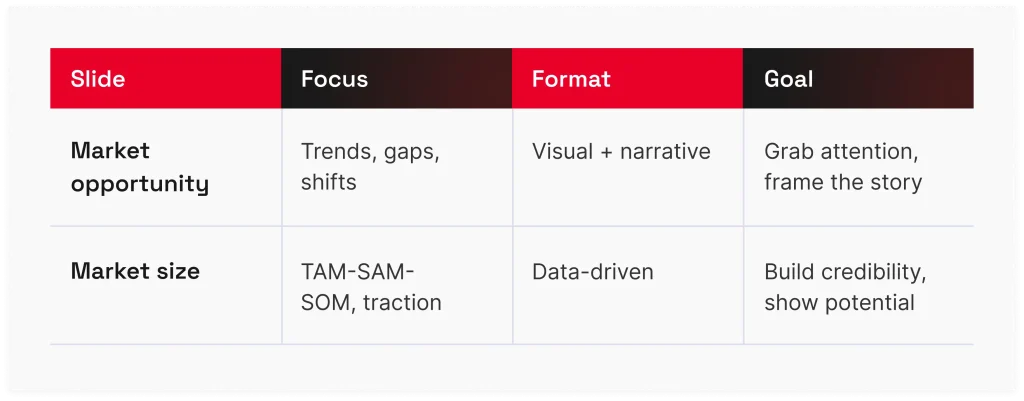
You don’t have to keep the market opportunity slide on its own. Suppose it fits naturally with your problem, why now, or even market size slide, go for it. A lot of great decks do this to keep things tight. Just make sure it’s clear what you’re showing – if you’re highlighting a market shift, don’t bury it under too much data. If the opportunity is big and deserves attention, give it room to breathe. Combine when it helps the story. Separate when it sharpens it.
Final thoughts
The best pitches hit with a story. They create a tension in the market, a wave forming, a moment that can’t be ignored. And that’s what your market opportunity slide should do.
That’s your pitch deck’s opening punch: short, sharp, and emotionally charged. When it works, it gives every slide that follows more weight. When it’s missing, your deck feels like a report, not a story.
Your opportunity slide does what numbers can’t: it creates belief.
Want help turning that belief into a pitch investors can’t ignore? At Pitchili, we build pitch decks that sell the opportunity. Whether you’re refining your narrative or need a full deck from scratch, contact us, and we’ll help you craft a story that sticks.
Related read: How to write a value proposition slide that gets you funded
FAQ
How do I build a market opportunity slide?
Start with what’s changing. Your market opportunity slide should spotlight a shift (consumer behavior, tech, regulation), then make a clear case for why your company is built to catch that wave. One bold insight, a stat or two, and a visual that lands fast. No fluff. Just the signal that this market is moving, and you know exactly where it’s headed.
What is the concept of market opportunity?
It’s the opening. Market opportunity is the gap, shift, or tension in a space that makes it ripe for disruption. It’s not just that the market is big; it’s that something’s broken, overlooked, or about to change. And you’ve got the timing and team to take the shot.
What is the role of a market opportunity slide in a pitch deck?
The market opportunity slide spotlights where the market is underserved, overlooked, or ready for a new approach. It defines the problem at scale and makes it clear there’s a gap worth betting on. This is where you show the playing field, the shift in motion, and how your company is built to step into it.
Can you give me a good market opportunity example?
Absolutely! Here’s one: “Gen Z is about to control 80% of luxury spend, but legacy brands are still selling like it’s 2005.”
This is more than stats; this is a signal that a market tipping point is hiding inside a deep, unmet problem. That’s the kind of insight that makes investors lean in.
