
Staring at a sea of competitors can feel overwhelming. Many founders either list every possible rival or claim they have no competition at all – both are quick ways to lose an investor’s confidence. Learning how to create a competitive analysis isn’t just about filling a slide; it’s about building a strategic narrative that proves you understand your market and have a real plan to win. This guide provides a step-by-step framework to do just that.
Key takeaways
- Focus on the vital few: Identify 3-5 key competitors, not a long list. This shows strategic focus.
- Go beyond features: Compare your product, go-to-market strategy, and business model to highlight your true moat.
- Visualize your advantage: Use a 2×2 positioning map to show investors your unique market position in a single glance.
- Tell a story with data: Frame competitor weaknesses as your opportunities and back every claim with hard evidence like traction metrics or customer quotes.
What a competitive analysis is really for
A powerful competitive analysis isn’t just a checklist of features. It’s a story. A story that shows investors you have deep market knowledge and highlights why your spot in the market is unique and defensible.
Investors have seen hundreds of tables with checkmarks conveniently stacked in the founder’s favor. They want to see the thinking behind your product and go-to-market plan. They need to know you’ve dug deeper than surface-level comparisons to truly grasp your industry’s dynamics.
This guide gives you a practical framework for building an analysis that does more than just tick a box. We’ll show you how to move from an endless list of rivals to a focused, compelling argument that helps you raise capital. A strong analysis is the foundation of your entire pitch. It validates your product roadmap, your growth strategy, and the core of your story. According to a recent Forbes article, this process is critical for uncovering market opportunities and threats.
The whole point is to connect your competitive insights directly to your unique strengths. That link is everything, and you can learn more about framing it in our guide on defining your value proposition.
A framework for defining your competitive landscape
Before you can analyze the competition, you have to know who you’re actually competing against. A common mistake is casting the net too wide, listing dozens of companies and creating a shallow, unconvincing overview. The goal isn’t to boil the ocean. It’s to identify the 3-5 key players who genuinely influence your path to market.
Investors don’t want a phonebook of every business in your space. They want proof that you understand the nuances of your market and can pinpoint the rivals that matter. Your job is to move from a broad market view to a focused, defensible list that shows strategic thinking.
Differentiate between competitor tiers
First, let’s categorize your rivals. Showing investors you grasp these distinctions builds immediate credibility.
Think of them in three primary tiers:
- Direct competitors: These are the most obvious. They solve the exact same problem for the exact same customer with a very similar solution. For a project management tool like Trello, a direct competitor is Asana.
- Indirect competitors: These companies solve the same core problem but with a different tool or for a slightly different audience. For Trello, an indirect rival might be Slack (solving team coordination via messaging).
- Potential competitors: These are big players who could enter your market tomorrow. Think of Google launching a more robust project management feature inside Google Workspace. They aren’t competing today, but they could be tomorrow.
Start by brainstorming a list for each category. Use Google searches, browse industry forums, and check review sites like G2 or Capterra to see who real customers are comparing you to. Especially in the digital realm, understanding how to do competitor analysis in SEO is crucial.
Move from a long list to a short list
Once you have your categorized list, it’s time to narrow it down to the 3-5 most critical players for your pitch deck. An analysis that’s a mile wide and an inch deep is just noise. Your goal is to select the competitors that best help you tell your story.
Ask yourself these questions to filter your list:
- Who do our customers actually mention? Your sales and support teams hear which alternatives prospects are evaluating every day.
- Who has the most market share? You need to include at least one established leader. A quick search on Crunchbase or PitchBook can give you a sense of funding and size.
- Who is the fast-growing upstart? Including a newer competitor shows you have your finger on the pulse.
- Who best highlights our differentiation? Select a competitor that helps you clearly illustrate your unique value proposition or go-to-market approach.
This process ensures your analysis is directly tied to your strategy, not just a random collection of logos. A sharp competitor analysis is a key part of your plan for winning customers, which you can explore in our breakdown of what a go-to-market strategy entails.
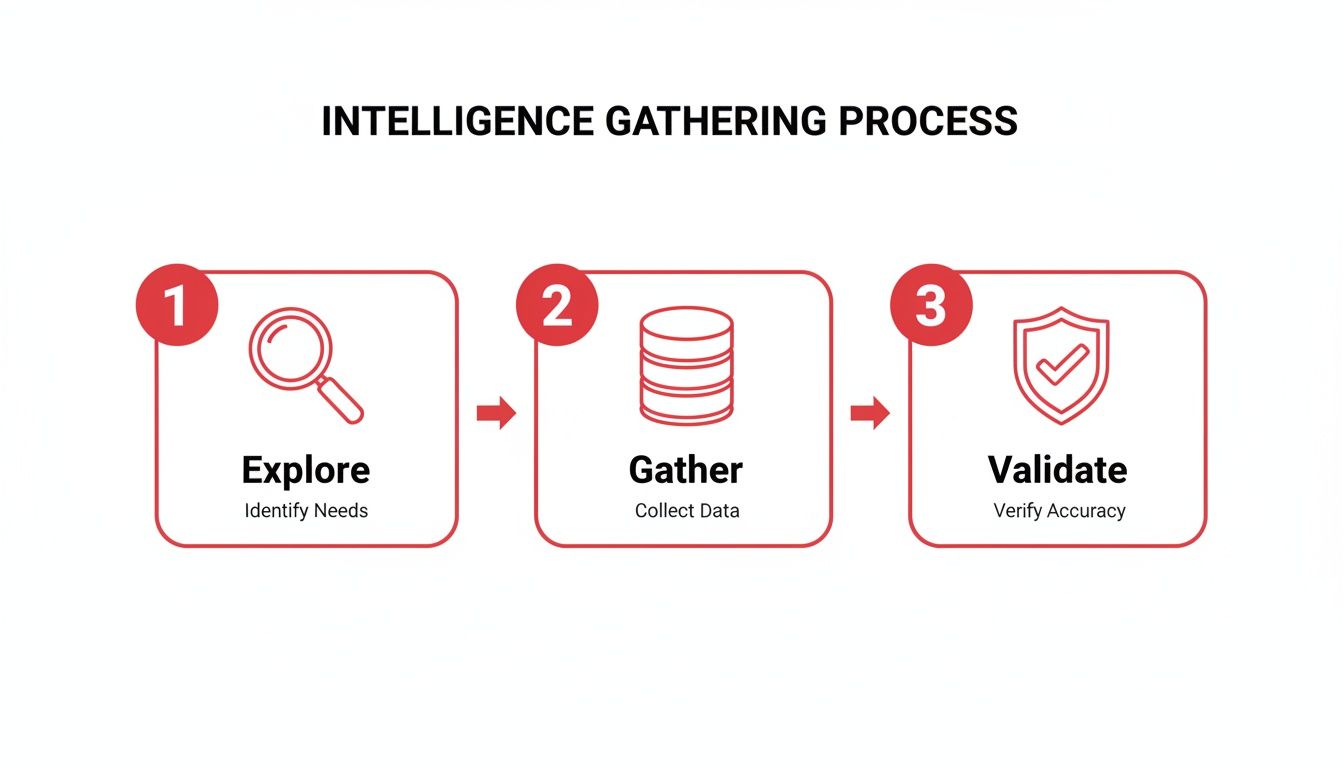
The steps to gather intelligence that matters
A sharp analysis is built on hard data, not just gut feelings. Once you’ve mapped out who you’re up against, it’s time to start digging for real intelligence. Your mission is to become an expert on their business – to understand their strategy, traction, and weaknesses.
Sourcing your data
To get the full picture, you need to mix quantitative data with qualitative insights. A balanced approach is the only way to understand both the what and the why behind your competitors' moves.
Here’s a practical checklist of where to look:
- Financial data: Use platforms like Crunchbase and PitchBook. You’re hunting for funding history, key investors, and company size. This tells you how healthy they are financially.
- Product and pricing: Go straight to their website. Deconstruct their pricing tiers, feature sets, and core value proposition. Sign up for a free trial or get a demo.
- Customer sentiment: Dive into review sites like G2 and Capterra. The real gold is in the three-star reviews, where customers reveal what they really think.
- Marketing channels: Use a tool like Semrush to see where their traffic comes from. Check out their social media feeds to get a feel for their messaging and content strategy.
- Team and talent: Scan their LinkedIn page and any recent job postings. Pay close attention to key hires. A new Head of Enterprise Sales can signal a major strategic shift.
Validating your intelligence
Collecting data is just step one. The real work is in validating it. Information found online can be wrong, spun, or old. Cross-referencing every key data point isn’t optional.
Look for consistency. If a press release boasts about a product launch, do you see customers talking about it in recent reviews? Triangulating data from at least three different sources is the best way to build a reliable picture. A solid competitive analysis directly impacts your ability to raise money. In fact, professionally designed decks with clear competitor positioning see 73% higher success rates, according to PitchWorx. You can discover more insights on pitch deck success rates to see how much this matters.
You’re not just gathering facts; you’re weaving them into a compelling story about your unique advantage.
An example of structuring your analysis
Raw data is just noise. Piles of facts don’t mean much until you arrange them into a story that leads to one conclusion: your startup is the obvious choice. A well-structured analysis guides an investor’s thinking, showing them exactly where the gaps are and how you’re built to fill them.
Select metrics that highlight your moat
The metrics you choose to compare are everything. Your goal is to strategically select the dimensions that best showcase your advantage. We’ve all seen the lazy feature checklists where the founder’s company conveniently has a checkmark in every box. Investors see right through that.
Instead, pick a handful of metrics across key battlegrounds:
- Product and technology: Dig into the core tech, integrations, user experience, and any intellectual property (IP) that gives you an edge.
- Go-to-market (GTM) strategy: How do you and your competitors find and win customers? Compare your marketing channels, sales models, and brand positioning.
- Pricing and business model: Look beyond the sticker price. Is their model subscription-based while yours is usage-based? Explain why your model creates more value.
Choosing the right metrics is the foundation of your pitch’s narrative. For a deeper dive, check out our guide on how to develop a strong narrative structure.
Reimagine the feature comparison table
The classic feature table is a staple, but most are useless. To fix this, add one more column: "Our unique advantage." This forces you to connect the dots. Instead of just noting you have "AI-powered automation," your advantage column might say, "Reduces manual data entry by 90%, saving teams 20 hours per week."
Here’s a simple template:
| Feature/Attribute | Your Company | Competitor A | Competitor B | Our Unique Advantage |
|---|---|---|---|---|
| Core Technology | Proprietary AI Model | Standard API | Open-Source Library | Processes data 3x faster, enabling real-time insights. |
| Key Integration | Salesforce & HubSpot | Salesforce only | None | Unlocks the entire mid-market GTM stack, not just sales. |
| Onboarding | Self-Serve, <5 mins | 2-week assisted | Manual setup | Frictionless adoption drives higher activation rates. |
| Pricing Model | Usage-Based | Per-Seat Tiers | Per-Seat Tiers | Customers only pay for value received, lowering entry barriers. |
This format instantly elevates your analysis from an inventory check to a strategic argument.
Visualize your position with a 2×2 map
A positioning map (or 2×2 matrix) is for immediate impact. This chart shows investors where you sit in the competitive landscape in a single glance. The secret is choosing the right axes. They have to be the two most important factors customers weigh when making a decision.
Get specific. Think about what separates the winners from the losers.
- For a B2B SaaS tool: 'Ease of use' vs. 'Enterprise-grade security'
- For a D2C brand: 'Niche audience focus' vs. 'Mass market appeal'
- For a deep tech startup: 'Speed of innovation' vs. 'Market adoption'
Your goal is to own the top-right quadrant. This visual tells investors, "The market is crowded over here, but there’s a valuable, underserved space over there – and that’s where we live." It’s a powerful shortcut to proving you’ve found a defensible corner of the market. According to Harvard Business Review, such clear positioning is a hallmark of successful strategies.
Wrapping up: your next step
You have the framework. You know how to move beyond a simple list of rivals and build a strategic narrative. A sharp, data-driven analysis is one of the most powerful tools in your fundraising arsenal. Don’t try to boil the ocean. The single most important thing to do next is to start small and build momentum.
Pick one direct and one indirect competitor from your research and start building their profiles using the methods we’ve walked through. This quick exercise gives you a solid foundation. A well-executed competitive analysis shows investors you’ve done the hard work and are ready for the fight ahead. Learning how to create a competitive analysis effectively isn’t just about research; it’s about strategic storytelling that builds confidence.
We at Pitchili can help you build the story that turns investor attention into term sheets.
FAQ
How many competitors should I include in my pitch deck?
Focus on 3 to 5 of your most relevant competitors. This shows investors you can separate real threats from background noise. A good mix includes direct competitors (solving the same problem with a similar solution) and indirect competitors (solving the same problem differently). Too many logos dilutes your message, while claiming you have none is a huge red flag.
What is the best way to visualize a competitive analysis?
The two most effective visuals are the feature comparison table and the 2×2 positioning map. The table provides a granular, side-by-side look at capabilities and pricing. The 2×2 map shows your strategic position at a glance, using two critical axes to prove you own a unique and defensible spot in the market.
What are common mistakes to avoid in a competitive analysis?
The biggest mistake is claiming you have “no competition.” Every business has an alternative, even if it’s just the status quo. Another error is a biased feature list where your company conveniently has a checkmark next to every feature. Investors see right through this. Acknowledge what competitors do well, then highlight where you have an undeniable edge. Finally, never make unsupported claims; back every point with proof.
What are some common value proposition mistakes?
The most common mistakes are using jargon and buzzwords, making vague claims without proof ("we’re the best"), focusing on features instead of benefits, and trying to appeal to everyone. A strong value proposition is specific, customer-centric, and clearly states why you are the best choice for a particular audience.
Where should I display my value proposition?
Your value proposition should be the first thing visitors see on your website’s homepage, often called the "hero" section. It should also be prominent in your marketing materials, sales pitches, and at the beginning of your investor pitch deck. Consistency is key to reinforcing your core message across all channels.
