
Competing in a crowded market feels like a zero-sum game. You’re fighting for inches, tweaking features, and undercutting prices just to stay afloat in a "red ocean" – an exhausting trap for founders. But what if you could make the competition irrelevant? This is the core of blue ocean strategy, a framework for creating new, uncontested market space where you create demand rather than fight over it.
This article breaks down eight powerful blue ocean strategies examples from innovative companies like Stripe, Slack, and Canva. You will learn how these companies identified unique value propositions and the tactics they used to build their moats. The goal is to give you a practical playbook for building a business that doesn’t just compete, but creates and dominates its own market category.
What is a blue ocean strategy?
A blue ocean strategy is a business framework focused on creating a new, uncontested market space ("blue ocean") rather than competing in an existing, saturated market ("red ocean"). Developed by W. Chan Kim and Renée Mauborgne, the core idea is "value innovation" – simultaneously pursuing differentiation and low cost.
Instead of fighting rivals for a share of existing demand, companies using this strategy make the competition irrelevant by creating a leap in value for both buyers and the company itself. This is achieved by using the "four actions framework":
- Eliminate: Which factors that the industry takes for granted should be eliminated?
- Reduce: Which factors should be reduced well below the industry’s standard?
- Raise: Which factors should be raised well above the industry’s standard?
- Create: Which factors should be created that the industry has never offered?
By applying these actions, a company can create a new value curve and unlock a new market.
1. Stripe: reimagining payment processing for developers
Stripe is a textbook blue ocean strategy example that redefined an industry by focusing on a neglected user group: developers. Instead of competing in the red ocean of payment processing on fees and merchant accounts, Stripe identified that for modern internet businesses, payments were fundamentally a developer’s problem, not a finance department’s.

This insight allowed Stripe to sidestep incumbents like PayPal. They built an API-first platform that treated payment integration as a software challenge, prioritizing clean code and exceptional documentation. This created a new market of startups and tech-forward companies that previously struggled with clumsy, bureaucratic legacy payment systems.
The uncontested market move
Stripe’s strategic genius was making a complex financial system simple through developer-centric infrastructure. They didn’t invent online payments; they made them accessible for the people who had to build with them. This move created an uncontested market by serving non-consumers – the developers and technical founders who found existing solutions too painful to implement.
- Eliminated: The need for a merchant account, lengthy underwriting, and complex gateway setups.
- Reduced: Integration time from weeks to hours and the complexity of regulatory compliance.
- Raised: Developer satisfaction, implementation speed, and documentation quality to unprecedented levels.
- Created: A simple, transparent, pay-as-you-go pricing model and an ecosystem of powerful, easy-to-use developer tools.
This approach transformed payment processing from a business hurdle into a simple, seven-line code implementation, creating a moat built on developer loyalty.
Actionable lessons for founders
- Find the forgotten user: Analyze your target industry and identify the key user whose pain is ignored by incumbents. Stripe saw that developers, not CFOs, were the real gatekeepers to payment integration. Build an exceptional experience for that underserved segment first.
- Turn documentation into a marketing asset: Stripe is famous for its world-class documentation. It’s not just a technical guide; it’s a powerful acquisition tool. According to a Stripe survey, 53% of developers say poor documentation is their biggest pain point. Invest in creating a developer experience so good that it builds a community.
- Build a platform, not just a product: Stripe started with payments but used its API-first foundation to expand into adjacent services like Atlas (incorporation), Billing, and Capital. By solving the first core problem well, you earn the right to solve subsequent problems for your customers.
2. Canva: democratizing design for non-designers
Canva is a definitive blue ocean strategy example that redefined the design software market by targeting a massive, overlooked audience: non-designers. Instead of entering the "red ocean" to compete with feature-rich, complex tools like Adobe Photoshop, Canva created a new market by focusing on simplicity, accessibility, and speed for the everyday user.
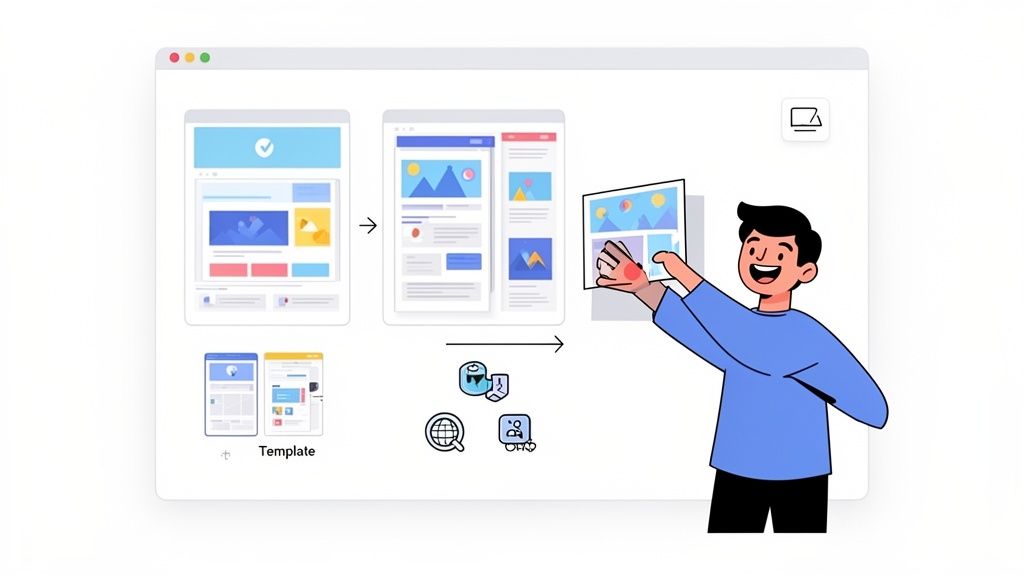
This strategic pivot unlocked millions of users-small business owners, marketers, and students-who needed to create visual content but lacked the training, time, or budget for professional software. Canva eliminated the steep learning curve and high cost of traditional design, making good design achievable for everyone.
The uncontested market move
Canva’s core strategy was simplicity over sophistication. They identified that the existing market competed on professional-grade features-attributes that were intimidating barriers for non-consumers. Canva reconstructed these boundaries by shifting the focus from tool proficiency to desired outcomes.
The company’s strategic canvas systematically eliminated or reduced the factors that defined professional design software. For those interested in a deeper dive into its competitive landscape, understanding Canva’s market position and alternatives offers valuable context on how it carved out this niche.
- Eliminated: The need for technical design skills and expensive software licenses.
- Reduced: The time from idea to finished design from hours or days to minutes.
- Raised: The accessibility of design through a freemium model and a user-friendly, browser-based interface.
- Created: A massive, searchable library of templates, stock photos, and design elements, and a collaborative, template-driven workflow.
This market-creating move has propelled Canva to a valuation that has exceeded $26 billion, serving over 135 million monthly active users, according to Forbes.
Actionable lessons for founders
- Serve the "good enough" market: Identify a complex, expert-driven industry and find the non-consumer segment that is intimidated by it. Build a product that delivers 80% of the value for 20% of the complexity and cost.
- Productize templates, not just tools: Your customers often don’t want a blank canvas; they want a shortcut to a finished product. Pre-built templates and content libraries lower the barrier to entry and deliver immediate value.
- Build a community-powered moat: Canva’s template marketplace creates a powerful network effect. As more users contribute templates, the platform becomes more valuable, attracting even more users. This user-generated content ecosystem becomes a formidable competitive advantage.
3. Slack: reimagining workplace communication
Slack redefined an industry by targeting the inadequacies of an existing tool: email. Instead of trying to build a better email client and competing in that deeply entrenched red ocean, Slack created a new market for real-time, channel-based internal team communication.

This move sidestepped a direct fight with email by complementing it. Slack positioned itself as the solution for synchronous, topic-specific conversations, while email remained the tool for asynchronous, formal communication. This distinction carved out a new category, addressing the widespread pain of cluttered inboxes.
The uncontested market move
Slack’s core strategy was channeling chaos into clarity. They didn’t invent instant messaging; they reimagined it for the workplace by adding persistence, powerful search, and deep integrations. This created uncontested market space by targeting non-consumers-teams that were "making do" with a patchwork of consumer chat apps and email chains.
- Eliminated: The friction of searching through disparate email threads for internal conversations.
- Reduced: The reliance on email for quick, internal questions and team collaboration.
- Raised: The discoverability of information and the speed of internal decision-making.
- Created: A persistent, searchable, and integrable "digital office" organized by channels.
This approach transformed workplace communication, leading to an eventual $27.7 billion acquisition by Salesforce, cementing its status as a market-creating innovator.
Actionable lessons for founders
- Solve a problem people don’t know they can solve: Many teams accepted cluttered inboxes as a cost of doing business. Slack identified this latent pain and offered a radically better alternative. Look for widespread frustrations that are considered "normal" in your industry.
- Make adoption frictionless and bottom-up: Slack’s freemium model and delightful user experience allowed individual teams to adopt it without executive approval. This created internal champions who drove company-wide adoption. Focus on creating an initial user experience so valuable that users become your sales force.
- Build a platform, not just a product: Slack’s open API and thriving app ecosystem were key to its strategy. By allowing integrations, Slack became the central nervous system for a company’s entire tool stack, creating immense value and high switching costs.
4. Cirrus Insight: democratizing sales enablement through integration
Cirrus Insight is another example of a blue ocean strategy that succeeded by embedding its product into an existing, high-frequency user workflow-the email inbox. Instead of building a standalone CRM, Cirrus Insight created a new market by bringing essential sales tools directly into Gmail and Outlook.
This move sidestepped the primary friction point for sales professionals: context switching. Sales reps hate leaving their inbox to log activities or look up contact details in a separate CRM. Cirrus Insight eliminated this pain point.
The uncontested market move
The core of Cirrus Insight’s strategy was integration over origination. They didn’t try to build a better CRM; they made the existing market-leading CRM (Salesforce) usable within the platform sales reps already lived in. This created uncontested market space by targeting non-consumers-sales professionals who found traditional CRMs too cumbersome.
- Eliminated: The need to switch between applications.
- Reduced: Training time and user friction for CRM data entry.
- Raised: CRM adoption rates by making it invisible and automated.
- Created: A seamless, all-in-one sales inbox experience with email tracking, templates, and scheduling built-in.
This approach transformed a complex software category into an accessible browser extension, serving over 250,000 sales professionals and leading to an eventual acquisition.
Actionable lessons for founders
- Anchor to an existing ecosystem: Identify a daily-use platform your target customer relies on (like Gmail, Slack, or Shopify). Build your solution as an integrated layer on top of it to drastically reduce the barrier to adoption.
- Sell convenience, not features: Your value proposition isn’t a longer feature list; it’s the elimination of friction. Frame your go-to-market hook around time saved and frustration removed. Cirrus Insight sold "Salesforce in your inbox," a clear, benefit-driven message.
- Use platform lock-in as a strategic moat: By integrating deeply with platforms like Gmail and Salesforce, Cirrus Insight created high switching costs. Once a team’s workflow is built around your integrated tool, leaving it means breaking their entire process.
5. Square: decentralizing payment acceptance
Square redefined the point-of-sale market by empowering individuals and micro-businesses to accept credit card payments. Instead of competing with established payment processors for large retail accounts, Square created a new market by turning any smartphone or tablet into a payment terminal.
The company bypassed the primary barrier for small merchants: the high cost and complexity of traditional merchant accounts. By offering a simple, free magstripe reader and a transparent fee structure, Square made payment processing accessible to sellers who were previously cash-only-think food trucks, artists at farmers' markets, and independent service providers.
The uncontested market move
Square’s core strategy was decentralization and accessibility. They targeted a massive, unserved population of non-consumers who found the existing solutions completely out of reach. By shifting the platform from dedicated hardware to ubiquitous mobile devices, Square reconstructed market boundaries.
- Eliminated: The need for a dedicated merchant bank account, monthly fees, and expensive terminal hardware.
- Reduced: The complexity of the application process and the time to get approved.
- Raised: Accessibility for micro-merchants and individual sellers.
- Created: A simple, mobile-first payment experience and a transparent, pay-as-you-go pricing model.
This strategy allowed Square to capture a new market segment from the bottom up, eventually expanding into a comprehensive ecosystem of business tools.
Actionable lessons for founders
- Arm the rebels: Identify a large group of non-consumers who are locked out of a market by complexity, cost, or access. Build a radically simplified solution specifically for them.
- Use technology to redefine cost structures: Leverage ubiquitous technologies like smartphones to eliminate expensive, proprietary hardware. This allows you to offer your solution at a dramatically lower price point.
- Build an ecosystem, not just a product: Start with a single, high-friction pain point and solve it brilliantly. Then, use that entry point to layer on complementary services (invoicing, payroll, capital loans) that increase customer lifetime value.
6. Notion: creating modular workspace infrastructure
Notion is a powerful blue ocean strategies example that redefined the productivity software market. Instead of competing directly with specialized tools for note-taking (Evernote) or project management (Asana), Notion created a new market by building a flexible, all-in-one workspace. Its innovation was recognizing that knowledge workers were frustrated with using a fragmented toolkit.
Notion’s approach sidestepped feature-for-feature competition. It offered a modular platform built on "blocks" – databases, text, images, and embeds – that users could combine to create their own custom workflows.
The uncontested market move
The core of Notion’s strategy was platform over product. They didn’t build a better project management tool; they built a set of simple, powerful primitives that allowed users to construct their own perfect tool. This move created uncontested space between rigid, single-use applications and complex, code-heavy enterprise platforms.
- Eliminated: The need for multiple, disconnected software subscriptions.
- Reduced: The barrier to creating custom internal tools and wikis.
- Raised: The level of personalization and workflow flexibility for users.
- Created: A community-driven ecosystem of templates and shared workflows, turning users into creators.
This strategy transformed a collection of distinct software categories into a single, unified workspace. With a valuation of over $10 billion and millions of users, Notion has proven the massive market potential of its blue ocean move.
Actionable lessons for founders
- Build a platform of primitives, not a rigid product: Provide users with flexible building blocks they can combine to solve their unique problems. This empowers them to build solutions you never imagined and creates deep product loyalty.
- Focus on community as a moat: Encourage and highlight user-created content like templates. This not only provides value to new users but also builds a powerful network effect. As the community grows, the platform becomes exponentially more valuable.
- Merge adjacent use cases: Identify fragmented tools your target audience uses and integrate those functions into a single, cohesive experience. As you build, a clear understanding of its components can be mapped using a business model canvas to ensure your value proposition remains cohesive.
7. Figma: reimagining design collaboration
Figma created a new market by shifting design from an isolated, desktop-based activity to a collaborative, web-first experience. Before Figma, the design tool landscape was dominated by Adobe’s Creative Suite, a red ocean of powerful but siloed applications.
Figma sidestepped this competition by recognizing that the biggest pain point wasn’t a lack of features but a lack of real-time collaboration. Designers were stuck in a frustrating loop of saving files, exporting assets, and managing version control. Figma eliminated this entire workflow, making design a multiplayer, browser-based activity accessible to everyone on a team.
The uncontested market move
Figma’s strategy was built on accessibility over complexity. Instead of trying to build a "better Photoshop" with more features, they focused on removing barriers. By moving the entire design process to the cloud, they made it possible for designers, developers, and product managers to work together in the same file at the same time.
- Eliminated: The need for software installation and manual version control.
- Reduced: The barrier for non-designers to view, comment, and inspect designs.
- Raised: The speed of the design-to-development handoff and cross-functional feedback loops.
- Created: A real-time, browser-based collaborative design environment and a platform for shareable design systems.
Figma’s success, culminating in a reported $20 billion acquisition offer from Adobe, validates its market-creating strategy.
Actionable lessons for founders
- Turn a solo activity into a multiplayer experience: Look for professional workflows that are still stuck in single-player, offline models. Building a web-first, collaborative solution can unlock massive value by eliminating communication overhead.
- Use browser-native architecture as a distribution advantage: By being web-based, Figma made its tool instantly accessible on any device with a browser. This removed purchase and installation friction, enabling viral, bottom-up adoption.
- Build an ecosystem, not just a tool: Figma’s success was amplified by community features like shareable component libraries and plugins. This creates a powerful moat; as teams build their entire design system in Figma, the cost of switching becomes prohibitively high.
8. Calendly: eliminating meeting scheduling friction
Calendly carved out a massive market by focusing on a single, universal friction point: the back-and-forth hassle of scheduling a meeting. Instead of trying to build a better calendar, Calendly created a new market by simplifying the act of scheduling itself.
This strategic move targeted a pain point everyone from salespeople to recruiters experienced daily. The endless email chains and time zone confusion were accepted as a "cost of doing business." Calendly challenged this assumption.
The uncontested market move
Calendly’s core strategy was simplification over feature accumulation. They didn’t build a complex calendar application. They built a "shareable link" that represented a person’s availability, turning a multi-step communication problem into a one-click action for the recipient.
This created uncontested market space by serving a need so fundamental it was overlooked. The viral nature of sharing a scheduling link also became a powerful, built-in growth engine.
- Eliminated: The need for back-and-forth emails and manual time zone conversions.
- Reduced: The cognitive load and time spent on administrative scheduling tasks.
- Raised: The speed and efficiency of booking meetings, both internally and externally.
- Created: A simple, shareable, and embeddable scheduling interface that became the user’s "personal scheduling assistant."
This focused approach proved incredibly effective. With over 10 million monthly active users, Calendly reached a valuation of over $3 billion in 2021.
Actionable lessons for founders
- Isolate a "micro-workflow": Identify a single, high-frequency, high-friction task that exists within or between larger, established platforms. Solving that one small but painful problem exceptionally well can create a massive market.
- Build in virality: Design your product so that its core use case naturally markets itself. Every time a Calendly link is shared, it exposes a new potential user to the product’s value.
- Define your value proposition around a negative: Calendly’s success comes from what it removes-friction, email chains, and wasted time. Frame your product’s benefit around eliminating a common pain point. You can learn more about how to craft a compelling value proposition on pitchili.com to attract both customers and investors.
Turn these lessons into your next pitch
The case studies we’ve explored are more than just inspiring stories; they are tangible blueprints. Each of these blue ocean strategies examples illustrates a fundamental truth: the most enduring companies aren’t built by fighting for inches in a crowded market. They are forged by creating new space and redefining value.
Instead of framing your pitch around competitive features, frame it around category creation. A blue ocean narrative is your most powerful tool for this.
Your blue ocean checklist:
- Who is my non-customer? Like Canva targeting non-designers or Square empowering micro-merchants, identify the vast, overlooked audience your competitors are ignoring. This defines your total addressable market (TAM) in a new, compelling way.
- What is my value curve? Map your offering against the industry standard. Your strategic canvas shouldn’t show you as 10% better. It should show a radically different curve – a clear visual representation of your blue ocean move.
- How do I articulate my moat? Your defensibility isn’t just technology. It’s the network effects, brand loyalty, and economies of scale that emerge from serving your uncontested market. Figma’s moat is its collaborative gravity – once a team adopts it, the switching costs become immense.
By mastering the lessons from these blue ocean strategies examples, you move your conversation with investors from "how are you different?" to "how big is this new market you’ve just unlocked?" This is the key to securing the capital you need to build an iconic company.
We at Pitchili can help you turn your blue ocean insight into a pitch that gets funded. Our team specializes in helping founders translate complex strategies into clear, compelling narratives that win over investors. We’ll help you build a pitch deck that perfectly articulates your unique value curve and uncontested market opportunity.
FAQ
What are the two main pillars of blue ocean strategy?
The two main pillars are value innovation and the rejection of the value-cost trade-off. Value innovation is the simultaneous pursuit of differentiation and low cost, creating a leap in value for both customers and the company. This breaks the traditional trade-off where companies must choose between offering higher value at a higher cost or reasonable value at a lower cost.
What are some famous blue ocean strategies examples?
Besides the tech examples in this article, classic examples include Cirque du Soleil, which combined elements of theater and circus to create a new form of entertainment for adults, and Yellow Tail wine, which simplified the wine selection process to appeal to casual drinkers who were intimidated by traditional wine culture.
How do I identify a blue ocean for my startup?
Start by looking for "non-consumers" – people who are not currently using your industry’s products because they are too expensive, complex, or inaccessible. Analyze their pain points and the compromises they make. Use the four actions framework (eliminate, reduce, raise, create) to brainstorm how you could create a new value curve that serves this untapped market.
