
Figuring out your target market means finding the specific people who will definitely buy what you’re selling. It’s simple: nail the painful problem you solve, slice up your user base, size the prize, and test your hunches. Get this right, and everything else clicks.
This guide gives you the step-by-step playbook founders use to find their perfect customers.
1. Move from a vague idea to a specific problem

Most startups fail because they build a solution looking for a problem. Before you write a line of code, anchor everything in a real pain point. People pay to make pain go away.
A vague goal like "helping teams collaborate" isn’t a problem. It’s a category. A real problem is sharp and specific. "Remote marketing teams waste 10 hours a week syncing feedback across Figma, Slack, and email." Now that’s a problem you can solve.
Uncover the real pain point
Customer discovery interviews are the only way to find real pain. Your goal is not to pitch. It’s to shut up and listen. Dig into past behaviors and current headaches with open-ended questions.
- "Walk me through the last time you dealt with [the process you want to fix]."
- "What was the most frustrating part of that?"
- "What tools have you tried to make this less painful? Did they work?"
- "If you had a magic wand, what one thing would you fix?"
This process separates what people say from what they need. People ask for features but pay for speed, efficiency, and pain relief. A well-defined problem is your best filter. It narrows your audience to people who feel that exact pain.
Example: A founder wants to build a project management tool.
- Vague idea: "A better tool for creative agencies."
- Specific problem: "Creative agency account managers waste 5-8 hours per week manually pulling client reports from a dozen platforms, which leads to bad data and wasted billable hours."
2. Segment your market beyond simple demographics
Knowing the problem is half the battle. Now you need to find the people who feel that pain so acutely they’ll pay you to fix it. Don’t use generic labels like "millennials" or "small businesses." That’s not a market; it’s a crowd.
You need to slice that crowd into precise segments. It’s about moving past who they are to how they think and act. Research shows 81% of consumers want to buy from brands that understand them. One study found segmented email campaigns drove a 760% increase in revenue. You can find more data on modern audience segmentation strategies on Britopian.com.
The old playbook of using only demographics is too broad. To find your true believers, layer firmographic, psychographic, and behavioral data. This builds a high-resolution picture of your ideal customer.
Modern segmentation checklist for startups
Use this table to move beyond basic demographics and find your best customer groups.
| Segmentation type | What it measures | Key questions to ask | Example for a B2B SaaS |
|---|---|---|---|
| Firmographic | The "on-paper" stats of a company. | What industry are they in? How big are they? Where are they located? | US-based FinTech companies with 50-250 employees using Salesforce. |
| Psychographic | The "why" behind their decisions – values, goals. | Are they early adopters? What do they fear? What does success look like? | Companies with "innovation" as a core value whose leaders speak at tech conferences. |
| Behavioral | The actions and triggers that signal intent. | Have they downloaded your content? Visited your pricing page? | A prospect who just posted a "Compliance Manager" role and read your blog on SOC 2 audits. |
| Needs-Based | The specific functional jobs they need done. | What outcome are they trying to achieve? What is the core job-to-be-done? | A company needing to pass a security audit to close a major enterprise deal. |
Start with firmographics for B2B
If you’re a B2B startup, start with firmographics. Think of them as demographics for companies. They are objective stats that let you filter out the noise.
This first layer is about efficiency. Instead of spraying and praying, you zero in on a specific profile.
- Industry: Which verticals feel the pain most? (e.g., FinTech vs. Manufacturing).
- Company Size: How many employees? A 10-person startup buys differently than a 500-person enterprise.
- Geography: Where are they located? This is critical for sales, support, and regulations.
- Tech Stack: What software do they use? This signals integration opportunities.
Example: A B2B SaaS building a compliance tool targets US-based FinTech companies with 50-250 employees. The universe of businesses just shrank to a manageable pond.
Layer on psychographics to understand the 'why'
Firmographics tell you what a company looks like. Psychographics tell you why they buy. This layer gets into the mindset and culture of a company and its decision-makers.
Two companies can look identical firmographically but have different buying triggers. Ask deeper questions to find these insights.
- What are their primary business goals? Rapid growth? Cost-cutting?
- What are their biggest fears? Falling behind competitors?
- Are they early adopters or risk-averse?
You can find this info in annual reports, executive interviews, or on their website.
Example: The compliance SaaS startup refines its search to FinTech companies that list "innovation" as a core value and whose CTOs speak at conferences. Those are the early adopters.
Pinpoint triggers with behavioral segmentation
The final layer is behavioral segmentation. This is all about action. You group customers based on what they do. Past behavior is the best predictor of future action.
You’re looking for buying signals – tangible triggers that show a company is actively solving the problem you fix.
- Purchase History: Have they bought similar products before?
- Product Usage: For freemium models, who are your power users?
- Online Engagement: Have they downloaded your whitepaper or visited your pricing page?
A company that just hired its first Head of Compliance is a hot lead. That single action signals a clear need for your tool.
Example: The compliance SaaS startup prioritizes prospects who recently posted jobs for a "Compliance Manager" and visited their blog post on preparing for a SOC 2 audit. That’s a conversation waiting to happen.
3. Calculate your market size with TAM, SAM, and SOM
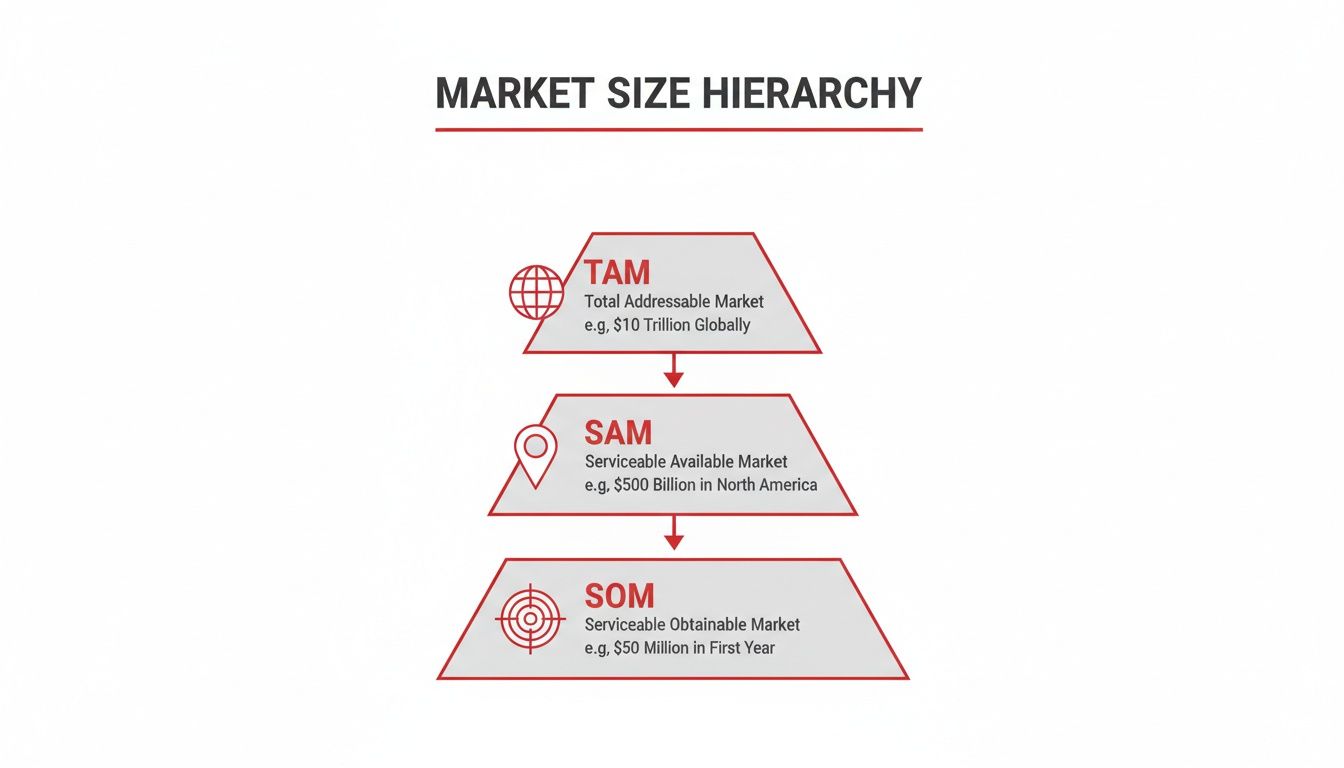
Investors ask one question: how big is the opportunity? A great idea in a tiny market is just a hobby. You have to prove your venture is chasing a prize worth winning.
The TAM, SAM, and SOM framework is the language VCs speak. Nailing these numbers turns a vague claim into a credible story backed by data. It’s a key step in learning what is market sizing.
Understand the market size framework
Think of these as Russian dolls, from the biggest potential down to what you can capture now.
- TAM (Total Addressable Market): The total worldwide demand for a solution like yours. It’s the "what if" scenario if everyone who could use your product bought it.
- SAM (Serviceable Available Market): Your slice of the TAM. It’s the part of the market you can reach with your current business model and channels.
- SOM (Serviceable Obtainable Market): Your short-term, realistic target. It’s the piece of your SAM you can win in the first 3-5 years.
VCs look at TAM for scale. They check your SAM and SOM to see if you have a credible plan. A massive TAM is useless without a believable path to capture a piece of it.
Choose your calculation method
There are two ways to calculate market size: top-down and bottom-up. Investors strongly prefer bottom-up. It shows you’ve done your homework.
- Top-down: Starts with a big market report number and carves it down. Quick but often seen as lazy.
- Bottom-up: Starts with your ideal customer and builds up. You find the number of potential customers and multiply by your price. More work, but far more believable.
Build your market size story with numbers
Let’s use a real-world example. A B2B SaaS called "ComplyBot" automates SOC 2 compliance for US-based tech companies.
ComplyBot Market Size Calculation (Bottom-Up)
| Metric | Calculation | Data Source | Result |
|---|---|---|---|
| TAM | Number of global tech companies x Annual price | Gartner, Statista | 500,000 companies x $15,000 = $7.5B |
| SAM | Number of US tech companies (10-250 employees) x Annual price | US Census, LinkedIn | 50,000 companies x $15,000 = $750M |
| SOM (Year 3) | Target market share of SAM based on GTM strategy | Founder projections | 2% of SAM = 1,000 customers x $15,000 = $15M ARR |
This bottom-up approach tells a powerful story. It starts with a huge potential (TAM), narrows to a reachable target (SAM), and lands on a specific goal (SOM). This is the data-driven narrative that gets investors to write checks.
4. Validate your assumptions with low-cost experiments
Your business plan is a collection of well-researched guesses. In the startup world, assumptions are silent killers. The only way to disarm them is with real-world data from potential customers.
The goal isn’t to be right. It’s to learn, fast. Use cheap, high-impact experiments to get validation.
Use landing pages to test your message
A landing page is a fast, cheap way to see if anyone cares. You don’t need a product. You just need a compelling value proposition and a clear call to action (CTA).
- Craft a sharp headline: State the problem and your fix in one punchy line.
- Write benefit-driven copy: Focus on the outcome, not features.
- Add a clear CTA: "Join the waitlist" or "Request a demo."
- Install analytics: Track visitors, clicks, and conversions.
A 5-10% conversion rate is a strong signal you’re onto something.
Example: A B2B SaaS runs a $500 LinkedIn ad campaign for its "AI compliance reporting tool." If 8% of visitors sign up for the waitlist, that’s a powerful slide for their next investor meeting.
Run social media ads to measure demand
Social media platforms are validation engines. Their targeting tools put your value prop in front of your ideal customer. You’re not trying to sell yet – you’re buying data.
Test different messages, creative, and audiences to see what sticks.
- Click-Through Rate (CTR): Does your ad stop their scroll?
- Cost Per Click (CPC): How much does it cost to get their attention?
- Conversion Rate: Of those who click, how many sign up?
This data doesn’t lie. It tells you which segment is most responsive and which message hits home.
Conduct smoke tests to gauge purchase intent
A smoke test is the ultimate validation. It asks for the strongest signal: a commitment to buy. It’s how you measure demand before your product exists.
Simulate a purchase. Set up a pre-order page or a "Buy Now" button that leads to a simple message. "We’re not ready, but you’ll be the first to know. Enter your email for a launch discount."
A click on "Join Waitlist" signals interest. A click on "Buy Now" signals intent. It’s a reliable indicator that people will pay to solve the problem. AI and Machine Learning are now standard for market validation, improving customer engagement by 86% according to some studies. You can discover more about emerging market segmentation techniques on GlobalBankingAndFinance.com.
Example: A startup gets 50 pre-order sign-ups in one week from a smoke test. That’s hard evidence of market demand and a powerful way to de-risk the venture.
5. Choose your beachhead market and win it
You can’t conquer the world on day one. You need a beachhead market – a small, specific niche you can dominate. Trying to be everything to everyone is a classic startup death sentence.
A beachhead strategy forces you to pour limited resources into a single, winnable battle. It’s how you get early wins and build a stronghold. This is a core part of a strong go-to-market strategy.
Prioritize your segments with a scoring framework
A simple scoring framework takes emotion out of the decision. Weigh each segment’s potential against your ability to win it.
- Urgency: How badly does this segment feel the pain?
- Market Size: Is it big enough to matter but small enough to own?
- Accessibility: How easily can you reach these customers?
- Founder-Market Fit: Does your team have an unfair advantage here?
Score each factor from 1 to 5. The segment with the highest score is your beachhead.
Facebook started with a laser-focused beachhead: Harvard students. They owned that niche, then expanded. Amazon did the same, selling only books to early internet adopters.
Example: A new CRM scores two segments:
- "Small law firms": Urgency (5), Size (3), Accessibility (2), Fit (2) = 12
- "B2B SaaS startups": Urgency (4), Size (4), Accessibility (5), Fit (5) = 18
B2B SaaS startups are the clear beachhead market.
Identifying your target market is the first step. The next is convincing investors it’s a prize worth winning. The team at Pitchili combines VC experience with killer design to build a pitch deck that gets funded.
